
The 2026 NFL Draft is still more two months away, but that means we have time to dive even deeper into our latest mock draft before the combine gets underway in Indianapolis. Earlier this week, The Athletic’s beat reporters made their picks for Round 1 (and parts of Round 2, for those teams without first-round selections). How’d they do?
Well, after last year’s actual draft, I took an analytical approach to grading the results for each team. I’m using the same methodology to see which teams came out as winners and losers of our beat writer mock draft.
Before we get started, let’s talk about the process. When I analyze drafts, I take into account value of the draft pick, contract value, position of the player drafted, as well as any trades made to acquire the pick. For this exercise, I only take into accounts trades that occur during the draft, not made prior. Essentially, I’m able to put a dollar value on each pick, compare it to the player selected and adjust its value based on that player’s position.
To get a sense of a prospect’s ranking within the class, I’ll be using our current consensus big board.
WinnersLas Vegas Raiders (Indiana QB Fernando Mendoza, No. 1)
It’s easy to gain the most value when you have the No. 1 pick, and it’s even easier when the top player on the consensus board is a quarterback. Mendoza plays the NFL’s premier position and is considered the draft’s top player.
I’d expect Mendoza to provide around $76 million of value over his rookie contract, which is considerably more than the $50 million for which the Raiders would be on hook in drafting him.
Cleveland Browns (Utah OT Spencer Fano, No. 6; Texas A&M WR KC Concepion, No. 24)
Fano actually comes in as a slight reach — he was the sixth pick but ranks 10th on the consensus board. When you adjust for positional value, however, this pick becomes a huge plus for the Browns.
You may wind up asking why the Browns rank ahead of the Cardinals on this list, given that Fano checks in lower than Francis Mauigoa at the same position. That’s where the cost of the draft pick matters. Mauigoa edges Fano by one spot on the consensus big board, while the difference between the third and sixth pick is more than $5 million — enough, especially when combined with Concepcion’s addition, to swing the edge in Cleveland’s favor.
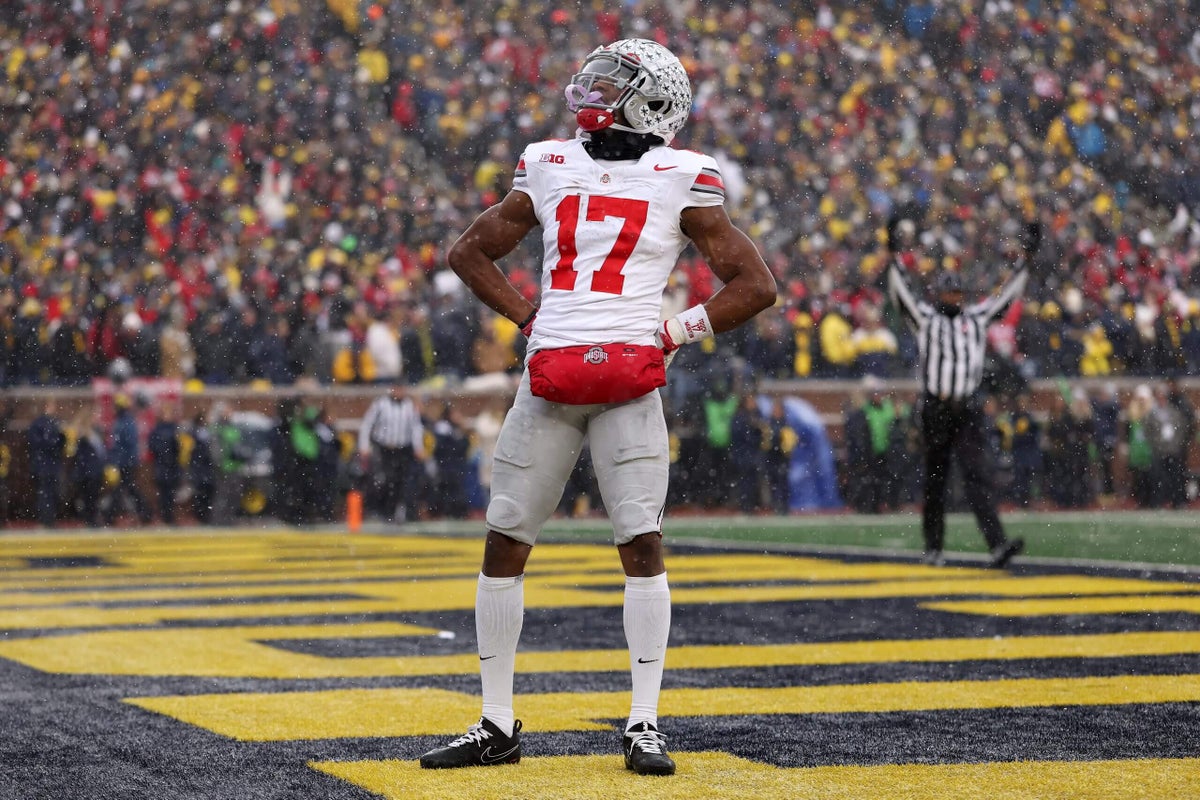
Kansas City Chiefs (Ohio State WR Carnell Tate, No. 9)
After a disappointing season, the Chiefs hold a top-10 pick. And in our beat writer mock, they hit by selecting the draft’s top wide receiver.
Though positional need isn’t factored into my process, you can’t deny the need for the Chiefs. They’ll be looking for several receiving options, especially with an aging Travis Kelce still deciding on his future. Tate ranks eighth on the big board, and when you adjust for the fact that he plays a premium position, the Chiefs find themselves well in the surplus — even more so when you consider a running back (Jeremiyah Love) came off the board at No. 8.
Washington Commanders (Miami edge Rueben Bain Jr., No. 7)
The Commanders had one of the worst defenses in the league last season, per my NFL Projection Model, so Bain would have a chance to make an immediate impact off the edge. He is one of the top three defensive players in this draft, and it wouldn’t be a surprise if he was the first defensive player selected come April. Washington getting him at No. 7 provides some nice value in this mock.
Bain ranks sixth on the consensus big board and plays a premier position (see a pattern here?). He’d give the Commanders a big-time talent.
Arizona Cardinals (Miami OT Francis Mauigoa, No. 3)
I already touched on this pick in the Cleveland section, and the Cardinals see slightly less value because of the financial ramifications of picking No. 3 versus No. 6.
Either way, Mauigoa would slide right into a Cardinals offense that will be going through an overhaul under new head coach Mike LaFleur.
LosersDallas Cowboys (Tennessee CB Jermod McCoy, No. 12; Georgia LB CJ Allen, No. 20)
My model is pretty neutral on the McCoy pick. It did not, however, like Dallas’ second Round 1 pick at all.
Allen at No. 20 is quite a reach on a player who doesn’t play a premium position. Allen is No. 28 on the consensus board, and The Athletic’s Dane Brugler has him ranked 32nd in his most recent top 100. So, not only were there higher-ranked prospects on the board for that Cowboys pick, there were several, including the next two players selected, Cashius Howell and Keldric Faulk — pass rushers who could’ve helped Dallas’ cause.
New Orleans Saints (Notre Dame RB Jeremiyah Love, No. 8)
Since the common theme here has to do with premium positions, it’s no surprise that the Saints are on this list as a mock draft “loser.”
If we use some revisionist history, the Raiders selected Ashton Jeanty with the No. 6 pick last year and the Falcons used the No. 8 pick on Bijan Robinson in 2023, and neither head coach at the time of those picks is still with their team. It’s not that Love or Jeanty or Robinson can’t become great players, it’s just that it’s unlikely they earn a second contract and the surplus value on their rookie contracts isn’t very high.
Furthermore, teams selecting in the top 10 usually don’t have the pieces in place to really gain the benefits of a great running back. The Saints fall in that category.
Baltimore Ravens (Penn State IOL Vega Ioane, No. 14)
The Ravens also are victims of selecting a non-premium position with a top-15 pick. The contract value of the No. 14 pick comes in at around $28 million total over five years (remember, you really want to be hunting surplus value here); if Ioane becomes one of the best interior offensive lineman in football, his value would be around $20-$22 million per year.
Sure, that’s a significant surplus. But if you compare it to, say, a wide receiver (the position of the next two picks in this mock), that player would be providing $40-plus million in value per year. And the same argument would stand if Ioane turned into a league-average starter — the surplus value just isn’t there when hitting on draft picks is so vital because those picks are cheap.
Indianapolis Colts (Texas Tech LB Jacob Rodriguez, No. 47)
A rare second-round pick finds itself on the “losers” list.
I was a bit surprised here. Rodriguez is a good player, don’t get me wrong, but this is quite a reach at No. 47 — Rodriguez ranks 82nd on the consensus big board and 64th on Brugler’s top 100. That’s a big gap for a second-round pick at a non-premium position, and that’s before you get into the fact that the Colts traded a lot of draft capital this past season for Sauce Gardner.
Cincinnati Bengals (Ohio State LB Sonny Styles, No. 10)
This is a tough one, I’ll admit. Right now, Styles is considered a linebacker, but he does have quite a bit of versatility that could result in him playing a big nickel type of role. In that case, I doubt the Bengals would fall into this category. However, there is some risk as Styles isn’t a sure bet to fill that role. (There will be a similar conversation surrounding with another Ohio State standout, LB/edge Arvell Reese).
But for the Bengals, a team void of much talent on the defensive side of the ball, I’d understand the pick because of Styles’ upside. His coverage skills need work, though. If Styles isn’t able to fit the nickel/safety role because he can’t hone those skills, picking a linebacker in the top 10 would be bad for business.