
Normal text sizeLarger text sizeVery large text size
The 17th green at Cathedral Golf Club, two hours north-east of Melbourne, plays host to an annual dinner on the eve of the invitational event that attracts some of the country’s best golfers.
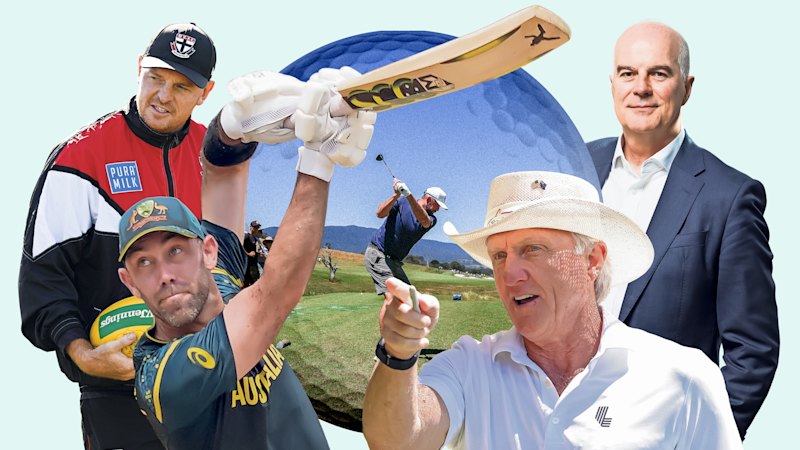
But the golf event has nothing on the star power at the dinner, where the guests include media mogul Craig Hutchison, cricket World Cup hero Glenn Maxwell, radio and podcast supremo Andy Lee, and football royalty from AFL and NRL including Chris Scott, Nathan Buckley, Joel Selwood and Billy Slater.
Hours earlier at the celebrity pro-am, spots in groups were going for $20,000. Some bartered with contra rather than cash.
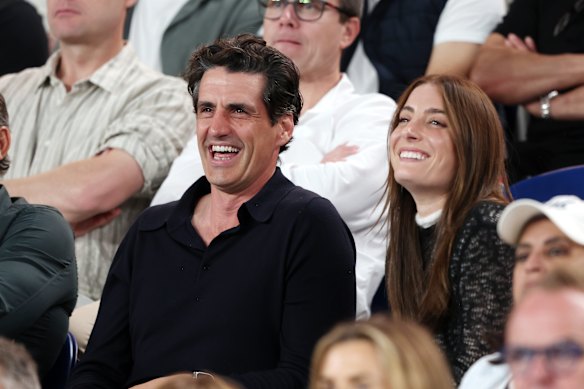
Andy Lee, pictured at this year’s Australian Open with his partner Rebecca Harding, appeared at Cathedral’s annual dinner.Credit: Fiona Hamilton / Tennis Australia
On the long par-three ninth, players were offered a nearest-to-the-pin prize rarely seen outside a tour event: a $60,000 Mini. Not for a hole in one. Not for perfection; just superiority. It was a subtle flex.
Cathedral, on the banks of the Goulburn River near Alexandra, is different from the city clubs this masthead has profiled in our series on Victoria’s prestigious private golf institutions.
“The mood changes once you get out of the city and through the valley,” says Craig Drummond, who is about to replace Richard Goyder as chairman of the AFL Commission.
Drummond, a former president of the Geelong Football Club, is a foundation member of Cathedral and a lifelong golf obsessive. He plays off a handicap of 13.
“Where pace of play would be an issue in the city clubs, it simply isn’t at Cathedral,” Drummond says. “You’re never jammed for time. It’s a relaxed but professional setting.”
Former No.1 AFL draft pick and ex-St Kilda and Essendon star Brendon Goddard is also a foundation member. He’s a gun golfer and once played off a handicap of +4.
Cathedral is no less exclusive than Melbourne’s sandbelt clubs, and it has a stated ambition to be Australia’s answer to Augusta, the famed host of the Masters in the US.
Back at the Invitational dinner, as dusk settled over the hills, the pavilion structure glowed against the darkening fairways, steel beams and clear panels framing the 17th green beyond it. Inside, tables were packed tightly together – green tablecloths, polished stemware, bottles of Grange sitting among the centrepieces. It was poured by the glass.
It was like an old-school sportsman’s night, except the wealth-metre had been quintupled. The mood was attentive rather than rowdy. Jackets and ties stayed on.
In front of the audience of business leaders, sporting figures and media identities was MC extraordinaire Hamish McLachlan.
Maxwell opened with a story about his unbeaten 201 at the World Cup – an innings built on resilience as much as flair. As the screens around the room began showing highlights of the ridiculous innings, he quipped, “I hope we are showing this ball-by-ball, because I remember every single one.”
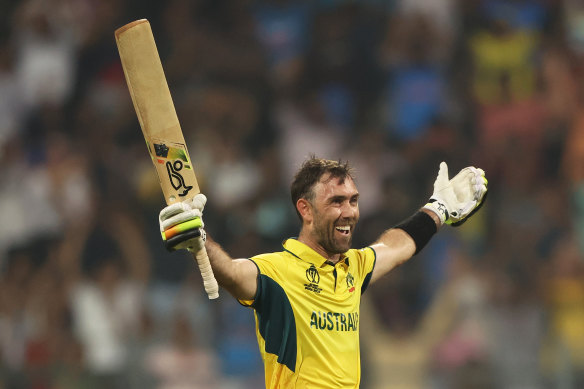
Glenn Maxwell celebrates his remarkable World Cup double century in 2023.Credit: Getty Images
Maxwell spoke about the cramping, about batting with little support left, about the clarity that can arrive when a match narrows to survival. Alongside him, Slater reflected on instinct under pressure in State of Origin contests, the split-second decisions that separate the elite from the very good.
The tone shifted when Damien Oliver spoke about the 2002 Melbourne Cup aboard Media Puzzle. He described riding just days after the death of his brother Jason – the conflict between grief and obligation, and the emotional weight of winning under those circumstances. The room quietened. Fellow jockey Glen Boss followed with memories of piloting Makybe Diva to three consecutive Melbourne Cups. Sustained dominance built on trust between horse and rider.
Olympians Steve Hooker and Andrew Gaze spoke about the intensity of representing Australia; the solitude of preparation and the compression of years of work into a single performance.
It closed, fittingly, with golf. Adam Scott, Geoff Ogilvy and Ian Baker-Finch discussed the discipline required to win majors. The grind of US Open conditions, the volatility of Augusta and the fragility of confidence in a game that constantly exposes doubt.
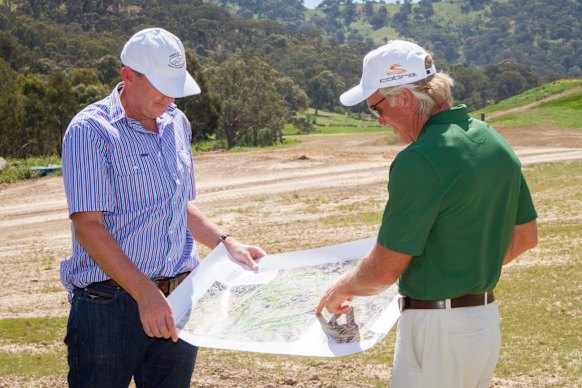
David Evans and Greg Norman, pictured back in 2017, realised their dream for Cathedral.
Most sportsman’s nights end with an auction. If you raise anywhere north of $20,000, it’s been a great night. As Australia’s elite finished writing their cheques, just under $400,000 had been raised for the Adam Scott Foundation.
Then came the closing act. From the carpeted stage, framed by steel railing and lights trained on the 17th green, three lucky guests were invited to chip against Scott. The incentive: $15,000 worth of accommodation at Lizard Island for anyone who could finish closer than a Masters champion.
The optics were unusual, to say the least. Balls struck from carpet, floating out into the valley night, momentarily disappearing before landing soundlessly on the lush green. Scott’s effort was controlled and precise, settling near the flag. But one challenger finished inside him.
The reaction was measured but unmistakeable, applause building through the pavilion as an amateur edged a major winner.
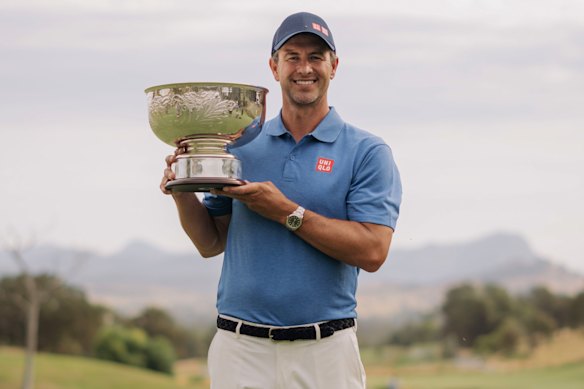
Adam Scott with the Cathedral Invitational trophy.
What makes Cathedral different from other clubs?
Cathedral operates on its own terms. You cannot apply for membership; entry is by invitation only, extended personally by David and Sonya Evans.
The club has its own helicopter, available for members to use at a cost. On occasion, those fortunate enough to be present might see Greg Norman being driven around in a golf cart by David Evans, inspecting the layout he designed.
Inside the clubhouse, the experience continues to defy modern conventions. There are no cash transactions and no card machines – everything is billed to member accounts.
The clubhouse itself could have been plucked from Augusta; old-school, immaculately maintained, with a stately warmth that contrasts sharply with the polished modernity of most contemporary golf clubs. Outside, rocking chairs line the deck, offering a place to linger, watch the sun trace the fairways and drink in the stillness.
The club’s ethos is clear; everything is designed to be immersive, unhurried and authentic.
It’s a place where extraordinary privilege meets understated elegance. And family.
The family
When interviewing former Essendon Football Club chairman David Evans last year about his love of golf, something stood out when we started talking about Cathedral.
“We’re a family club,” he smiled.
It’s an interesting choice of words for a place with a six-figure joining fee and annual subscription costs north of $15,000.
This masthead contacted six members of Cathedral, none of whom who wanted to speak publicly, but all six used the word “family.”
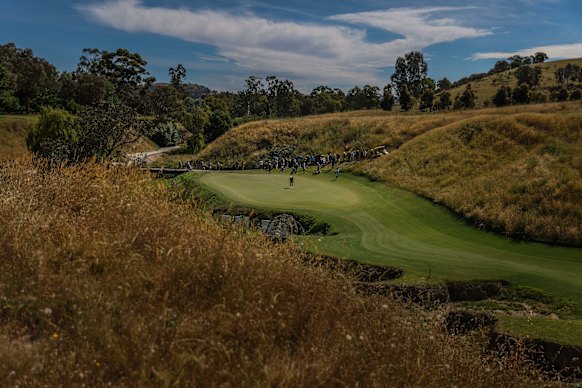
The stunning Cathedral landscape.Credit: Getty Images
One said it was the “home away from home” for him and his wife.
On the surface, “family club” conjured images of plastic range buckets, kids in oversized polos, grandparents on the putting green at dusk. And Cathedral does have some of that.
But the adjective “family” carries a second, more coded meaning at Cathedral. It signals something quieter: continuity, stability, intergenerational transfer – not just of membership, but of wealth, networks and social capital.
Cathedral doesn’t seek attention. There are no gold-plated crests or faux-Scottish theatrics. There are no Lamborghinis parked out the front. The clubhouse leans more functional than flamboyant. It has couches and an open fireplace. The first thing you see on the deck are the rocking chairs.
“The people are just extremely hospitable,” says Drummond, who spent two decades alongside Evans at JBWere.
“David has done a wonderful job of incorporating the local community and driving local employment. I would say it’s very friendly in a rural way – and that’s coming from someone who grew up rurally – and all the members appreciate the generous spirit that the place evokes.”
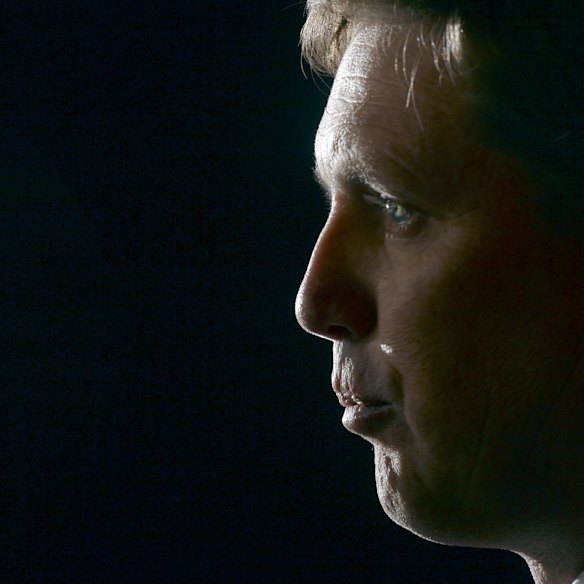
Evans is a former Essendon Football Club chairman.Credit: Sebastian Costanzo
“David and Sonya have really encouraged family to come to the club and see it. There’s not just golf, there’s horse riding, bushwalking, they even have a pool now. Every time you walk through the door you are made to feel incredibly welcome.”
And all the while, Cathedral avoids pretension.
“There’s nothing about it that’s highfalutin. Everything is exceptionally authentic,” Drummond said.
Business conversation isn’t banned, but it’s not the point either. “You’re just there with good friends, to have great conversation, play golf and enjoy yourself. And not take yourself too seriously.”
Drummond admits his new role as AFL chairman may limit his golf time.
“Most likely,” he laughs. “But it’s still important I think for all of us to have passions and hobbies outside of what we do nine to five.”
The cart that got away
The clubhouse at Cathedral is something to behold. While the course sits folded into the valley like it’s been poured there, the clubhouse is perched high enough to feel removed from the world below. It’s a place where the air is a little thinner, the stakes feel lower and, after a good round and a better dinner, sensible decisions can start to blur at the edges.
On this particular evening several years ago, the protagonist is a prominent Melburnian. The sort of name that carries weight in Collins Street boardrooms and private dining rooms alike. A man who enjoys his sport, his wine and occasionally a story worth retelling.
Loading
He’d played 18 at Cathedral that afternoon with a few of his buddies. The group adjourned to the clubhouse as the light dropped behind the ridgeline. Stories lengthened and dinner turned into the kind of long-table affair that makes country golf clubs special.
There was only one logistical issue. He was staying up the hill.
It’s not Everest, but after a full round, some story telling and the gravitational pull of a warm dining room, the walk back to accommodation can feel steeper than it is.
Would it be possible to borrow a golf buggy for the short trip up the incline? The staff obliged. There wasn’t enough room for a staff member to drive them, so the group was simply asked to return the buggy the following morning before checking out.
A set of keys changed hands. He drove off into the Cathedral night. It was a practical solution to a minor inconvenience.
He parked the cart outside his accommodation – on a slight angle, as it turned out – and went inside and off to bed.
Somewhere between midnight and dawn, gravity made its own decision. No handbrake.
Loading
At some point in the dark, the unattended buggy began its quiet descent. By morning, the cart was gone.
Our man emerged the next day and noticed the empty patch where the cart had been.
There was mild confusion, a flicker of concern, then rationalisation: the club must have sent someone up early to retrieve it.
After making the descent down the hill by foot and asking around, no one had collected it. In fact, no one had seen it. It wasn’t until later that the truth surfaced. The cart had been discovered – eventually – in a ditch further down the property, having completed an unsanctioned off-road adventure. It was damaged beyond repair. Written off.
He approached a senior member at the club, contrite but calm. These things happen. Insurance exists for a reason, right?
Well, not always.
Insurance, as he learned, tends to draw a firm line on “accidentally forgetting the handbrake”. The claim would not be entertained by the club.
The bill: $35,000.
To his credit, he didn’t argue. No posturing, not outsourcing of the blame. He wrote the cheque: 35 grand for a downhill lesson in handbrakes.
He left Cathedral with a story that will follow him longer than any scorecard from that day.
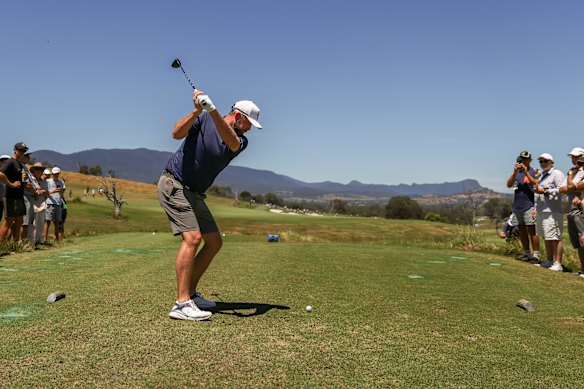
Marc Leishman tees off at the 2023 Cathedral Invitational.Credit: Getty Images
The fire
Earlier this year, as fires ravaged parts of Victoria, David and Sonya’s dream nearly went up in flames.
Local towns in the Thornton and Alexandra area were evacuated and people were told to leave.
“Sonya and I were there for Black Saturday, and we promised ourselves that our bushfire plan would be to go and not stay,” Evans told this masthead.
That’s exactly what they did. Just 36 hours later, fires bared down on the property. Flames got to within 10 metres before something extraordinary happened: the wind died down. The fire hit the lush green fairways and it stopped.
“The fires burnt out 300 acres of the property. There was no livestock lost, no property loss,” Evans said.
“Through the bravery of the CFA, we were able to save a lot of the assets. The wind dropping definitely was a factor and just the brilliant work of the firefighters.”
The fire stopped within metres of the fairway – an abrupt, almost surreal divide where green gave way to ash and luck felt uncomfortably close to running out.
It’s only when you stand there that you understand it; the fire didn’t almost reach Cathedral, it arrived. And then, for reasons no one can quite comprehend, it stopped.
“It was incredibly stressful time. Not only for us but for the rest of the community. So many people have lost livestock and a good chunk of their livelihood. We were one of the lucky ones,” Evans said.
Start the day with a summary of the day’s most important and interesting stories, analysis and insights. Sign up for our Morning Edition newsletter.