
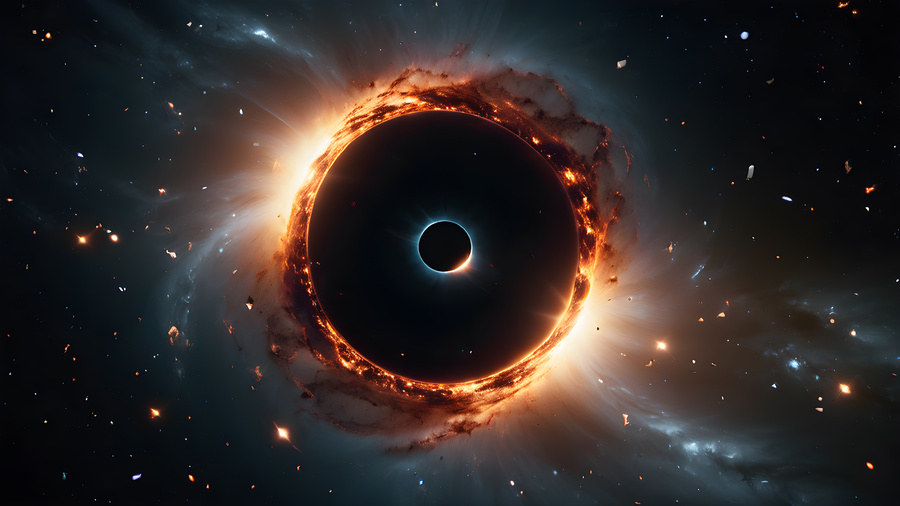
In traditional models of stellar evolution, the fate of massive stars is always dramatic: when fuel is exhausted, the core collapses and the resulting shockwave ejects the outer layers into space, producing a spectacular supernova explosion. However, in recent decades, astronomers have observed unusual cases: some massive stars disappear without exploding or producing a bright flash, vanishing silently. These are called “failed supernovae.”
Silent disappearance: M31-2014-DS1
One such event occurred in the Andromeda Galaxy (M31), about 2.5 million light-years away. The star, designated M31-2014-DS1, is considered a candidate for a failed supernova. Historical records show it was a bright red supergiant with a mass about 13 times that of the Sun. Based on its luminosity, it was expected to become a Type II supernova.
In 2014, however, something unusual happened. Observations with infrared detectors on ground-based telescopes detected significant infrared emission from the star, but no visible light explosion—only a faint, hidden red flash. By 2023, follow-up observations with the Keck Observatory confirmed that the star had disappeared in visible light. Unlike ordinary supernovae, this process showed no bright optical outburst.
Theory predicts that when a massive star exhausts its fuel, its core collapses. In normal supernovae, the collapse generates a shockwave strong enough to eject the star’s outer layers. In M31-2014-DS1, however, the shockwave failed to overcome the inward-falling material, and the result was not an explosion but the formation of a black hole.
Models suggest that during the formation of the event horizon, a brief burst of neutrinos may be emitted, which stops once the black hole forms. The infrared emission observed could represent the ejection of the star’s outer layers (roughly one solar mass) and the formation of dust, while the remaining mass silently collapsed into a black hole.
The debate is not fully settled. In 2026, observations from the James Webb Space Telescope detected a faint, persistent infrared source at the same location, leading some researchers to suggest that the star may not have fully disappeared but instead entered a phase of heavy dust shrouding. Others propose that the 2014 red flash could have been a long-lasting eruption of a luminous red star or a bright blue variable star, meaning the apparent “disappearance” could be a temporary visual effect.
 Countless celestial bodies in the universe still await discovery and confirmation by humankind. (Image: Adobe Stock)
Success
You are now signed up for our newsletter
Success
Check your email to complete sign up
Another case: N6946-BH1
A more extreme example is N6946-BH1 in the galaxy NGC 6946, about 20 million light-years away. This star, also referred to as a failed supernova, could have been either a red or yellow supergiant with a mass around 25 solar masses. Between March and May 2009, N6946-BH1 briefly reached a luminosity of several million Suns, but this was not enough to trigger a full supernova explosion. By 2015, it had vanished in visible light, though infrared emission persisted for some time.
In 2017, researchers proposed that failed supernovae could represent the direct formation of black holes: when the core collapses, neutrino emission slightly reduces the total mass, producing a weak shockwave that ejects some outer layers and dust but is insufficient to create a normal supernova. If confirmed, this could represent the first direct observation of black hole formation. Moreover, it may explain the long-standing puzzle of “missing” massive stars.
Theoretically, massive stars with initial masses above roughly 18 solar masses should often explode as Type II supernovae. Yet observations suggest some stars quietly collapse without a spectacular explosion.
Recent James Webb Space Telescope observations continue to reveal changes: the infrared signals may originate from multiple stellar components, consistent with models for M31-2014-DS1 and N6946-BH1, making the events complex but supporting the black hole formation hypothesis.
Together, M31-2014-DS1 and N6946-BH1 suggest that not all massive stars end in spectacular explosions. Some may quietly end their lives, with little visible light and only faint red flashes before disappearing.
If these events are ultimately confirmed as direct observations of black hole formation, they could significantly revise our understanding of stellar evolution: the dramatic supernova we expect is sometimes replaced by a silent collapse.