
In a major shift for the prized Brownlow Medal, the AFL has announced field umpires will now receive official player performance statistics starting this season.
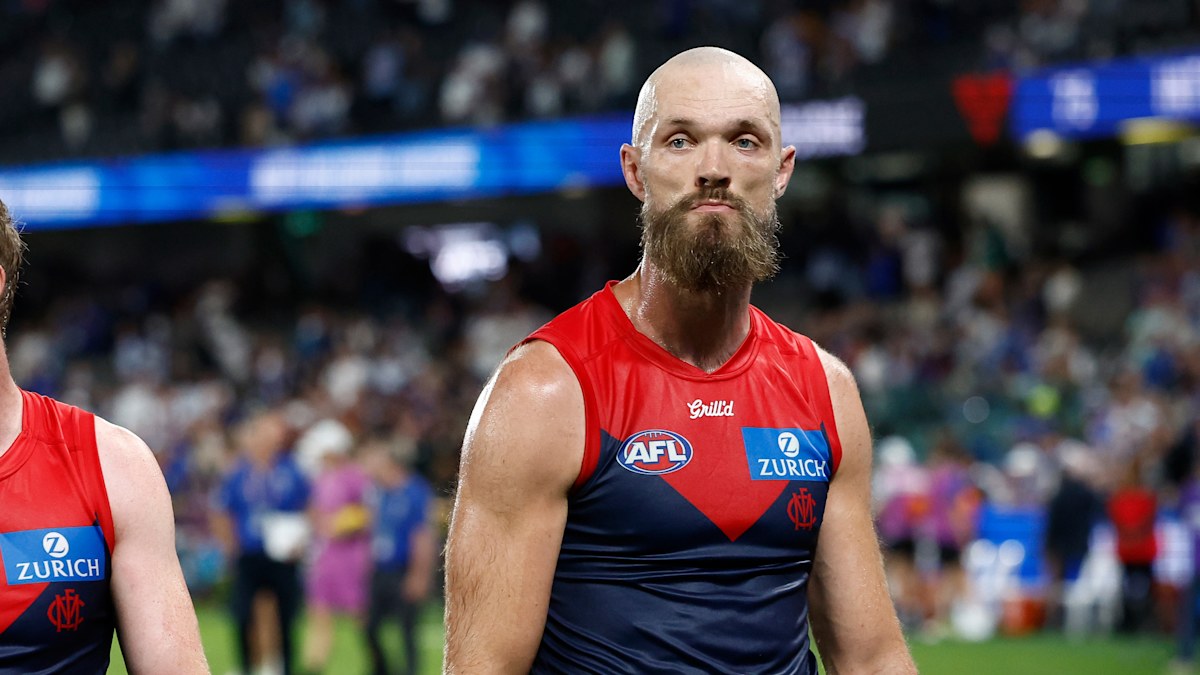
And Melbourne captain Max Gawn isn’t a fan of the change, saying the award has “lost the whole aura of the Brownlow”.
To protect the integrity of the process, umpires must only use this official data and are strictly prohibited from accessing outside sources or using mobile devices until their Brownlow Medal votes are submitted after each game.
READ MORE: ‘No need’: Mahoney shuts door on messy Bulldogs exit
READ MORE: ‘Diabolical’ ruck change slammed as star goes down injured
READ MORE: ‘I knocked him out’: Greene’s ugly fight with drunk dad

Matt Rowell with the Brownlow Medal. AFL Photos via Getty Images
To assist in their deliberations, the data set provided will include kicks, handballs, disposals, marks, contested marks, tackles, goals, behinds, goal assists, score involvements, clearances, contested possessions, hitouts, kick-ins, intercept marks, intercept possessions and spoils.
The move follows years of controversy surrounding the umpire-voted system.
There was widespread criticism of last year’s count, specifically in round 20 when St Kilda’s Nasiah Wanganeen-Milera was remarkably overlooked for the three votes.
Despite a dominant performance against Melbourne in which he finished with 34 disposals and four goals, the superstar Saint was awarded only two votes, sparking renewed debate over the legitimacy of the umpire-voted system.
Gawn, who was among the Melbourne players who reacted with shock to the Wanganeen-Milera snubbing, isn’t a fan of the change.
“I think it’s lost the whole aura of the Brownlow,” Gawn told Triple M’s Mick in the Morning on Thursday.
“But in 15 years that will be the new normal.
“The initial change is the aura is sort of gone.
“They have howlers, but they normally get (the winner) right. Nick Daicos still came second. I know he was the favourite. They normally get it quite right.
“They’re voting for something quite cool. It’s how they’re going out on the ground, compared to the numbers.
“I’ll still go,” Gawn laughed.

Reaction to Nasiah missing out on three votes. Nine
Two-time Brownlow medallist and former Docker Nat Fyfe voiced his support for the change, believing the modern game has outgrown the old way of voting.
“I think it’s reasonable,” he told Seven on Wednesday.
“The umpires have got such an enormous job trying to officiate the game, and then trying to understand who the best players were after is difficult.
“In 2005, Ben Cousins won with 20 votes. I was mid-30s [when I won the award]. It’s up to 40-odd votes now, so it’s trending in one direction and anything that evens the playing field out and brings forwards and backs in, and will keep the award, I think, as the best player in the game.
“So maybe a reasonable step forward.”
This new process will also be adopted across the AFLW competition, beginning with the 2026 season.

Max Gawn speaks on the Brownlow. Triple M
To ensure security, umpires will access Champion Data statistics through a protected link on encrypted, AFL-issued devices.
The AFL emphasised that while these statistics would assist deliberations, the final votes would remain a unanimous and subjective decision made by the four field umpires.
In a statement released on Wednesday, AFL football boss Greg Swann insisted the Brownlow remained a human-first award, balancing the introduction of new technology with the competition’s traditional prestige.
“The Brownlow Medal is the most prestigious individual award in the AFL competition. Field umpires who are entrusted to vote are instructed to take time, care and thoughtfully deliberate before reaching a unanimous decision to ensure the integrity of the award is upheld,” he said.
“While statistics can provide useful and reliable data, the essence of the award is clearly set out on the ballot paper. It is the subjective opinion of the field umpires that will determine the voting for the award, and the umpires are acutely aware of the importance of the award and the standing in which Brownlow medallists are held in the game.”
Fyfe argued for the value of “humanness” with the count, suggesting the drama of the Brownlow Medal — the unexpected snubs, the smoky who polls well, and the controversial omissions — was actually part of what made the night a national event.
“I think that would obviously help tip that over the line. But just thinking on my feet, I think some humanness, a little bit of error, keeps things interesting. A few anomalies here and there, maybe it’s not the worst thing,” he said.
“But some of those big omissions, it would be helpful to take the pressure off the umpires in those situations.”

Nat Fyfe celebrates after claiming his second Brownlow Medal in 2019. Getty
Speaking on SEN Breakfast on Wednesday morning, Essendon great Tim Watson pushed for quality over quantity regarding the 17 data points now provided to umpires.
Watson argued that to truly increase accuracy, the AFL should move away from a comprehensive list of raw numbers and instead focus on the specific metrics that determine a player’s effectiveness, such as disposal efficiency.
“If this is about making sure there’s more accuracy in their decision-making, wouldn’t you go to Champion Data and say, ‘Look, what do you believe are the six most important stats to look at in determining the effectiveness of a player in a game of football?'” Watson asked.
Co-host Garry Lyon voiced concerns that the shift could inadvertently transform the award into a “Champion Data medal”, but Watson countered that the statistics should only serve as a guideline.
When pressed by Lyon on what specific data he would prefer, Watson highlighted effective disposals and disposal efficiency.
While Lyon agreed, he noted that umpires would need to become increasingly “savvy” to interpret the degree of difficulty associated with certain statistics.
Ultimately, Lyon argued the “beauty” of the current system lay in the umpires’ personal judgment.
“They can lean on what they want, but this is the beauty of the umpires — it is what you value more than perhaps other people. I don’t judge them on it,” he said.
Despite the introduction of data, the fundamental voting process will remain the same: field umpires will meet after every game to decide 3-2-1 votes as a group.