
Leading up to the Super Eights, every key metric had New Zealand top of the pile in terms of their batting. But when their next set of fixtures moved from India to the slower Sri Lankan surfaces, questions arose on how they would adapt. On Wednesday night against Sri Lanka, despite not playing a competitive fixture for eight days, New Zealand made a mockery of any such reservations by winning comfortably.
The mood in the camp is therefore understandably “chipper” ahead of Friday’s game against England, and New Zealand head coach Rob Walter is banking yet again on his side’s greatest asset – an ability to solve problems on the fly – to propel them to the semi-finals.
“I think if you look historically at the Black Caps, you would probably say that they’re a team that have been great problem solvers, they are street smart, they find a way to understand the conditions quickly,” Walter said, reflecting on his side’s knack for navigating tricky conditions.
Editor’s Picks
“It’s certainly something that we pride ourselves on. And when you are in the subcontinent and there’s different soil types on the same block, you are faced with different conditions all the time. And that’s the beauty of the game of cricket, isn’t it? It’s like nothing’s ever the same. And so we want to keep being a side that responds quickly.”
That adaptability was on full display against Sri Lanka. After the top order crumbled, the game required a “significant momentum shift” and a “special partnership” at the back end. Rather than panicking, New Zealand leaned on their lower order. Mitchell Santner and Cole McConchie put on an 84-run stand as New Zealand finished on 168.
Walter was particularly glowing about Santner, describing him as a “proper batter” whose exploits go under the radar. The captain scored 47 off 26 balls to snatch the advantage from Sri Lanka.
“There’s a sort of psychology from a batting unit point of view when you can trust the middle to lower order, and know that if you do get into trouble, they can pull you out,” Walter said. “He [Santner] is sort of understated, and flies under the radar. And the next thing he’s got four for nothing or scored 70 off nothing. And that’s him.
“He’s just got a wonderful skill set, but he’s understated, doesn’t draw any attention to himself. But he delivers, and has, throughout the summer, to be fair, delivered under pressure when the team has been under pressure. If you look at the skill range that he showed the other night and has shown on multiple occasions that he’s a wonderful batsman, he’s got great power, and he finds it quite effortlessly.”
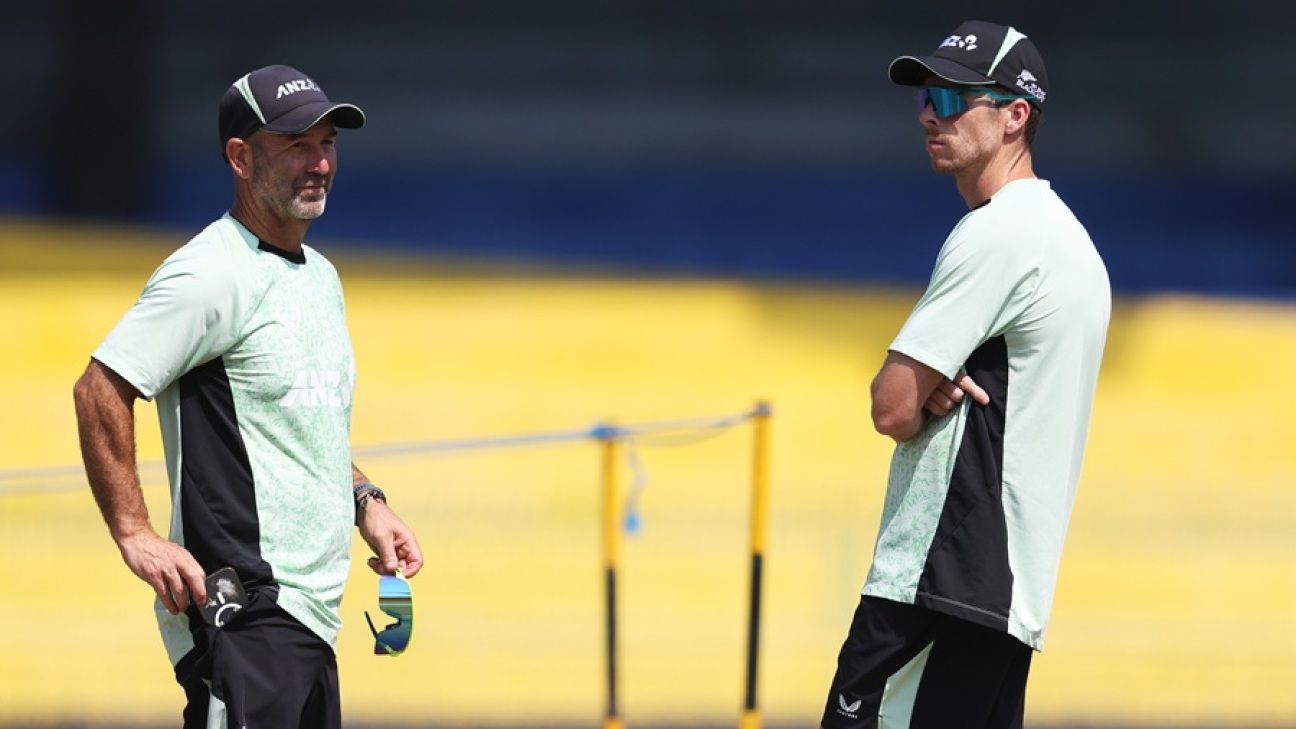
New Zealand coach Rob Walter and captain Mitchell Santner have a chat Getty Images’Restriction as valuable as wickets’
New Zealand have the worst bowling strike rate, and have taken the least number of wickets this tournament among the final eight teams, but Walter was not concerned, as long as they were restricting teams.
“In T20 cricket, sometimes restriction is as valuable as wickets,” Walter said. “So from our point of view, taking wickets is just the end process of executing a skill, isn’t it? It’s about responding to the conditions, understanding what we need to do as a bowling unit, and then collectively doing it really. And whether that has a team seven down, or all out or two down, if we win the game, it’s irrelevant, really.”
New Zealand now face an England side already secured of a semi-final spot. From a bowling point of view, Walter wanted to the team to be balanced – both about Jos Buttler’s lull in form and the explosive potential of Harry Brook.
“You’d never doubt the quality of Jos Buttler… it only takes one knock for that to change. Hopefully, that’s not tomorrow,” Walter said before shifting his attention to Brook, who played his first ever game at No. 3 against Pakistan to devastating results. “Where in the order he comes in is probably irrelevant. You’ve still got to bowl to him whether it’s in the first over or the 15th.”
While the win over Sri Lanka has given New Zealand a buffer of sorts, the stakes will be high with qualification not fully secured. A win guarantees progress, but a loss leaves their fate to “external factors”. That’s a position Walter is desperate to avoid.
“We’ve sort of tried to place an emphasis on every game,” he said. “I think that’s probably a cliché that all teams use. It’s not doom – we’re not dead if we don’t win – but certainly we leave it up to external factors then, and out of our own hands. So we certainly don’t want to be in that position. But it’s really taking care of the ball-by-ball process, and hopefully that takes care of the result.”