
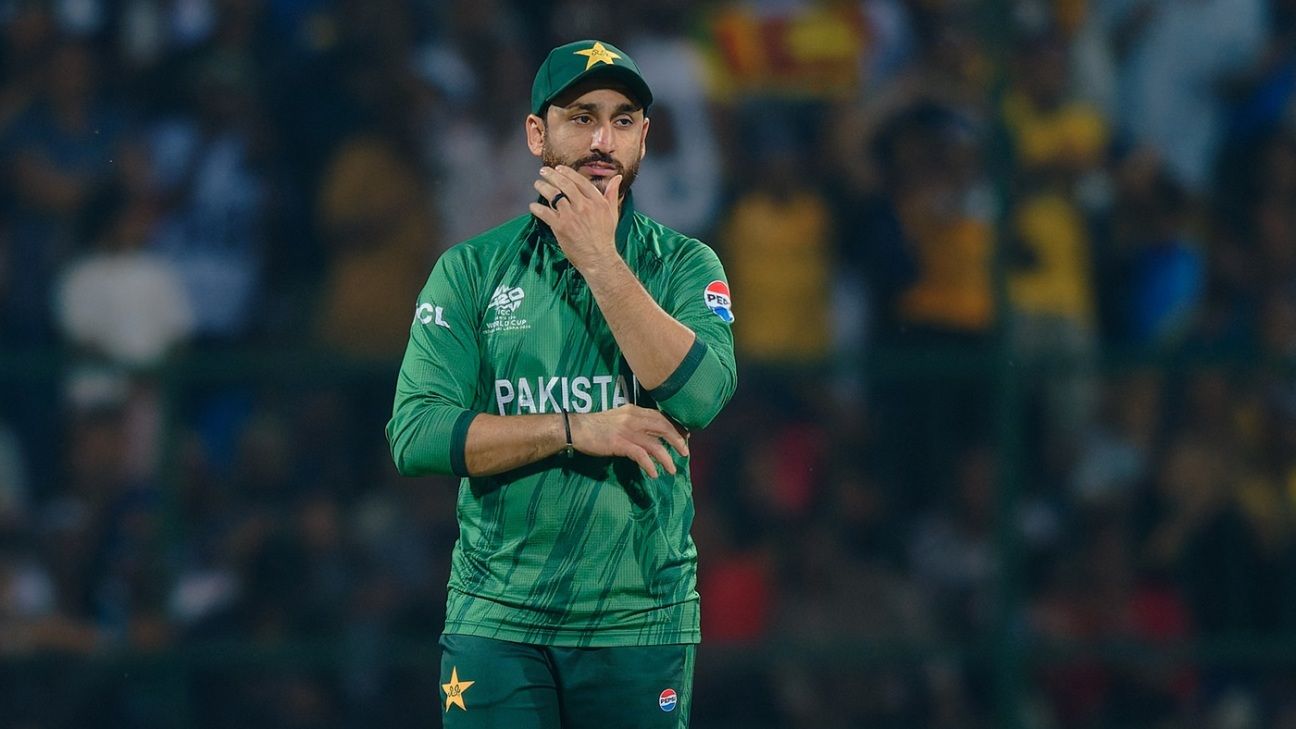
Usman Tariq paused before eventually ambling up to the crease. The ball tamely made its way to Dasun Shanaka, who equally harmlessly parried it back to the bowler. Tariq fumbled as he collected, and the ball trickled along down the ground, Sri Lanka shuffling across for the single that took them to 148, guaranteeing Pakistan‘s elimination from the T20 World Cup before the semi-final stage for the fourth men’s ICC event in a row. There was no reaction from the crowd, and Sri Lanka were squarely focused on the bigger match target of 212. Tariq sent down the next ball to close out the over, which Pavan Rathnayake flicked away for a couple to bring up 150. A footnote of an exit for what has lately become a footnote of an ICC tournament team.
***
Pakistan prepared for this World Cup like perhaps no other side. A six-week PSL season last April and May was followed immediately by a T20I series against Bangladesh at home. It kicked off a period that culminated in Pakistan playing 34 T20Is until the start of the World Cup, comfortably more than any other major side in the world. Captain Salman Agha, recently appointed to his position, said the Pakistan team would be “fearless without being careless”, perhaps his own interpretation of Shane Warne’s famous exhortation “to tee off (not recklessly)”.
Editor’s Picks
2 Related
Pakistan won most of those 34 matches: 24, to be precise. They won two triangular series, and lost just one of five bilateral series. They reached the Asia Cup final. They deprioritised other formats, with just two Tests across the nine months, and six ODIs. They adopted a liberal No-Objection Certificate (NOC) policy for overseas T20 leagues, with dozens of players taking part in the ILT20, BBL and BPL. With all of Pakistan’s games in Sri Lanka, they hastily organised a three-match T20I series in the country in January, perhaps after realising they had not played T20 cricket there in nearly 11 years.
If wanting to draw optimism from all of that – and Pakistan often vocally did – it wasn’t particularly hard. In that glut of cricket, however, the lines around what Pakistan wanted to prove – or learn – from any particular series would become increasingly blurred. The patterns of most series blended into one. The series they won either came against sides not in realistic contention for the World Cup itself, or teams so heavily diluted by player absence they effectively fell into the first category. That was in particular the case for Pakistan’s wins over South Africa and Australia, with their other wins coming against Bangladesh, West Indies, Afghanistan, Sri Lanka, Oman the UAE and Zimbabwe. Significantly the three games they played against India would all end up in defeat.
They twisted themselves in knots around the question of what to do with Babar Azam, head coach Mike Hesson in particular contradicting himself when he said he’d been asked to work on his strike rate at the BBL, only to bring him back to the team before that and stick with him despite his T20 game continuing to slide backwards. Two of the young aggressive batters Agha had indicated Pakistan would build the team around – Hasan Nawaz and Mohammad Haris – were gone from the team before the end of the year. Haris Rauf has not played a T20I since the Asia Cup final, omitted despite finishing as the BBL’s top wicket-taker, while Naseem Shah was taken to the World Cup after only playing three of those 34 build-up T20Is.
***
Salman Ali Agha looks on Getty Images
Exactly six months ago, Mohsin Naqvi, the PCB’s all-powerful chairman, put out a post on X in a rare direct intervention to defend an individual player. “Salman [Agha] and [Mohammad] Haris deserve support, not social media trolling,” he said. There was little he could have done to strengthen Agha’s position as T20I captain after a couple of years of musical chairs with the armband.
Notwithstanding that Haris disappeared from the national side within four weeks of that unequivocal support, it is fair to call for less toxic discourse on social media, which in Pakistan can be downright abusive. But while Agha – or any other player – does not deserve social media trolling, what he also does not deserve is freedom from scrutiny. When appointed captain, a statistical case showed this to be his weakest format, and at the start of this year, his T20I strike rate was the third lowest among all Pakistan players with at least 500 T20I runs.
In a rain-reduced game against Sri Lanka in January, he pushed himself up to No. 3 and smashed 45 in 13 balls. A couple of strong showings against a thoroughly enfeebled Australia later, he had made that position his, with little long-term evidence of his ball-striking ability. Indeed, his limitations as a top order batter were not dissimilar to Babar’s, whom he had nudged out of the way for the position.
ICC events invariably have a deflationary effect on runscoring, but for Agha, the result was more of a market crash. In six innings, he finished with 60 runs, 38 of them coming against Namibia. No player in the entire tournament with as many innings scored fewer runs. Agha said after their game against Sri Lanka, where no one outside the top two managed double figures, that it was a difficult pitch to start quickly on. But for the Pakistan captain, it’s hard to know what would have happened as his innings progressed, given he faced just 46 balls, again the lowest among players to have batted six times at this World Cup.
play
2:11
SL vs PAK – Is the end of Babar Azam in T20Is?
Urooj Mumtaz and Farveez Maharoof on Pakistan’s decision to drop Babar Azam
And if the theory was his tactical astuteness made up for the weaknesses in his T20I game, well, the evidence for that is similarly sparse. Agha testily rebuffed suggestions on Friday that he was little more than a “dummy captain”, insisting him and Hesson were central to decision-making at the tournament. But the internal logic of those decisions struggle to bear the weight of any serious scrutiny.
For one, there was Babar’s selection in the middle order at a position he had only batted at once before the start of this year, during a phase of play when Pakistan’s ability is already under stress. Fakhar Zaman, meanwhile, continued to warm the bench even as Saim Ayub‘s struggles as opener continued, making a mockery of that decision when he smashed 84 off 42 as opener against Sri Lanka.
As a result, the middle order was packed with players either out of form, unsuited to the format, or bit-part allrounders in an almost obsessive preoccupation with batting depth. It didn’t help that, even by their disappointing standards, Pakistan’s batting order aside from Sahibzada Farhan collectively decided to have a legendarily off tournament; a whopping 38% of Pakistan’s runs were scored by Farhan alone, by orders of magnitude the highest for any side at this World Cup.
But most staggering of all was Pakistan’s almost instant disillusionment with Abrar Ahmed after three poor overs against India. None of Pakistan’s players enhanced their reputation in that lopsided loss, but the fury of their selectorial might fell squarely on Abrar, Pakistan’s best T20I spinner over the past year. At the Asia Cup in 2025, he boasted an economy rate of 5.36; no one else across the tournament kept theirs below six.
Sahibzada Farhan’s contribution ESPNcricinfo Ltd
ESPNcricinfo understands there were frustrations within the camp at his inability to hold his nerve under pressure, and the sudden rise in Tariq’s stock ended up sidelining him. But Mohammad Nawaz’s ineffectiveness throughout made the call even more puzzling. It spoke once more to Pakistan setting an inordinate amount of store by batting depth, but Nawaz scored 15 runs at an average of 3.00 all tournament. When Abrar finally did return against Sri Lanka, he was, with a kind of dull predictability, Pakistan’s best bowler, taking 3 for 23 as no other bowler kept their economy rate below nine, or took more than one wicket.
Agha’s in-game management at crucial times was also similarly vulnerable to scrutiny. Famously at the Asia Cup final, he had erred by stockpiling three Rauf overs for the death – a phase of the game he is unsuited for – and then following the script by using him even as the spinners had India reined in on a sticky surface. At this World Cup, he did not appear to have learned that lesson, particularly in his use of Tariq at crucial points against India and England.
It wasn’t until the 11th over that Tariq, around whom all the hype and attention centred, was introduced. Offspin against the left-hander is often a match-up captains favour, but by then, Ishan Kishan’s match-winning 40-ball 77 had already been played. India could afford to be respectful of Tariq’s four overs, which leaked just 24 and took the one wicket. They already had a score Pakistan would never get near.
Against England, with Harry Brook on the rampage, Tariq was taken off after he dismissed Tom Banton with his first delivery to leave England wobbling at 58 for 4. The three overs Pakistan bowled in the middle before he came back on produced 36 wicketless runs, including 17 off a Shadab Khan over that brought the chase down to 7.33. He struck immediately upon return, but England could afford to knock him around for the next couple, and when he signed off with a rare errant over, England picked him apart for 14 to virtually kill the game off.
On ESPNcricinfo’s TimeOut show, Urooj Mumtaz said Agha may merely be saved by the dearth of captaincy options available to Pakistan, but with a new two-year cycle to begin, staying put is every bit as active a choice as getting rid. Agha has now led Pakistan in 50 T20Is, more than any other man besides Babar. Elite T20I sides choose captains who have demonstrated tactical brilliance or individual ability that makes their own position in the side unquestionable. Ideally both. Over a large sample size, Agha has failed to convince that he has either.
***
Usman Tariq was thrilled to get the wicket of Sam Curran Getty Images
It would be unfair to hone in on Agha as the convenient scapegoat, though. Since the current Naqvi administration assumed power, it effectively ended the factional infighting between Najam Sethi and Zaka Ashraf. Pakistan’s political realities mean Naqvi has enjoyed near-absolute authority in decision making across virtually all departments of the PCB, from building stadiums to hiring and sacking coaches and captains. While such a system may bring other concerns, it is conducive to stability, and any project deemed useful or advantageous can be pushed through where it might otherwise have faced factional roadblocks.
But the disappearance of administrative volatility has also brought with it the vanishing of on-field volatility. In the three years prior, Pakistan may have been a similarly middle-of-the-road team, but it retained its signature unpredictability on the biggest stages that rendered Pakistan a capricious force to deal with. At the 2021 T20 World Cup, they dismantled India by 10 wickets and were de facto tournament favourites until they came undone against Australia. At the 2022 edition, they lost to Zimbabwe, only to follow it up with that intoxicating mix of brilliance and good fortune that saw them reach the final. They beat India in a fixture at the 2022 Asia Cup, to knock them out.
Since 2024, however, Pakistan have been utterly predictable. They exited in the group stages of the 2024 T20 World Cup, which included an ignominious loss against the USA. At a home Champions Trophy Pakistan pulled out all the stops for, they did not win a single game and finished bottom of their group. At this tournament, it was only wins against three Associate nations that even took them to the second group stage. At the World Test Championship, they finished rock bottom in the cycle spanning this period, including a 2-0 home series loss to Bangladesh. The four ICC events have seen four different captains with no through-thread between them.
The narrow win over Sri Lanka was the only traditional top side Pakistan have beaten at an ICC event in the last three editions, their other wins coming only against Canada, Ireland, Netherlands, USA and Namibia. They have lost all six matches to India they have played.
Abrar Ahmed struck with his first ball Associated Press
There’s also no sense of a long-term philosophical undercurrent in their coaching and administrative appointments. In 2024, Gary Kirsten and Jason Gillespie were announced as white and red-ball coaches respectively. Naqvi personally made the announcement at a press conference, heaping praise on both saying their “stellar track records preceded them. I have every confidence that their expertise will guide our players to reach new heights.” Eight months later, they had both quit after becoming frustrated with the lack of true decision-making authority, with Gillespie’s falling-out with the PCB especially acrimonious and public.
Meanwhile, Pakistan’s selection committee has seen more chopping and changing than a chameleon in a disco. It currently counts Aqib Javed, Aleem Dar and Asad Shafiq among its members, but has at times seen an almost comically large number of people, and to this day, has no official chief selector.
True power, though, has appeared to lie with Aqib. He briefly emerged as all-format coach alongside his selectorial duties after Gillespie and Kirsten’s departure, and led Pakistan during their ill-fated Champions Trophy campaign. Alongside Dar, he was the architect of Pakistan’s production of ultra-spinning tracks in home Tests, with Mohammad Rizwan proclaiming Pakistan were playing “Aqib-ball” even while Gillespie was nominally head coach.
He announced the squad for Pakistan’s T20 World Cup this year, saying he was happy to “own” and “take responsibility” to the squad, and that he had hope Pakistan would “not only do well” but also win the World Cup. But “taking responsibility” has become little more than a buzzword, with Agha saying the same on Saturday, and no one seems to think the impact of the words extends beyond the verbal.
Perhaps the biggest surprise is that it all took so long. Pakistan’s T20 squad player pool is exciting, but not transformational. It isn’t clear how independent their coaches are, or what role non-cricketing factors play in cricketing decisions. At the top end of the administration, there is an aspiration to competence, but the decisions required for its execution are largely missing.
They still remain one of cricket’s most marketable sides, and their geopolitical reality with India and the riches that fixture brings to cricket allow them to play a kind of administrative leverage no cricket board outside the big three can manage. But the cricketing gods will only extend credit for so long, and over the last three years, they have only given Pakistan precisely what they deserve, and not an inch more.
This has been a bang average side for quite some time, and at last, it is getting bang average results.