
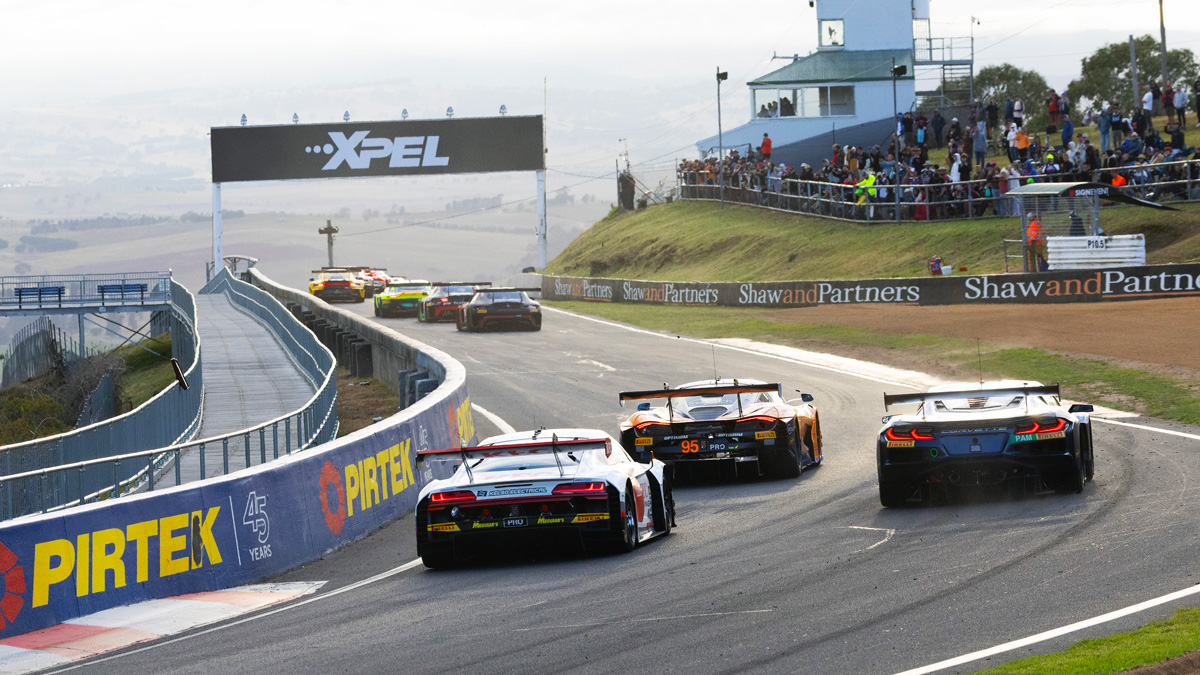
WHEN it comes to horror Bathurst crashes, Ryan McLeod has seen it all – and far too much for his liking.
McLeod was competing in the Super2 field the weekend that Mark Porter was involved in a fatal accident.
Two years later, in 2008, he was involved behind-the-scenes in the Team Kiwi Racing entry of Chris Pither that collected Paul Weel’s stricken Commodore.
Come the 2020 Bathurst 12 Hour, he was fielding the car which almost went down the side of the hill, when an unsighted Tyler Everingham ploughed into the crashed Triple Eight Mercedes-AMG of Sam Shahin at Skyline.
As if all that wasn’t enough, McLeod was on the scene at last month’s Bathurst 12 Hour when race leader Ralf Aron brutally smashed into Johannes Zelger’s Porsche on the run to Forrest’s Elbow. Aron suffered a broken back.
“We actually had a sponsor tour at the top of the Mountain and it happened to happen right there in front of the lot of us,” McLeod told V8 Sleuth.
The cause behind red flag conditions in Bathurst.#B12Hr pic.twitter.com/JYs7dSUNAM
— Bathurst 12 Hour (@Bathurst12hour) February 15, 2026
“To me, having been through those other experiences, it was immediately obvious what was about to happen and it was exactly the same scenario playing out that has played out over the years.”
Enough is enough, according to the five-time Bathurst 1000 starter.
“Whether it’s Bathurst council, whether it’s Motorsport Australia, whether it’s Supercars, they don’t learn,” he said.
“They need to do something about it immediately. They can’t just brush it off and pretend it didn’t happen.
“Now they might all say ‘we’re going to sit down and have a meeting about it’ but they actually need to do something and they need to do it quickly, because the Bathurst 6 Hour is coming up.”
McLeod has a simple solution, too: the instigation of a ‘super yellow flag’ system for Mount Panorama.
Effectively, that involves providing more warning via easier-to-see flags and the stringing together of multiple flag points.
That might, for example, see the entire run from the Dipper down to the exit of Forrest’s Elbow be treated as an entire yellow section, as opposed to the caution only applying to a very specific section of track.
“I think it can happen very easily and with some event-specific training and a particular guide written – which I’m happy to be involved with writing – about how to operate the flag signals on the top of the Mountain,” he said.
“There’s no point in putting a yellow down in the dip at the Grate; you arrive there committed. You have seen the huge accidents that have happened there. Those yellow flags need to be relayed immediately back three points.
“A super yellow should cover at least the three preceding points to the accident; potentially four. I could go through all the points and work out exactly where they should be, but a group of drivers could do it easily.
“And they should be larger yellow flags, as simple as making them larger, on longer poles that can go further out onto the track.
“I haven’t actually been a flag marshal but I’ve looked at plenty of flags and have looked at plenty of video from preceding incidents where guys were like ‘I couldn’t see the flag, it came out so late’.
“In that instance, to me, bigger is better, and earlier warning is better.
“If you look at the accidents, it’s never the car directly behind that hits. It’s always a car that comes on the scene later.
“In the case of Tyler Everingham, he’s lucky he’s alive. And that car was there for a long time.
“Paul Weel – another guy that’s lucky to be alive, should have been dead. Driver’s side into the traffic sitting at the bottom of the Grate, waiting for someone to hit him. Numerous cars got past, the later ones didn’t. Chris Pither didn’t.
“Mark Porter, the same scenario.”
McLeod noted it’s furthermore important to strenuously outline the expectation on drivers under yellow – i.e. to assume the track could be blocked and be prepared to stop – and to not purely rely on in-car warning systems.
“We keep trying to give the driver more information but it’s all too late,” he reiterated.
“I think that the in-car warning is great but it has the capacity to breed complacency and perhaps be vulnerable to technical problems as well.
“The simple solution that needs to happen immediately and would cost nothing is to go ahead and make some bigger flags and join the flag sections together back up the road from where these accidents have been happening, three or four flag points at a time.
“Where the yellow flag came out (for the Zelger incident at Bathurst) the accident happened like 10 metres after it. What are they supposed to do?
“I get really upset about it because I have been in these situations and have seen all this stuff happen, and it just keeps happening and happening and happening.
“It’s absolutely not good enough. They have to do something, and I think the simple approach is the best.”
McLeod is the son of 1987 Great Race winner Peter, the father of Ford Racing ace Cameron, and the boss of new Mustang Cup Australia team RM Race Cars.
James Moffat and Jack Perkins remember Allan Moffat
In this special clip from the latest edition of The Undercut, James Moffat and Jack Perkins remember the life of the legendary Allan Moffat.