
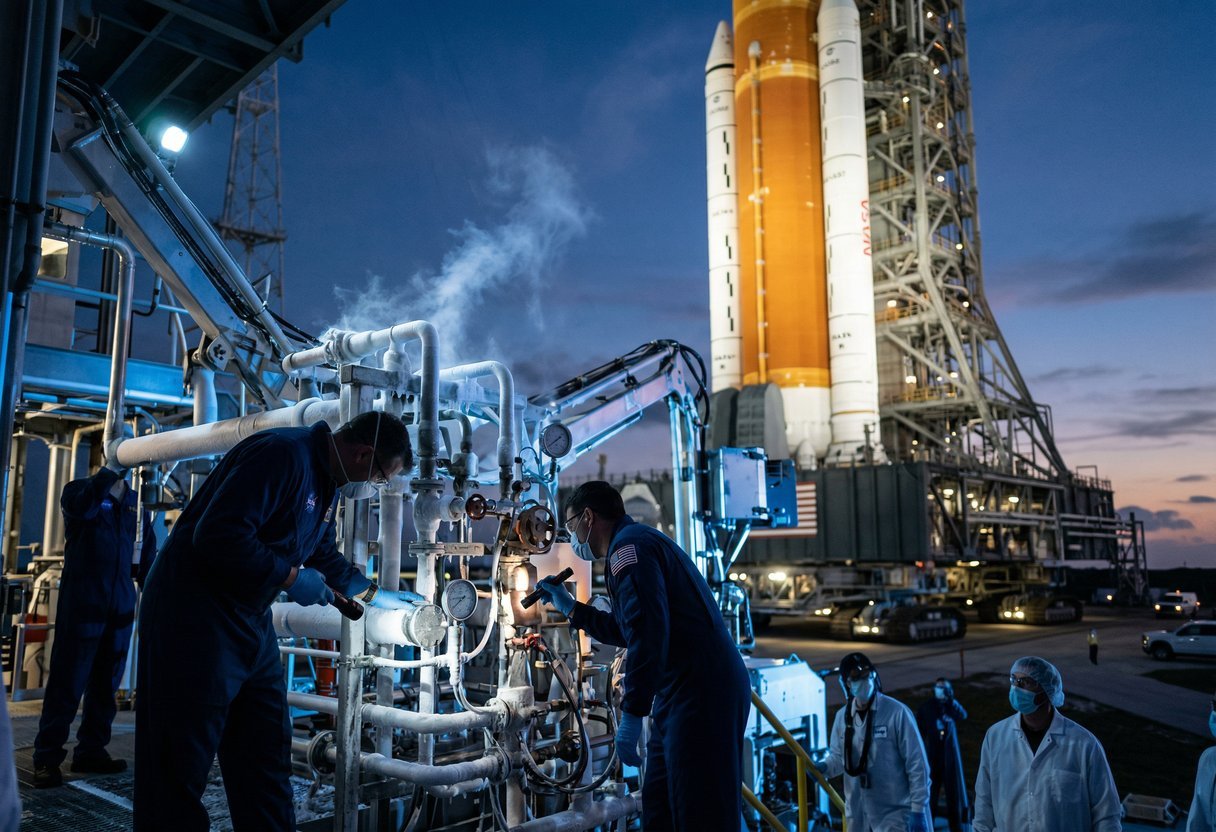
An adversary you cannot see is dictating terms to a $2 billion moon rocket. To keep the countdown alive, how much safety is NASA willing to trade for time?
At minus 253°C, the liquid hydrogen meant to lift Artemis II can shrink metal, stiffen seals, and slip through joints as a near-invisible leak. To keep the schedule intact, NASA now tolerates higher hydrogen concentrations at the pad, from 4 percent up to 16 percent, a move its program manager John Honeycutt insists remains safe from spontaneous ignition. The stakes are towering: each SLS tops $2 billion and ground ops run roughly $900 million a year, even as voices like Jared Isaacman argue private alternatives could do the job for less. With a full system overhaul aimed at Artemis III and a critical March 2026 window ahead, one miscalculation could ripple into years of delay and fresh political heat.
Liquid hydrogen: NASA’s invisible troublemaker
Artemis II was meant to be the steady handoff from test flights to a crewed return, a clean arc from launchpad to lunar orbit. Instead, the program keeps circling one tiny antagonist: hydrogen. On the Florida pad, technicians chase wisps that vanish the instant they appear, and the stakes feel bigger with every scrub. How do you tame a fuel that wants to escape every seal?
Liquid hydrogen is breathtakingly cold, at -253°C, and it shrinks metals enough to open micrometer gaps. Its molecule is so small that it slips through gaskets once considered tight. Leaks show up around quick-disconnect arms that feed the SLS before launch, sometimes after meticulous repairs. The result is a cycle of load, detect, vent, and try again.
Operational compromises to salvage progress
Faced with persistent leaks, NASA eased a key threshold: allowable hydrogen concentrations rose from 4% to 16% in certain monitored zones, paired with tougher containment and purging. Program leader John Honeycutt says the approach remains safe, since ignition risks are reduced by active ventilation and isolation (plus redundant sensors that trigger rapid cutoffs).
The message is pragmatic. Total elimination of leaks may be unrealistic with current interfaces, so crews are tightening procedures while widening what the ground system can tolerate. It is risk management, not resignation, calibrated to keep the Artemis timeline moving without courting catastrophe.
The financial test of NASA’s lunar ambitions
Every SLS carries a staggering price, above $2 billion per unit. Keeping the launch complex ready adds roughly $900 million a year. Each prolonged countdown or scrub burns time and money, from cryogenic commodities to overtime. The economics magnify the pressure to load cleanly, launch promptly, and avoid hardware damage during troubleshooting.
Critics, including Jared Isaacman, argue that commercial models could trim costs and accelerate cadence. NASA counters with a focus on reliability and human-rating standards. Still, the arithmetic is unforgiving. Schedule slips ripple into contracts, facilities, and flight crews, complicating everything from training plans to downstream science payloads.
Mission stakes and engineering excellence
Hydrogen headaches threaten to push Artemis II further right on the calendar, with knock-on effects for Artemis III, currently marked for March 2026. Managers are already weighing deeper changes to loading systems and ground plumbing to break the cycle. Another prolonged delay could force a return to the Vehicle Assembly Building for rework.
The contest is intimate and exacting, fought inside chilled lines and seals rather than in deep space. Master the micro-leaks, and momentum returns to the Moon campaign. Fall short, and costs rise while confidence erodes. The outcome hinges on disciplined engineering, steady operations, and the patience to fine-tune physics at cryogenic scale.