
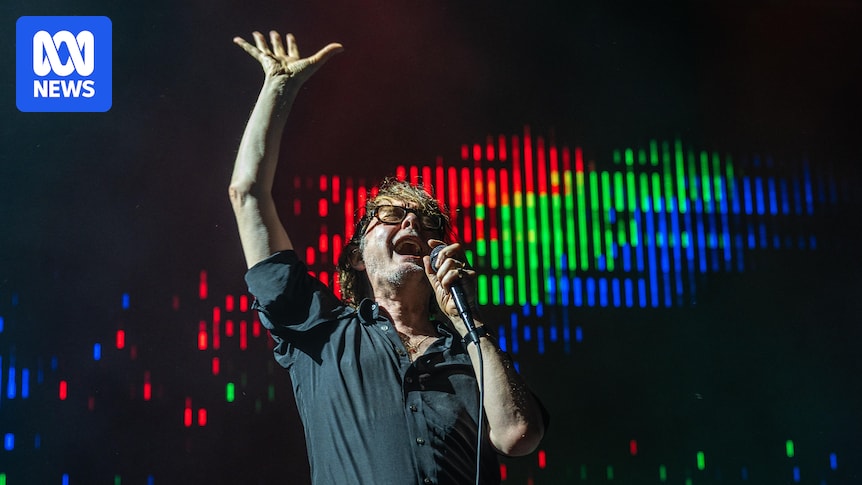
Towards the end of Britpop legends Pulp’s free show at Elder Park to open Adelaide Festival, frontman Jarvis Cocker delivered a simple message.
He was just about to sing 90s anthem Common People as inflatable air dancers shot up across the stage. He explained he had been inspired to write the song by a conversation he had with someone he disagreed with.
“All voices are important and all voices should be heard,” Cocker said.
“There’s no us or them. It’s all us, we are all the same. But then, as I look out at you in this audience, you all look different, and that’s the magic of it.
“It’s when we’re together — when we’re all together — that the magic happens.”
Warning: This article contains discussion of rape which some readers may find distressing.
It seemed like a reference to the January cancellation of Adelaide Writers’ Week (AWW) — usually part of Adelaide Festival — after more than 180 authors withdrew in protest of the disinvitation of Palestinian Australian author Randa Abdel-Fattah by the Adelaide Festival board.
Within days, the director of the writers’ festival, Louise Adler, who had not been involved in the decision, resigned, as did the board. It was quickly replaced by a new board chaired by arts leader Judy Potter.
Pulp had been among the acts in the wider festival who decided to boycott over the censorship of Abdel-Fattah, but moved ahead after the board’s about-face one week later, when it “unreservedly” apologised to both the author and Adler.
“We want to make it absolutely clear that Pulp refuse to condone the silencing of voices. We celebrate difference, and oppose censorship, violence and oppression in all its forms,” the band wrote on social media after the board apologised.
“Given this new and welcome development we feel able, in good conscience, to honour our invitation to perform in Adelaide on 27 February. We hope that our free concert will be an opportunity for different communities to come together in peace and harmony.”
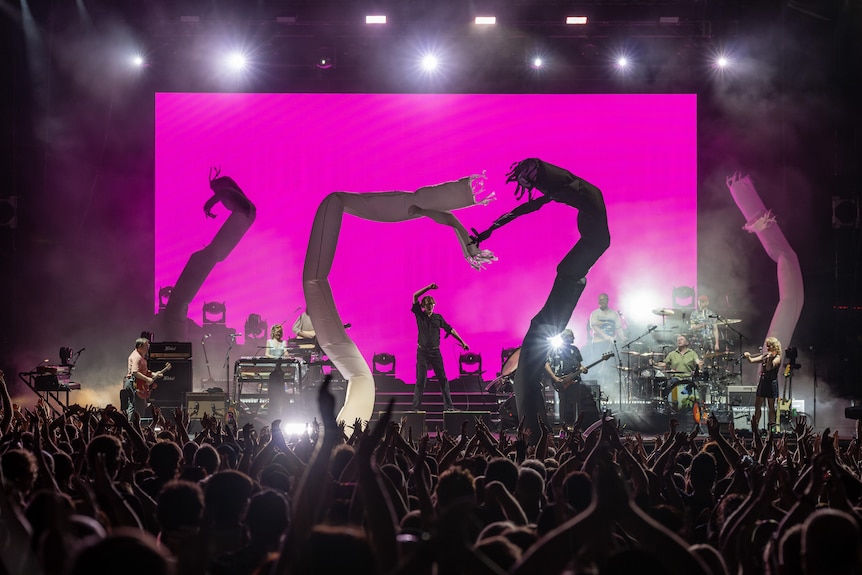
To introduce Sorted for E’s and Wizz, Pulp invited the audience to a 90s rave in Sheffield. (Supplied: Adelaide Festival/Andrew Beveridge)
The cancellation of AWW cast a pall over this year’s Adelaide Festival, whose opening weekend offered provocations on censorship, revolution and class.
Speaking to ABC Arts on the morning of Pulp’s show, the festival’s new artistic director Matthew Lutton said: “There was a moment when we were worried about how [the cancellation of AWW] would impact the festival, but once the new board arrived that worry ceased.
“The new board are just 100 per cent supportive and focused on us delivering this year’s festival.
“Everyone’s on the same page and everything is about getting this festival out to as many people as possible.”
Reaching a younger audience
On that front, Adelaide Festival has so far been successful.
More than 10,000 people attended the opening night concert from Pulp, which saw the band perform hits from across their catalogue, including much-loved 1995 record Different Class (Disco 2000; Sorted for E’s & Wizz) and last year’s More (Spike Island; Farmers Market).
Jarvis Cocker Takes 5 with Zan Rowe
On top of the free opening night event, the festival introduced $40 tickets to most shows for under-40s, which saw a younger generation crowd the Adelaide Festival Centre over the course of the opening weekend.
Those low ticket prices were paired with programming choices tapping into the interests of young people, including a Korean-language adaptation of The Cherry Orchard appealing to fans of K-pop and K-dramas, and a German-language adaptation of the novel History of Violence by 33-year-old French writer Édouard Louis.
“There’s a huge buzz at the moment about the creativity that’s coming out of Korea, from KPop Demon Hunters to Squid Game,” Lutton says.
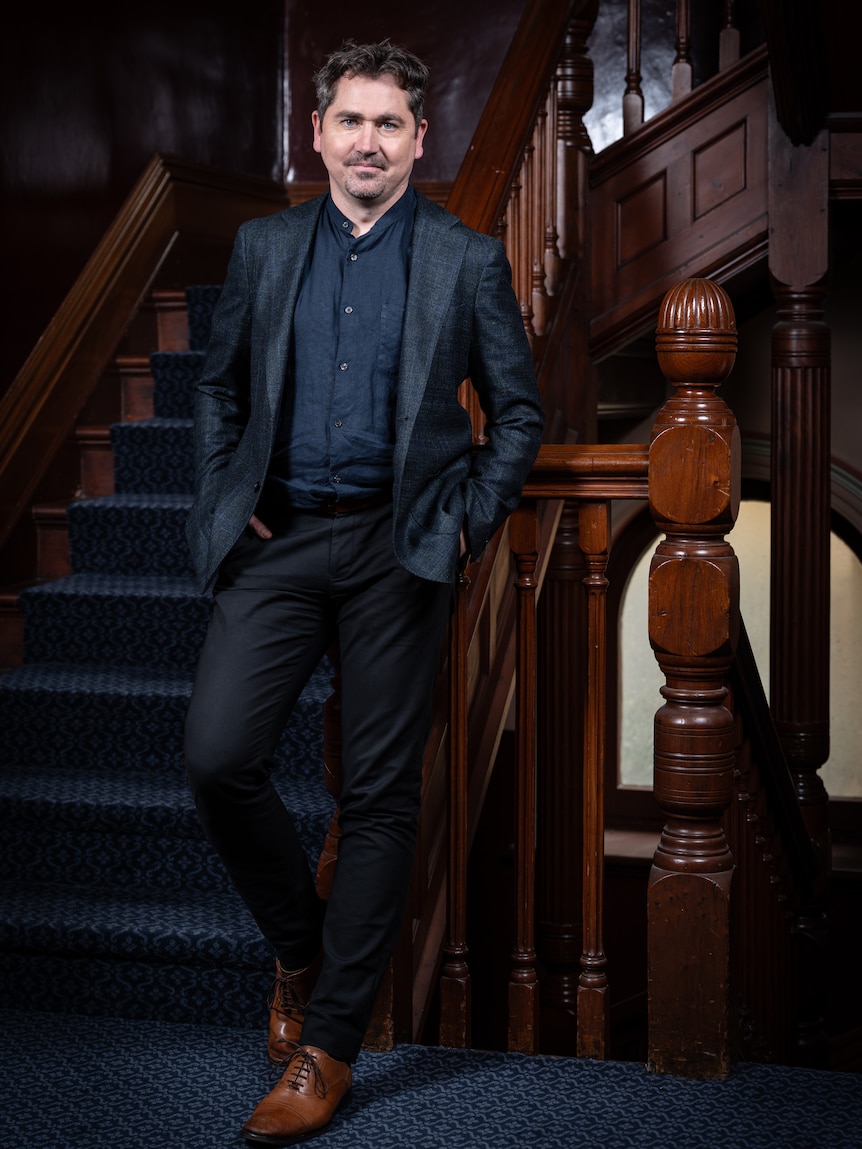
Lutton took over Adelaide Festival after almost a decade at the helm of Melbourne’s Malthouse Theatre. (Supplied: Adelaide Festival/Andrew Beveridge)
“That voice is unique and specific, and something we don’t often find in Australia.”
Both The Cherry Orchard and History of Violence are also “very contemporary” — another aspect of the program Lutton suggests appeals to younger audiences.
“Allowing art to be controversial and provocative makes it feel essentially like it’s really speaking to the times,” he says.
Lutton says that’s the space an arts festival like Adelaide Festival provides artists and audiences.
“It has to be a space where you can articulate ideas that make an audience sit with discomfort,” he says.
“But you also have to curate a program that’s full of joy and adrenaline and excitement, and is about heart and feeling elated.”
Sexual violence on stage
One of those controversial productions was History of Violence, which brought a vicious act of sexual violence to the stage.
On Christmas Eve in 2012, Louis was raped and nearly killed in his Paris apartment. He turned the harrowing experience and the way it was then warped by the judicial process into his second novel, released in 2016.
Two years later, German theatre company Schaubühne — led by artistic director Thomas Ostermeier — debuted a stage adaptation of the book, adapted by Louis, Ostermeier and Florian Borchmeyer.
After a night out with friends, a fictionalised Édouard (played by Laurenz Laufenberg) encounters Reda (Renato Schuch), a young Kabyle Algerian man, who he eventually invites up to this apartment. What begins as a consensual sexual encounter escalates into brutality after Reda appears to steal Édouard’s phone, iPad and wallet.
Ostermeier was interested in adapting the book into the play because of the way it grapples with difficult subjects, including homophobia, racism, education and class dynamics.
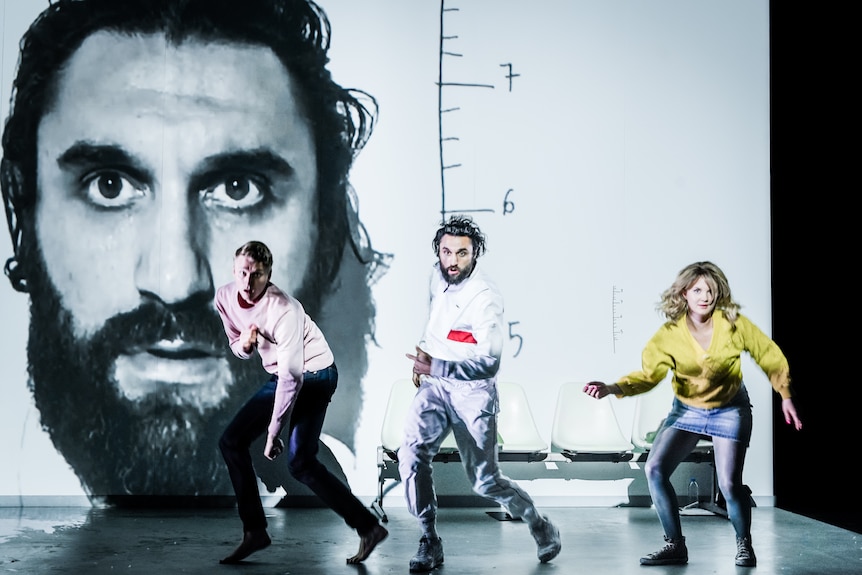
Lutton was thrilled to have directors like Ostermeier, Stone and former festival director Peter Sellars at opening weekend. (Supplied: Schaubühne/Arno Declair)
He sees it as part of a group of plays bringing the idea of class into the open, after his 2017 adaptation of French author Didier Eribon’s memoir Returning to Reims.
“[Eribon and Louis] put it back on the agenda that we’re living in a class society, and what poverty and a lack of education does to our society,” Ostermeier says.
In his first few days on the job, Lutton invited Ostermeier to bring History of Violence to his first festival.
“It’s a queer resilience story,” Lutton explains.
“Édouard needs to tell everyone what happened on that night, and everyone — the police, his family — keeps trying to rewrite his story.
“It’s about how to confront something you need to control your narrative. You need to be able to tell your past truthfully.”
Using live video and drums, the show invites Édouard, his sister Clara (Alina Stiegler), Reda and the police to literally take the microphone. Sometimes, they share their perspectives; at others, they torment Édouard.
The production feels relentless as it shifts between Édouard’s police interview, hospital visit, escape to his sister’s home, and an unflinching re-enactment of the rape.
Ostermeier says he never intended for the rape scene to be so graphic but that he was led by his actor-collaborators Laufenberg and Schuch.
“I’m the last person who suggests making it graphic,” Ostermeier says. “I’m always trying to protect the performers, but they wanted to be explicit.”
He adds that the performers saw themselves as having a responsibility to put Louis’s perspective on stage — and to “defend” his actions.
“For them, it’s not only a theatre show,” Ostermeier says. “It’s as if the audience is a courtroom and the actors are defending the case of Édouard and his view on things.”
When Louis first saw the play, he left the auditorium during the scene.
“He still is not able to watch it,” Ostermeier says.
Peter Sellars plots return to Adelaide Festival 24 years after controversy
Schaubühne has taken History of Violence across Europe, North America and to Japan, and in each place the show has received a standing ovation. Ostermeier attributes that reception to the boldness of his performers, but also to the form of storytelling.
“Everything is done in a very choreographed and rhythmical and musical way,” he says.
“And the non-chronological storytelling reflects the contradictions which everybody feels when they look at events in the news.
“[History of Violence] is a love story and a story about rape at the same time. What could be more contradictory than that?”Space to take risks
Another show that looks at seeming contradictions and strange intersections is Faraway, the latest work from Australian Dance Theatre, choreographed by Jenni Large.
Why 150-year-old fairy tales still resonate with modern audiences
It’s one of a handful of productions from local companies on the Adelaide Festival line-up, alongside a collection of works for young people: Mama Does Derby from Windmill Production Company and A Concise Compendium of Wonder, the final trilogy of shows by Slingsby.
For Lutton, the Australian thread of the program was about “empowering and amplifying” local companies “creating audacious ideas of scale”.
It’s especially important to make that space, he says, as opportunities for Australian artists shrink and those artists may feel the need to “think smaller”.
“When we’re working with Australian artists, it has to be something that they could not do at any other time of the year,” Lutton says.
“I think it’s really important right now that Australian artists are allowed to dream big.”
But in the case of Faraway, its full scale was stripped back just shy of the festival opening in an act Large cautiously describes as censorship — or at the very least risk aversion.
“A couple of big elements of the show were taken out quite last minute and it’s just really disappointing,” she says.
“People want risk-taking art, and then often, institutions aren’t prepared to have enough process around what it actually takes to get there safely, so that the art can have safe risk.”
In her program note for Faraway, Large writes: “It feels critical to be provocative in a world that routinely censors.”
She tells ABC Arts: “Artists are censored a lot, and I experienced that, and I watched so many of my peers experience that, and I guess it just reflects a more global picture of censorship of people and voices.”
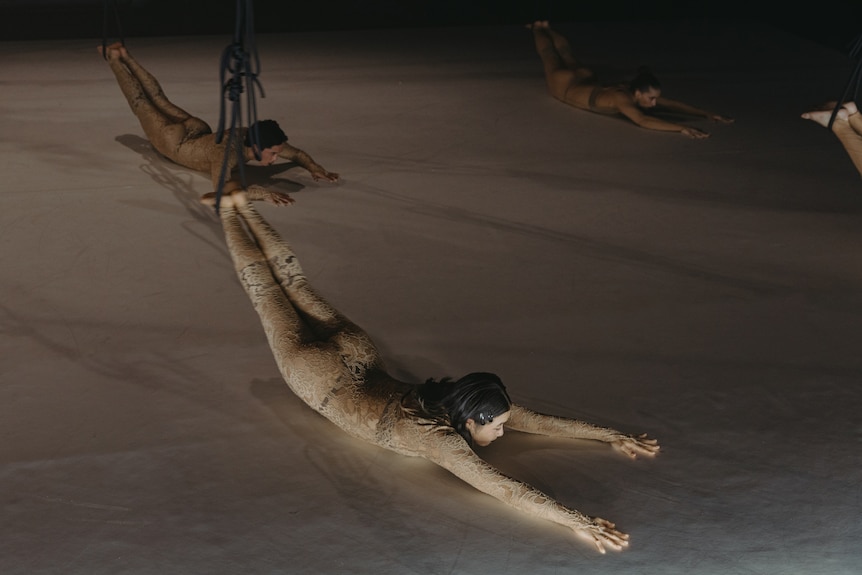
In some sexualised scenes in Faraway, dancers make direct eye-contact with the audience, up-ending ideas about voyeurism in dance. (Supplied: Adelaide Festival/Jonathan VDK)
Like Pulp, Australian Dance Theatre, led by Wiradjuri artistic director Daniel Riley, had conversations about whether and how to move forward as the writers’ week saga played out.
“It was a very heavy time and had massive ripple effects,” Large says. “Everyone was essentially trying to do the right thing — by the values of the company and by the people here.”
Ultimately, the company decided to press on with the provocative Faraway.
Its provocation is in the “mashing together” of the imagery of fairy tales — including mermaids, sirens and fairies — and the playfulness of childhood, like swinging and skipping rope, with the movement and aesthetics of kink.
Large’s starting point for Faraway was her interest in sex and power dynamics, and how both fairy tales and kink offer a sense of escapism.
“Kink is really fascinating because it brings about so much language, so much safety, so much space for such quirky experiences, and all kinds of people to express themselves in safe containers,” she explains.
“And essentially it has theatrical mechanics, like setting up a scene and dialogue or boundaries or costuming and role-playing.
“All these things have these really interesting correlations to life, art and contemporary dance.”
Soon she was connecting those ideas to fairy tales and mythical creatures and combining them into one piece of dance.
Large has found audiences are feeling “energised, entertained and challenged” by Faraway. She’s thrilled to see that response, considering “a lot of contemporary dance work in Australia is still pretty conservative”.
“I like to ruffle that up a little bit,” she says.
“It’s such a privilege to have an opportunity to make work, have it at Adelaide Festival, for it to be seen, and to share and collaborate that it’s motivating me to try to be unapologetic about what I’m trying to do.”
Politics and class
There’s resonances between the unapologetic nature of Large’s practice and that of Simon Stone, the Swiss-born Australian director who now lives between London and Vienna.
In his 20s, as an actor and then director, Australia’s so-called “enfant terrible” of theatre became known for modern twists on classic plays, first with independent theatre company The Hayloft Project in Melbourne and then at Belvoir St Theatre in Sydney.
Stone explains his rewriting of the classics initially came from a desire to centre actors in his shows.
“As a former actor myself, I aimed to kill the cult of personality that was the writer,” he says.
“I believe that actually writing is fairly easy. Standing on stage and entertaining people is hard.
“The principle of my work is to talk to the audience about what their life is right now through an actor who feels relatable and recognisable and is being brilliant.”
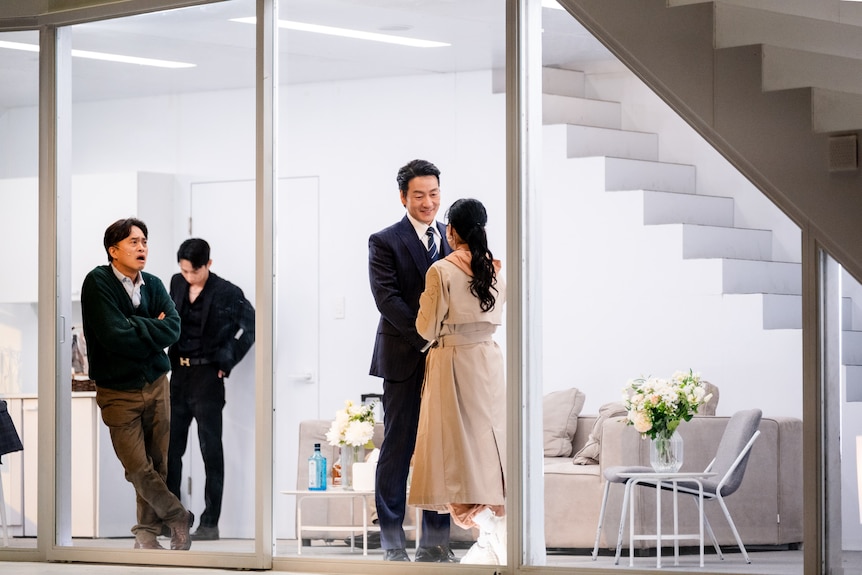
“Rewriting so that that moment is brilliant and relevant and important for a new audience every time they see that show, that’s the revolutionary thing,” Stone says. (Supplied: Adelaide Festival/Jack Fenby)
Stone’s productions, including an adaptation of Henrik Ibsen’s The Wild Duck which toured internationally, led him to the UK and Europe, where he picked up an Olivier Award for his adaptation of Federico Garcia Lorca’s Yerma, starring Billie Piper.
Both The Wild Duck and Yerma took place behind glass — as does much of his latest production to land in Australia, a new Korean-language adaptation of Russian playwright Anton Chekhov’s The Cherry Orchard staged inside a pyramid-shaped house, designed by Saul Kim.
The Korean setting came from Stone wanting to work with South Korean actors, including Park Hae-soo Park (Squid Game) and Jeon Do-yeon (Secret Sunshine), who star in The Cherry Orchard as the ambitious businessman Doosik Hwang and the returning matriarch of a crumbling empire Doyoung Song.
“The culture of performance in Korea has always been totally fascinating to me, because there’s this remarkable ease with which [Korean actors] move from comedy to tragedy; from really high stakes drama into something light and ridiculous,” Stone says.
He also sees resonances between Korea today and the turn-of-the-century Russia Chekhov was writing about in The Cherry Orchard — societies on the cusp of a revolution, with class barriers rapidly disintegrating.
“[Chekhov’s] plays are about rapidly changing society, where all of the rules of structure, authority, tradition are being thrown up in the air, and everything’s in jeopardy, socially and politically,” Stone explains.
South Korea only became a democracy in 1987, after protests to military rule forced the country to hold free elections. As recently as 2024, its then-president Yoon Suk Yeol declared martial law, causing political turmoil and Yoon to be jailed for life for insurrection.
“This kind of political instability is much more present in Korea, so the idea of being able to mine that sense of who are we, what are we going to be, what’s the next phase of us as a nation [was appealing to me],” Stone says.
“It’s often difficult to do [Chekhov] in the Anglo-Saxon world because of the sense of democracy as an established tradition that probably isn’t going to be threatened with a revolution.”
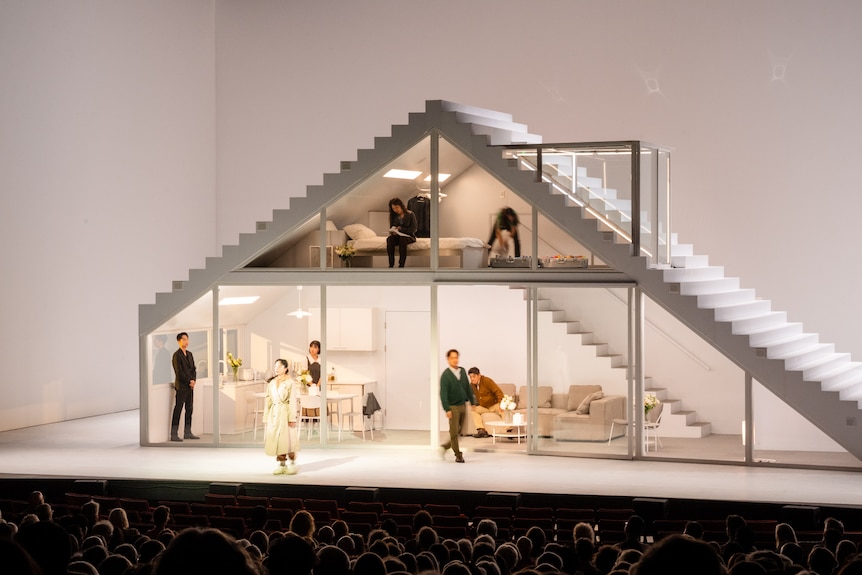
Stone once created a version of The Cherry Orchard set in Australia in the 70s, for Melbourne Theatre Company in 2013. (Supplied: Adelaide Festival/Jack Fenby)
Stone adds “change is very slow in Australia”, pointing to how long it took for the 2008 apology to the Stolen Generations as an example.
“It takes a long time for people to get round to the idea of doing anything vaguely politically extreme or different,” he says.
“In Australia, we don’t have any kind of culture of revolution or rioting or going out on the streets.
“In fact, it seems to be OK to ban protests in this country, which to me is outrageous, but seems to be not hugely politically unpopular.”
Setting The Cherry Orchard in South Korea also brings its representation of shifting class dynamics to the fore.
That subject of class is one that has resonances to the arts community in Australia, where the cost of an arts degree has risen to more than $55,000 and working-class voices and audiences are increasingly shut out.
“You need subsidies in order to have working-class theatre,” Stone says.
“If there is literally no financial incentive to being an actor or a writer or a director, if it doesn’t represent any kind of economic stability, then we’ll never have that voice in the arts.
“We need to see it as a craft, exactly like a carpenter or a plumber or electrician, and as something that we need around us.
“It’s part of mental health, being able to go to the theatre and see yourself represented on stage.”
Adelaide Festival continues until March 15.