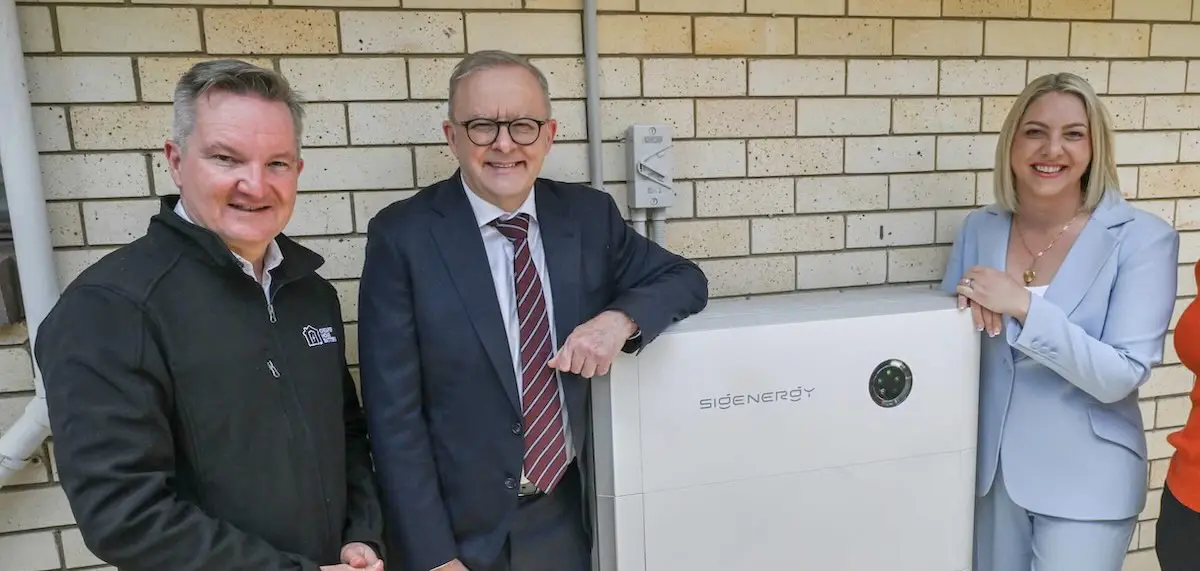
The renewable energy industry has expressed shock and doubt over fresh claims that the Albanese government’s smash-hit Cheaper Home Batteries scheme is being targeted for further Treasury-driven design tweaks – and a possible early wind-up – ahead of the next federal budget.
The stunning success of federal Labor’s home battery rebate has defied all expectations, at latest count chalking up more than 250,000 installations nationwide since its launch in July – a combined total of more than 6 gigawatt-hours of rooftop solar storage.
But with this success came concerns about the scheme’s cost and sustainability, as it churned through its initial budget of $2.3 billion, largely due to another unforeseen outcome – the popularity of super-sized home battery systems of 50 kWh and above.
To address this, federal energy minister Chris Bowen announced in December that the government would boost the rebate’s total budget to $7.2 billion, while also adjusting its settings to make it last longer and go further – including by gearing it towards much smaller systems.
The changes, which will come into play from May 01, will see batteries sized up to 14 kilowatt-hours (kWh) continue to receive the full roughly 30% discount off the up-front cost of a storage system. Batteries sized between 14 kWh-28 kWh will get 60% of the discount, while batteries between 28 kWh and 50 kWh will get 15 per cent.
But a report in the Australian Financial Review on Thursday claims the federal Labor is currently modelling further changes to the subsidy that could have it scaled back further, as it looks to plug holes in the budget.
Citing a “government source familiar with the proposals but not authorised to speak publicly,” the AFR says “options modelled by the government include winding up the program early, lowering the discount level, or further reducing the size of the batteries eligible for the subsidy.”
The report says the new options being modelled “by the department” are in addition to the December changes.
It is unclear which particular government department the report refers to, but Renew Economy has sought comment from the Department of Climate Change, Energy, the Environment and Water (DCCEEW).
The Smart Energy Council, which worked closely with Bowen and his department on the original design of the rebate, and then again on the changes the the scheme announced in December, says it has heard nothing of further changes being modelled or planned.
“The Smart Energy Council was surprised by reports the Australian government is considering further changes to the Cheaper Home Batteries Program, aside from those already due to take effect on 1 May this year, and doubt it will occur,” SEC acting CEO David McElrea told Renew Economy.
“This program is extraordinarily successful. It brings down power bills for all Australian households, assists with the cost of living, stabilises the energy grid, and helps combat dangerous climate change.
“The Smart Energy Council was pleased to work with the Australian government on the recent rebate amendments to help ensure the program remains sustainable and successful.”
With the December changes to the rebate due to take effect in May, ahead of the federal budget, it would indeed come as a surprise if the Albanese government decided to further rein in the popular policy, which was a core election promise ahead of its re-election last year.
Just this week, Chris Bowen was celebrating the latest milestone of the “common sense policy” and the benefits it is delivering to more than a quarter of a million Australian solar households – many of them in the regions.
DCCEEW had not responded to Renew Economy’s questions at the time of publication.