
Phones, medicines, cars, surgical tools, even the temperature in an office. They were all designed to suit the average man.
He’s known as Reference Man. He’s a white male, 25 to 35 years old, weighing around 70 kilograms and about 170 centimetres tall.
“Reference Man was created in the mid-1970s,” says Nicole Kalms, a professor in the department of design at Monash University, and founding director of the Monash XYX Lab, which leads national and international research into gender-sensitive design practices.
“[He] became what I would describe as a kind of default or standard human that was the measure for everything.”
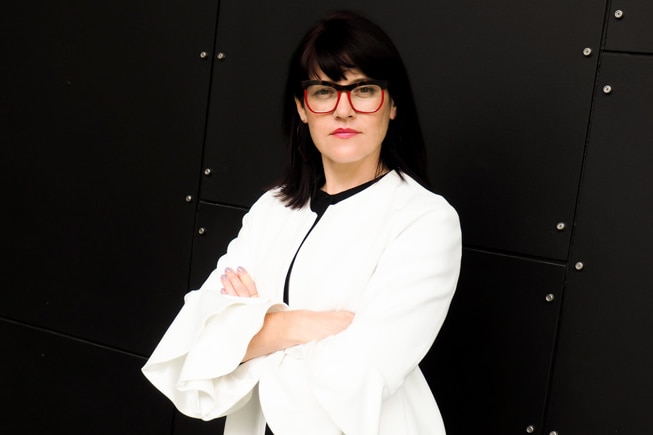
Nicole Kalms says women are often an afterthought in the way many products and spaces are designed. (Supplied: Ella Mitchell)
Kalms says the male so-called “standard human” continues to influence the way products and spaces are designed today, and those standards often leave women as an afterthought — if they’re thought of at all.
“It’s actually kind of started to influence the ways that we might think about anatomy, or the ways that we might think about the design in my disciplinary area of seating and bench heights and products and equipment.”
Kalms says women and gender-diverse people have raised issues about the design of public spaces and infrastructure, and how those issues make them feel uncomfortable and even unsafe.
“We do a lot of public transport research, and one of the things that they often talk about are the hand-holders on trains and trams, because actually they’re really quite high.
“And what happens is half of your top will ride up and kind of expose parts of your tummy and it’s just really uncomfortable. And that’s one clear thing that’s a real problem.”

Nicole Kalms says the height of hand-holders on public transport is one issue that has been raised. (Unsplash: Shawn Rain)
Women aren’t in the data
Despite making up about 50 per cent of the population, women have historically been excluded from research studies, so their measurements rarely made it into the data that shapes design.
Even now, when there is female-specific data, the sample size in studies is often small.
As an industrial or product designer, Alexandra Garland has seen how a lack of diversity in product development plays out in the real world.

Alexandra Garland says men are the default user in product design testing. (Supplied: Alexandra Garland)
“From my time spent researching the anthropometric data, it very much is clear that the man is the default user,” she says.
“So there is a real lack of diverse testing when it comes to early user testing in product design and just assuming, I guess, a certain type of user.”
When designing or redesigning products for women, the most common shortcut is to scale down an average man’s measurements by 30 to 40 per cent to estimate an average woman’s.
But there’s a clear problem with that method – women are not just short men.
Your average woman has a different body shape and proportions to your average man, with many variations in body fat, bone mass, muscle mass, bone density, blood pressure, resting heart rate and even the volume of certain brain regions.
By ignoring these physical and physiological differences, Kalms says, it’s doing a disservice to women who must navigate a man’s world every day.
“We know that women have a range of quite different physical attributes that are different to men, but also that just broadly, our population is very diverse,” she says.
“I think this is a really current and critical issue that we’re kind of navigating now.”
Loading…Biased design can be dangerous
At best, biased design can be inconvenient or insulting for women.
There are often no pockets, or fake pockets, in women’s clothing, and sports shoes aren’t always fit for purpose. Razors, power tools and even musical instruments can be more difficult, less comfortable, or less effective for women to use.
Even some products created exclusively for women have lacked the research to make them work properly.
Take disposable period pads and tampons, which weren’t tested using blood – just a saline solution – until 2023.
At worst, biased design can be dangerous or even deadly.
Studies show women are more likely than men to suffer pelvic fractures in the army, with a designer highlighting biased design in military boots, course requirements and backpacks.
Female surgeons have reported issues using surgical tools that are designed for typically male hand size and grip strength.
Most personal protective equipment isn’t designed for women, despite women making up about 70 per cent of frontline healthcare workers in the world.
According to one study, women are up to 75 per cent more likely to experience adverse reactions to prescription medicines, which are tested on more men than women.
And, in some countries, studies show women are more likely to be injured in a car crash than men.
“There is a recent big study, and many before that, that also shows for more severe and fatal injuries that females are less well protected than males,” says Astrid Linder, a world-renowned traffic safety expert at the Swedish National Road and Transport Research Institute.
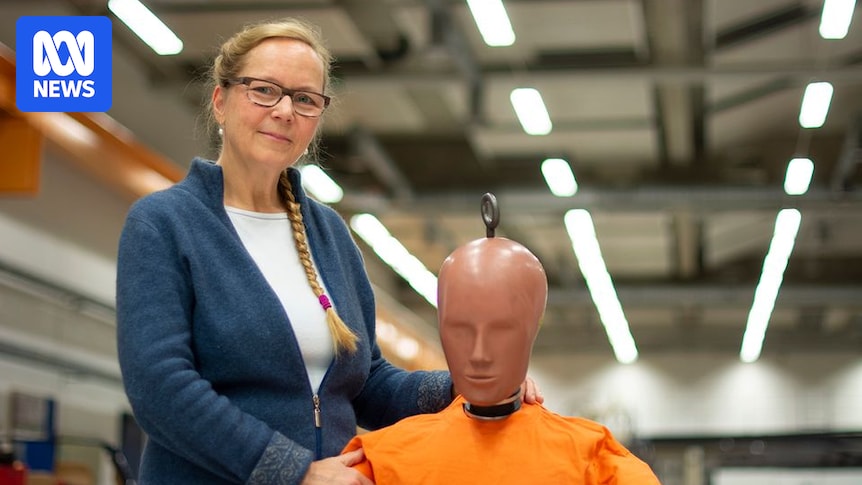
Professor Linder created the world’s first average female crash test dummy in 2022, after seeing only average male crash test dummies being used to test car safety for decades, or a smaller version used to represent a very small adult woman.
Loading…
She says her crash test dummies show the differences between the average female and male’s size and how proportions can change the outcomes of a crash.
“There we are failing women; we as society,” she says.
“The female part of the population is not represented when we’re talking about the occupant.”
Pink it and shrink it
Even when products are adapted with women in mind, the items often end up just being a smaller, pinker, more expensive version of the same product that was designed for men.
“They market tools for women, but they’re just a different colour. They’re not a different design,” Garland says.
“So there’s no substance behind what you’re paying extra for.
“I think it really says something to how companies perceive women and a lack of confidence in our intelligence, you know, and it just makes me feel like they think that I can’t see through it.”
Kalms says, “We use a great example, which is a pink basketball court, which a landscape architect kind of thought would cover off the inclusive box in his recreational facility.
Tailored gear a game-changer for women’s sport
“And when we really start to dig deeper, we can also see that sometimes it can create even higher risk of injury. It can reduce performance if we’re thinking about particular forms of products, or shoes, or clothing.”
Kalms says the gender-based price disparity on some products, commonly known as the “pink tax”, can have long-term impacts, especially during a cost-of-living crisis.
“We can understand how there might be really serious consequences in terms of medicine or safety, but also women and girls can end up paying lots more money for things because products are increasingly expensive when they’re targeting women,” Kalms says.
“So this idea of gender bias is a really important one that we need to pay attention to, because it’s not just that kind of object or that moment, it’s actually a lifetime of gender bias that really contributes to the ways that we’re shaping women and girls’ lives.”
Change starts with education
Garland recently completed a Bachelor of Industrial Design. She says she was one of only two full-time female students in the university course.
“I always felt like I had to be ready to defend my ideas and my point of view, maybe more than I should have, because I was coming from a different perspective than the default perspective that was already presented in that class.”
She says one way to help solve design bias is to start at the education level.
“It needs to be embedded into the education and the courses that it is important to design for all users, because only some of the teachers are kind of expressing that to students.”
Subscribe to the BTN Newsletter
Garland now works as a graduate at the Department of Infrastructure and Transport and she hopes to continue making designs functional, usable and appropriate for more than just the average man.
“I think that we definitely need more women in research and in the doing. We need more women across the whole process from concept to research, to delivery, to implementation.”
But Garland says it can’t just be up to women to consider other women in their designs.
“I never want this to come across as excluding men from the conversation. If a lot of the people in power are men then, 100 per cent, we need to have them championing this as well.”
Kalms agrees that young people are key to unlocking a more inclusive future.
“The younger generations of learners are really wanting to design inclusive spaces,” she says.
“And so they’re all contributing to the ways that we might ensure that good design, unbiased design, actually benefits everybody, which is the really critical thing.
“It is a long game, but I think there’s a really critical awareness that means we’re going to see some great and very unbiased designs in the future.”