
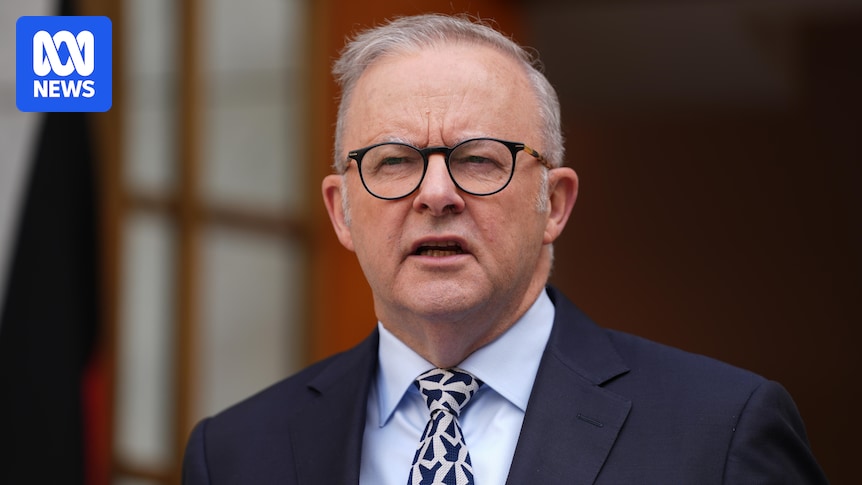
The prime minister has confirmed three Royal Australian Navy personnel were on board a US submarine that sank an Iranian warship earlier this week.
But Anthony Albanese insisted they sat out the operation to sink the IRIS Dena, saying Australian military personnel did not “participate in any offensive action” against Iran.
Iran war live updates: For the latest news on the Middle East crisis read our blog.
The US fast-attack submarine sank the Iranian frigate off the coast of Sri Lanka, and as of yesterday Sri Lankan authorities said 87 bodies had so far been recovered, along with 32 survivors.
The US has not identified the submarine, but some US military websites say it was the USS Minnesota, a Virginia-class submarine that rotated through HMAS Stirling near Perth last year.
Dozens of Australian personnel have been rotating through placements on US fast-attack submarines based out of Pearl Harbour in preparation for Australia acquiring its own nuclear-powered submarines under the AUKUS agreement.
Australian authorities had been unwilling to confirm reports that Australians were on board the submarine involved in the attack.
Loading…
But this morning, Mr Albanese told Sky News three Australians were on board.
“We wouldn’t normally confirm such an issue, but given our [National Security Committee] meetings and the public interest, I can confirm that there were three Australian personnel on board that vessel,” he said.
Read more about the Iran war:
“I can confirm also, though, that no Australian personnel have participated in any offensive action against Iran.”
Mr Albanese said there were frameworks in place to ensure Australian personnel did not take part.
“These are long-standing third-country arrangements that have been in place for a long period of time, and what they do is ensure that Australian Defence Force personnel, where they are embedded in third countries’ defence assets, they act in accordance with Australian law, Australian policy, and that is, of course, taking place across the board.”
In October, Defence officials told parliamentary hearings there were “more than 50” ADF personnel serving on US fast-attack submarines, with the expectation that number would grow.
More than 100 ADF personnel are training within the US in preparation to rotate through.
According to Defence, about one in 10 crew members on serving US nuclear-powered attack submarines are Australian.
Civilians are also being trained in the maintenance of nuclear-powered submarines, preparing to work on Australia’s own submarines in the future.
Meanwhile, Sri Lanka has offered safe harbour to another Iranian vessel in the wake of the attack on IRIS Dena.
The Iranian replenishment vessel IRINS Bushehr has been taken to the north-east port of Trincomalee, while 208 crew members were ferried off the vessel and taken to a naval base near Colombo.
Loading
Greens senator David Shoebridge slammed the government, saying Australia was now complicit in an illegal war.
“Labor’s statement since this war began that Australia is not directly involved … has been a lie,” he said.
“This is three Australian defence personnel who were embedded on a US nuclear submarine that has been out there fighting the US’s war.
“We’re being dragged into these wars because of the dystopian logic of AUKUS, that we’re somehow safer by being part of an alliance led by Donald Trump and his lawless regime.”
Submariners may have ‘retreated to their cabins’
Malcolm Davis from the Australian Strategic Policy Institute said the Australian submariners on board likely would have simply stepped away as the attack took place.
“I think the most likely scenario is once the decision had been made by the skipper of that sub to attack the target, they would have recused themselves from any operational role,” Dr Davis said.
“Retreated to their cabins until such time as the tactical operation was over.”
Since reports first emerged that Australians may have been involved, Australian authorities have referred to “long-standing arrangements” governing these kinds of situations.
Dr Davis said while this situation was undoubtedly historic — the first US Navy destruction of a warship with a torpedo since World War II — the rules underpinning how the Australian personnel would have behaved were relatively uncomplicated.
“Basically when any agreement is made to host Australian sailors on board any foreign warship, be it an American submarine or a British naval vessel … agreements are made on contingencies, and one of those is what if there is military action,” he said.
“And I think that would have been covered under any agreement.”
Expert analysis on the Middle East: