
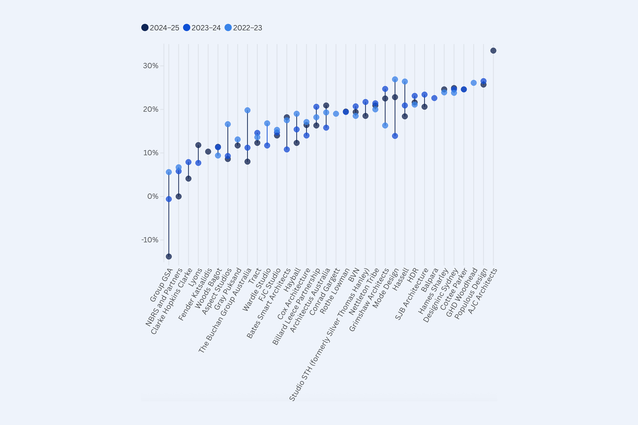
Australia’s Workplace Gender Equity Agency (WGEA) has released its 2024–2025 gender pay gap figures for 10,500 Australian businesses, including thirty architecture and landscape architecture firms.
The 2024–2025 reporting cycle is the third since reforms passed by parliament in 2023 mandated that businesses with more than 100 employees submit gender employment data to the WGEA. Among the thirty architecture and landscape architecture firms that participated in this cycle, the median total gender pay gap was 18.3 percent.
WGEA considers gender pay gaps within -5 to +5 percent as an optimal target range, allowing for normal workforce fluctuations. Gaps within this range do not significantly favour women or men. By contrast, gaps below -5 percent are characterised as being in favour of women.
In 2024–2025, Group GSA reported a median gender pay gap of -13.8 percent, placing it below the WGEA target range and in the “in favour of women” category. This marks a continued decline from -0.6 percent in 2023–2024 and 5.6 percent in 2022–2023. Women make up the majority of the practice’s upper-middle (77 percent) and lower (65 percent) pay quartiles, while men remain the majority in the upper (60 percent) and lower-middle (65 percent) quartiles, illustrating the firm’s varied gender distribution across pay levels.
The top performers within WGEA’s target range of -5 to +5 percent were NBRS and Partners, with a median gender pay gap of 0 percent (down from 5.8 percent in 2023–2024 and 6.7 percent in 2022–2023), and Clarke Hopkins Clarke, at 4.1 percent (down from 7.9 percent in 2023–2024).
At the opposite end, first-time reporter AJC Architects had the largest median gender pay gap at 33.5 percent, followed by Populous Design at 25.7 percent and Designinc Sydney at 24.9 percent.
Comparing the first and latest cycles, Group GSA has achieved the largest reduction in its median gender pay gap, dropping 19.4 percentage points. Other firms also made notable improvements: The Buchan Group reduced its gap by 8.0 percentage points (from 19.8 percent to 11.8 percent), Hassell by 8.0 points (26.4 percent to 18.4 percent) and Aspect Studios by 8.0 points (16.6 percent to 8.6 percent).
Grimshaw, meanwhile, has experienced the largest increase in its median gender pay gap, rising 6.2 percentage points from 16.3 points in 2022–2023 to 22.5 percent in 2024–2025. Compared with last year, however, this gap has narrowed from 24.7 percent, showing progress.
Nettleton Tribe and Rothelowman are the only participating practices for 2024–2025 to have achieved a balance of 50/50 ratio of female and male employees within their organisations.
Tract is closest to achieving parity in the upper pay quartile by gender composition, with female employees representing 48 percent and male employees making up 52 percent. AJC Architects follows with 45 percent women and 55 percent men. Clarke Hopkins Clarke is the only firm with a majority of women in the upper quartile, with females representing 56 percent and males representing 44 percent.
In the lower pay quartile by gender composition, the firms with the lowest representation of women include FJC Studio (43 percent), Hayball (46 percent) and the Buchan Group (46 percent). At the other end, the highest representation is seen at Designinc Sydney (82 percent) and Gray Puksand (81 percent).
Across the broader architectural services industry, there were several positive signs. Every practice that submitted data had conducted a gender pay gap analysis within the past two years, and 96 percent have taken action as a result. Reported actions include investigating the causes of the gaps, reviewing remuneration decisions and addressing cases of unequal pay.
To view the data in full, visit the WGEA Data Explorer.