
For all the chaos, the terror and the loss of life in the past week following America’s war on Iran, one thing has managed to maintain a semblance of stability.
Oil, the lifeblood of the global economy and a primary source of the conflict, has remained remarkably composed in the face of the onslaught, even as global stock markets have been jolted.
With a fifth of the world’s supply trapped in the Persian Gulf, overwhelmingly reliant on ships to move it through just one exit — the narrow Strait of Hormuz — and into the Gulf of Oman, there’s general agreement that a prolonged war could be catastrophic for the global economy.
Iran war live updates: For the latest news on the Middle East crisis read our blog.
So far, however, that’s yet to be reflected in oil prices. Compared to Russia’s invasion of Ukraine four years ago, the reaction to the bombardment of Iran has been decidedly muted.
That’s because most analysts are convinced, rightly or wrongly, the conflict will be a short-lived affair.
The black liquid rose off historically subdued levels weeks before the outbreak of hostilities to about $US70 a barrel.
Since the first bombs were dropped over Tehran last Sunday, however, it has stabilised at just above $US80 a barrel, the level it traded at for more than two years between late 2022 and early 2025.
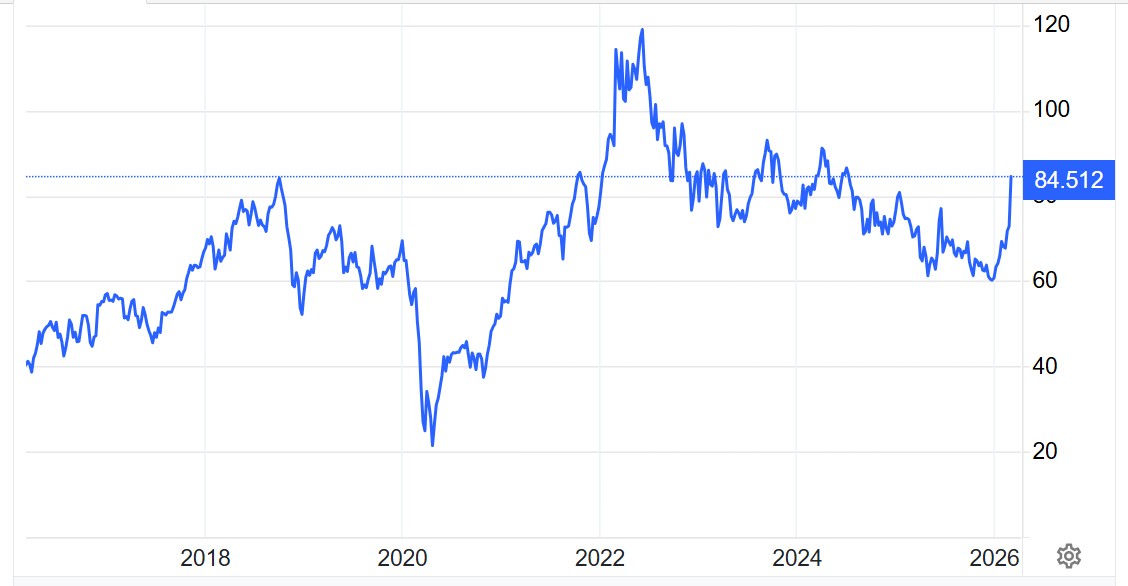
The oil price has stabilised at just above $US80 a barrel. (Supplied: Trading Economics)
Rabobank’s Ben Picton believes that’s around where it will sit, at least for the time being, despite all the lurid headlines of $US200 a barrel, fears of panic buying and queues at petrol stations.
“$US200 a barrel, we would say, is an extreme worst-case scenario,” he told the ABC.
“We think that, given what we know at the moment, $US85 a barrel is more likely in the near term.
“But if we do see Hormuz closed for an extended period, we might see $US130 a barrel or slightly more.”
LoadingTACO time again?
America and Israel may be partners in pummelling Iran.
But they have very different ambitions and are subject to different political pressures at home.
‘Nothing is safe’ on global financial markets
For US President Donald Trump, given his election promise a little over a year ago that he would extract America from “forever wars”, there is enormous pressure to bring the attack to a conclusion as soon as possible.
But there is an even more pressing issue: the midterm elections, and the prospect of an inflation breakout.
While skirmishes in the past have disrupted shipping, the Strait of Hormuz — the narrow choke point at the end of the Persian Gulf — has never been completely shut.
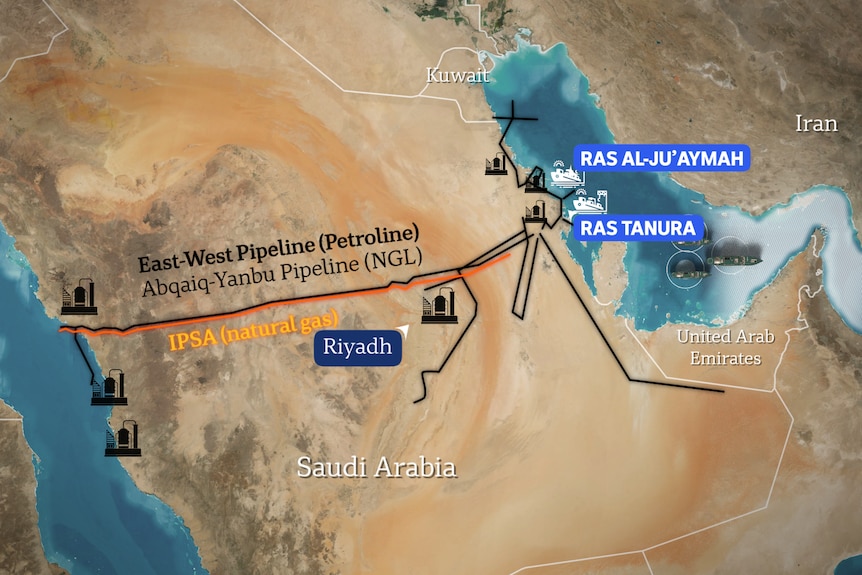
The Strait of Hormuz is the only sea passage from the Persian Gulf to the open ocean. (Source: UBS/Graphic: Eric Zheng )
Until now.
In the past, closing the Strait would have required Iran to face off against the US Fifth Fleet, stationed in Bahrain, along with the Armada sent to the Gulf in recent weeks.
Now, however, cheaply built drones can deliver devastating results with pinpoint accuracy. And Iran has made it clear that it will attack any ship attempting to make its way through.
“The Strait is closed,” declared Ebrahim Jabari, a senior advisor to the Iranian Revolutionary Guard’s commander in chief on Monday.
“If anyone tries to pass, the heroes of the Revolutionary Guard and the regular navy will set those ships ablaze.”
Read more about the Iran war:
The only other passageway for Middle East oil and gas is a pipeline across Saudi Arabia to the Red Sea. But that simply doesn’t have the capacity to divert a meaningful supply. So, energy supplies are effectively trapped.
And Iran has begun targeting infrastructure — ports, pipelines and refineries.
Oil prices may have stagnated for much of the past week. But another week could see global prices, including those in America, forced higher, which would be disastrous for Trump in the upcoming mid-terms.
While America may be largely self-sufficient in energy production, it still imports oil from the Middle East for specific refining requirements, along with Canada and Mexico.
Expert analysis on the Middle East:
The knock-on effects would be even worse, delaying mooted interest rate cuts and possibly forcing the US Federal Reserve to hike the federal funds rate.
Along with Saudi Arabia’s Raz Tanura refinery — which was shut Tuesday after being hit by drones — other refineries may be forced to shut as they can no longer load ships.
About 112 tankers, including 70 jumbo tankers, are trapped in the Gulf with about 20 million barrels of oil and gas.
Should that continue, the US president’s resolve to stay the course may waver.
That’s why oil traders are playing the TACO — Trump Always Chickens Out — trade once again.
Liberty or leverage?
In about a month’s time, Trump is scheduled to meet with Chinese President Xi Jinping to discuss trade, among other things.
China has long held the whip hand over the US when it comes to rare earths and just about every other metal on the planet. If it doesn’t control the minerals, it dominates the refining and production.
Everything you need to know about why Trump is threatening Spain
Suddenly, it has found its cheap supplies of energy drying up.
For years, China has been able to pick up supplies of oil from sanctioned countries like Venezuela, Iran and Russia at hugely discounted prices. But in January, the US captured Nicolas Maduro and his wife, and the new administration has cut off supplies to China.
Now, Iran has gone. Iran produces about 3 per cent of global oil supplies and ships almost 90 per cent of its exports to China.
That’s now under threat, depending on who takes control of the country.
Of equal concern to China is gas.
China also sources much of its liquefied natural gas from the Persian Gulf, mostly from Qatar.
Destruction at huge oil refinery
During the past four years, according to investment bank UBS, it has increased its reliance on Qatar as shipments to Europe have declined.
But production was halted this week after Iran struck the processing facilities with drones, leaving Chinese industry exposed.
Beijing won’t easily be able to make up the shortfall. Australia is operating and shipping at close to full capacity.
That leaves America, which only recently overtook Qatar and Australia, as the world’s biggest supplier.
Regime change for Iranians? Or a bargaining chip in a bigger war?
Loading…