
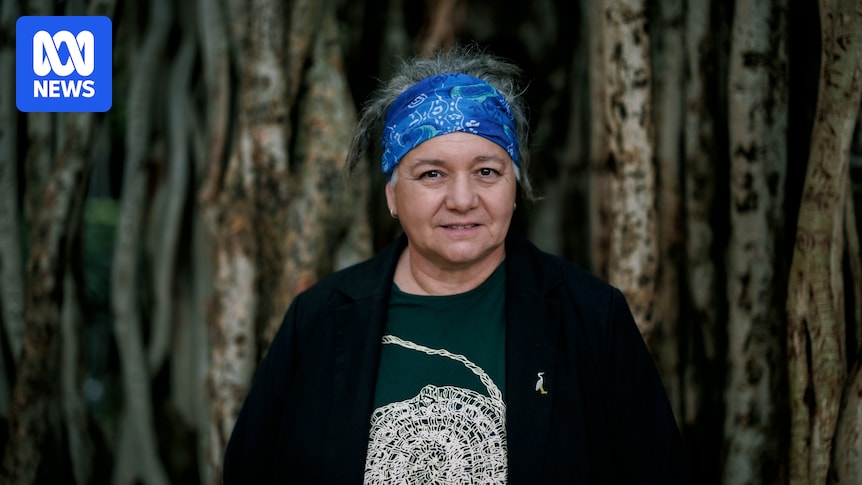
Melissa Lucashenko decided to do something a bit different with her latest book partly because of an encounter she had.
When a friend of hers asked if she’d meet her teenager, an aspiring writer, Lucashenko was happy to oblige.
The teenager, who had a case of hero worship going on, as Lucashenko puts it, declared how much of a big fan they were of Lucashenko’s work, but followed that up with: “Mum, has Melissa written any fiction?”
It became clear that the teen had only read the acclaimed novelist’s non-fiction work.
“It cracked me up,” Lucashenko told ABC News.
“It was only about 12 months ago, too.”
It was one of the reasons Lucashenko decided to compile a collection of new and old essays in a book called Not Quite White in the Head, a title that’s a nod to what’s to come.
“I guess it was my way of telling readers that it’s a book about race, but it’s a book coming at race from a different angle to what they might expect,” she says.
Lucashenko, who is of Bundjalung and European heritage, won the 2019 Miles Franklin Literary Award for her novel Too Much Lip. Her most-recent novel Edenglassie has won eight major awards, including the Victorian Premier’s Literary Award for Fiction.
Despite not considering herself a journalist, she’s also won Australian journalism’s highest honour — a Walkley award in 2013 for Sinking Below Sight: Down and Out in Brisbane and Logan.
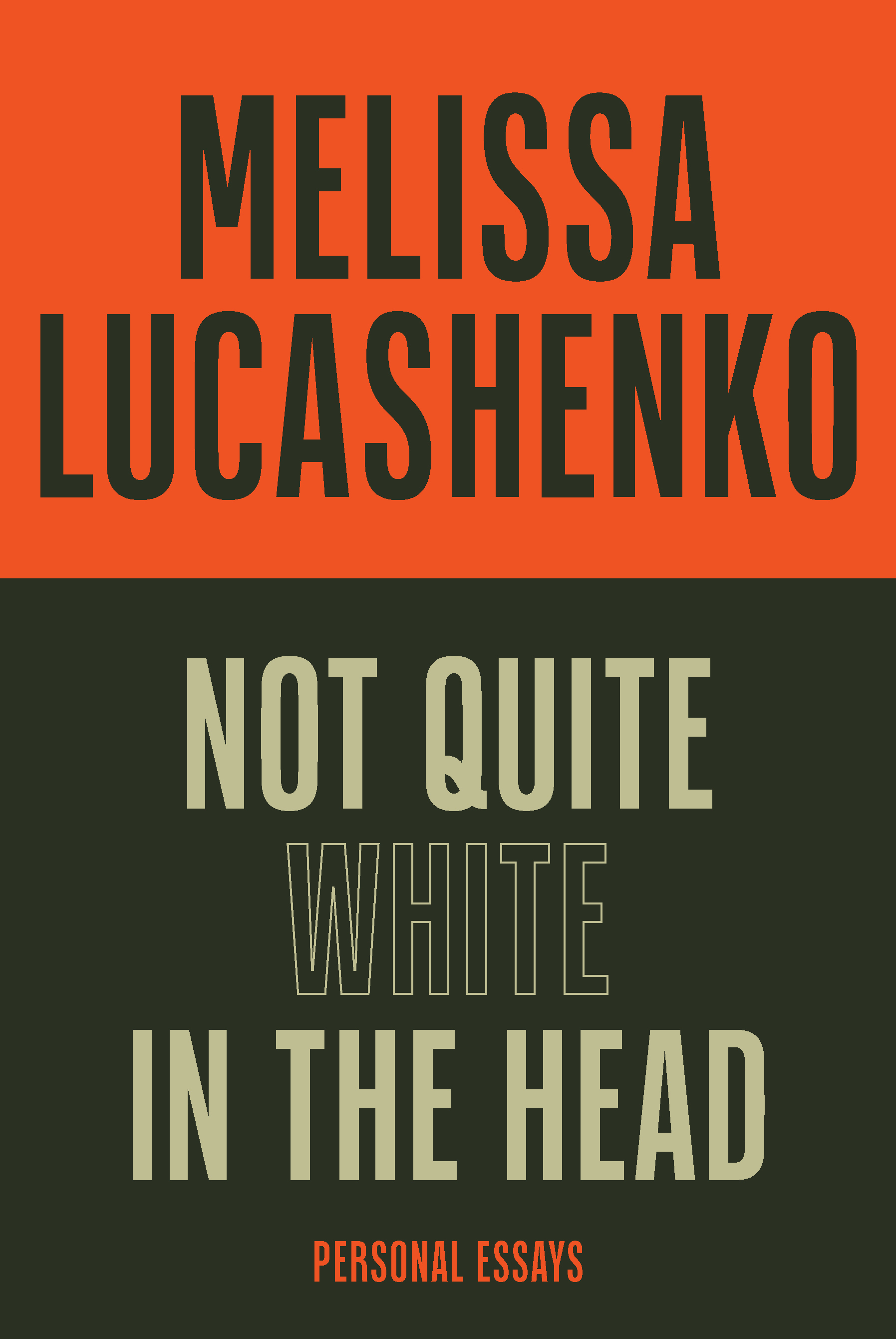
Not Quite White in the Head is out now. (Supplied: UQP)
Lucashenko explores a variety of topics in Not Quite White in the Head, including the lives of prisoners and the urban poor, being caught in a siege, meeting her writing idol, Aboriginal identity and Australian literature, and her approach to writing First Nations characters.
“[I’m always] trying to portray the possibility of love and laughter and land for us,” Lucashenko says.
“Because those things are extremely new in the mainstream Australian imagination.
“The idea of an Aboriginal person living the good life is still mindboggling to a lot of Australians.”
She says this is partly because of a separation that existed until recently.
“I’m from Queensland [and] until a generation ago, a really big slice of the Aboriginal population in Queensland were still living on missions. And so there was a kind of semi-apartheid up until the 80s.
“People would go out to work, but their lives would orbit around missions. And so, a lot of the white population in Queensland was cut off from Aboriginal life.
“You add an assimilation policy onto that, and you’ve got a whole lot of distance and a whole lot of racist mythology replacing real relationships in Queensland.”
Think you’ve never met an Aboriginal person? Think again
Lucashenko is sceptical, however, of the claim by some Australians that they’ve never met a First Nations person.
“99.9 per cent of the time they have,” Lucashenko said.
“But they’ve thought that they were white or Arab or Asian or, you know, anything except Aboriginal.”
On the flipside of that, her mother felt it safer to hide her Aboriginal identity, keeping it even from Lucashenko.
“It was a lot safer to be Russian,” Lucashenko said.
Narrating in her own voice
She’s recorded an audiobook as an Audible exclusive and, for the first time for one of her texts, it’s in her own voice.
But she faced some challenges.
“The guy that owns the recording studio went and had a heart attack … over the period of my recording,” Lucashenko said.
“And so, I had to finish it off in this little cupboard under a staircase at a different recording studio.”
Thankfully, he’s fine, and overall, Lucashenko enjoyed narrating the book.
“The good thing about narrating it was that I got to get the pronunciation right on every single word, but I also got to give emphasis to what I wanted to, in each essay, in each sentence. I got to deliver it as I wrote it,” Lucashenko said.
“I’ve learnt over the years that readers read the book that they want to read. They don’t read the book that I wanted to write.
“But when I’m narrating it, I get to diminish that distance between what I meant and what the reader experiences a bit.”
Not Quite White in the Head is out now.