
Water clocks, known as a clepsydra in Ancient Greece, were widespread for centuries, and the philosopher Plato is credited with first adapting one into an alarm in the 5th Century BC. He trapped air inside a vessel which water was flowing into; as the water increased so did the pressure, eventually resulting in a loud kettle-like whistle. Water clocks were also some of the earliest automated village bells, notes Champion. They used large basins of water which when drained would lead to the striking of a bell – one 12th Century chronicle records such a water reservoir being used to put out a fire.
The first mechanical clocks – meaning oscillating mechanisms that mark the passing of time, linked to an escapement that counted these beats – first arrived at the end of the 13th and early 14th Centuries.
“From very early they sometimes played tunes before the ringing of bells,” says Champion. By the later 15th Century, domestic wall clocks also began having alarms, set using a pin, he says. “The alarm was a bell chime, and later repeated striking of a small bell.”
Knocker uppers
Clockmaking advanced significantly in the 17th Century, says Handley, and there is evidence of people “mackling up their own alarm clocks when they go travelling, for example”, she says. The first known mechanical alarm clock was invented in 1787, although it was only after the first patent was registered in 1876 that production became more widespread. Still, these wound spring alarm clocks were both unreliable and too expensive to be widely available for most people.
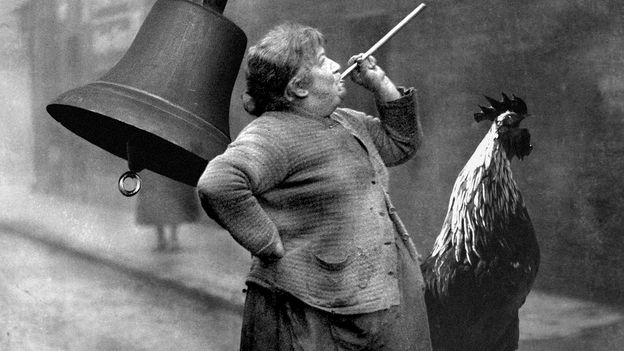
In the industrial revolution, though, sleep requirements changed for many people, and knocker uppers, with their rods, sticks and peashooters, became prevalent across the growing industrial towns of Leeds, Manchester, Sheffield and in east London.