
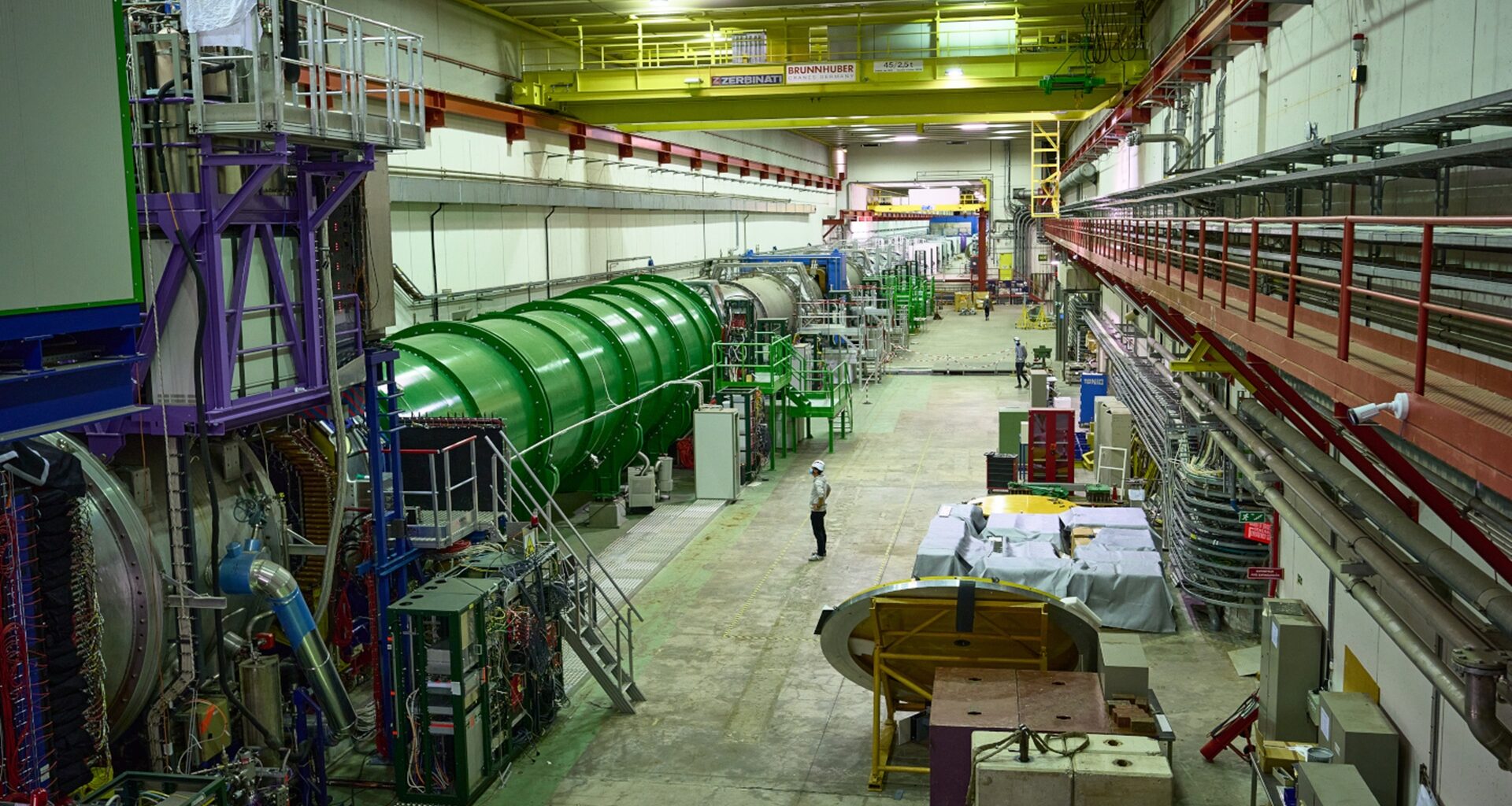
Researchers at CERN have just upgraded their understanding on one of the rarest particle processes ever observed, by using the NA62 experiment to study a kaon decay that occurs only once in about 10 billion events.
The NA62 Collaboration, which involves 33 institutions across 16 countries around the world, focuses on studying decays of particles made from strange quarks, or s quarks, called kaons.
Considered the third lightest of all quarks, kaons are short-lived particles and are created in high-energy collisions. The collaboration’s results have now reduced uncertainty in the measurement of a rare particle decay.
“This is the most sensitive dataset we have analyzed yet.” Joel Swallow, PhD, a lead data analyst at CERN, pointed out. “The fact that we can see clearly and measure with precision something so rare and elusive is a great success from a technological point of view.”
Inside the NA62 experiment
The team investigated an extremely rare process, in which a positively charged kaon decayed into a pion and a neutrino–antineutrino pair (K+→π+νν). Because neutrinos interact very weakly with matter, detecting this decay needs enormous datasets and highly precise detectors.
Neutrinos have no electric charge and an extremely small mass. They can escape the detector without leaving a trace. This is why researchers need to reconstruct the decay indirectly by carefully analyzing the remaining particles’ motion and energy.
According to the researchers, the decay is so rare that it occurs roughly once in 10 billion kaon events. The team had to therefore analyze enormous volumes of collision data to isolate a handful of candidate events from billions of ordinary particle interactions.
The experiment therefore generated an intense stream of kaons, a capability that has earned it the nickname “kaon factory.” The kaons are created by firing a high-intensity beam of protons from the Super Proton Synchrotron, the second-largest machine in CERN’s accelerator complex, at a beryllium target.
As a result, this produced nearly a billion particles every second. About six percent of these are kaons. Their decay products can be studied in great detail using the NA62 detectors.
Tracking kaon events
The researchers reportedly observed the process with five standard deviations of statistical significance in 2024. By adding data from 2023 and 2024, and applying improved machine-learning analysis techniques, the team has now further refined its understanding of the kaon decay.
They calculated that the decay occurs about once in every 10 billion kaon decays. Their new measurement is around 40 percent more precise than earlier estimates.
With the improved precision, the kaon decay matches theoretical predictions and limits possible physics beyond the Standard Model, which explains the interaction between the basic building blocks of matter.
“This stress test of the Standard Model is remarkable given the extreme rareness and theoretical cleanliness of the process that we investigated,” Giuseppe Ruggiero, PhD, NA62 spokesperson, said in a statement. “We have demonstrated once again that our current leading theory of nature has incredible predictive power.”
The NA62 Collaboration’s results were just presented at the 2026 La Thuile conference.