
Louth Bay resident Linda Davies has been visiting the beach for 50 years and says she has never seen two dead marine mammals on the same stretch of sand.
Warning: This article contains images of dead marine life readers may find distressing.
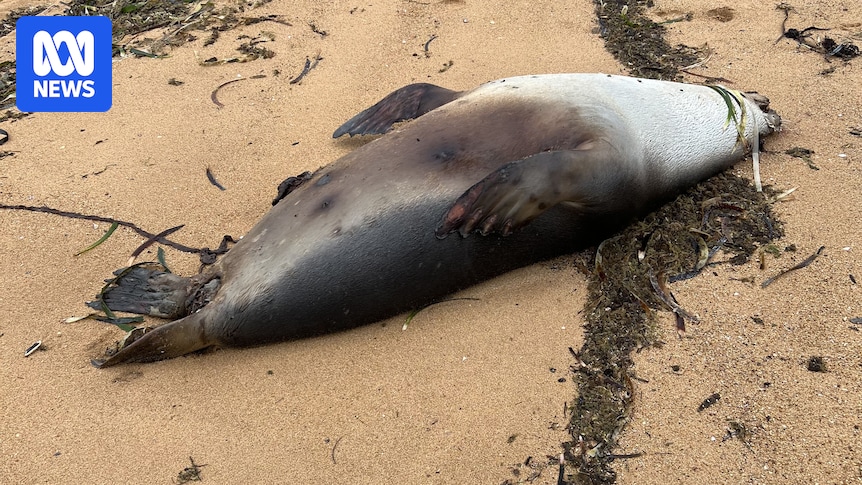
Last week she found an adult dolphin and an adult seal dead on a 6 kilometre stretch of beach north of Port Lincoln.
“I didn’t think too much about it until we got further down the beach and found a [deceased] female adult seal [near Poonindie],” Ms Davies said.
She reported the animals to the Department for Environment and Water (DEW) but was told samples would not be taken.
“It was a bit distressing because they already knew about the seal,” Ms Davies said.

A dead dolphin found on a Louth Bay beach on February 28. (Supplied: Linda Davies)
When she returned to the beach three days later, both creatures were still there and she wanted to know why the animals had not been collected or examined.
“The two animals were still just rotting on the beach … and the foam was really bad,” Ms Davies said.
“I don’t know if it was the algae bloom — I’m not saying it was, I’m not saying it wasn’t.
“I’m saying the procedures weren’t correctly done to actually know that.”
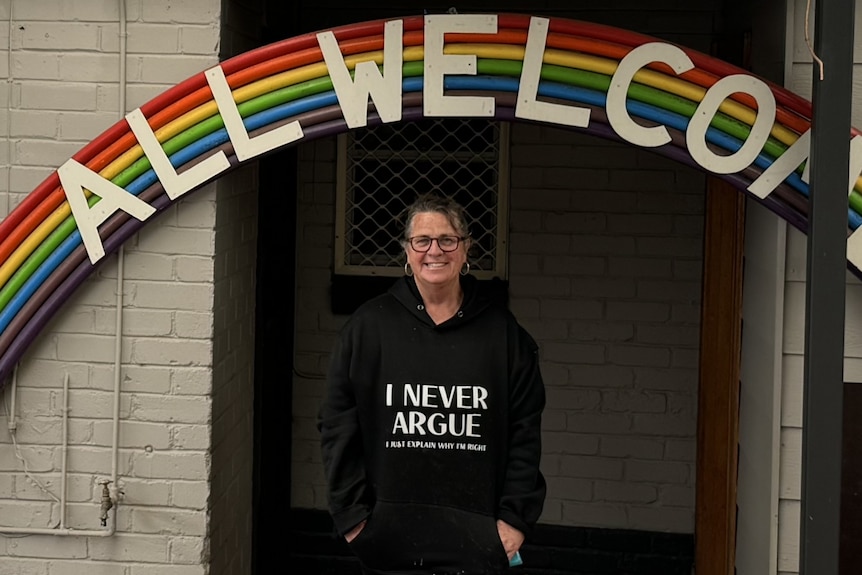
Linda Davies says she reported the dead dolphin and seal to the Department for Environment and Water. (ABC Eyre Peninsula: Emma Pedler)
A DEW spokesperson confirmed it received a report on February 26 of a dead seal at Todd River, near Poonindie, but said it was too decomposed for testing or collection.
They added that DEW also received a report of a dolphin carcass south of Louth Bay on March 1.
“Rangers attended the site but were unable to locate the carcass and believe it to have washed to sea,” the spokesperson said.
“While rangers may attend reported dead marine life, it is not always possible or required to take the carcass for necropsy or testing if it is too decomposed.
“In these instances, and depending on its location, a carcass is either buried or left to further decompose and wash back to sea.”
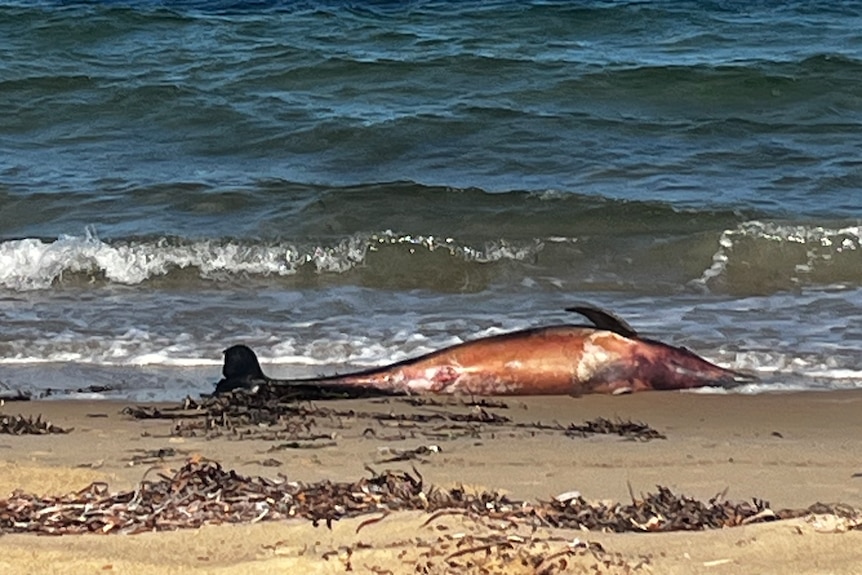
The Department for Environment and Water said the dolphin and sea lion carcasses were too decomposed for testing. (Supplied: Linda Davies)
The DEW spokesperson added that it received a report of a dead dolphin at North Shields, south of where the other carcasses were found, on February 9.
“[South Australia’s National Parks and Wildlife Service] rangers attended on the same day and noted that the dolphin carcass was too decomposed for a necropsy or testing,” they said.
Illness reported after seeing ‘yucky’ orange foam
In North Shields, north of Port Lincoln, citizen scientist Wendy Lambert has been regularly taking water samples since the bloom broke out last year.
She said in early February she noticed a small bloom near a reef south of North Shields.
“When you get big wave actions, you do get foam,” Ms Lambert said.
“But this was mucky foam and it wasn’t very pleasant … every day it became a little bit more. There was a dead dolphin and fairy penguin on the beach.
“They all got washed away, then we had a big wave action for a couple of days and had foam coming across the road.
“It was a yucky, orange foam. It was horrible.”
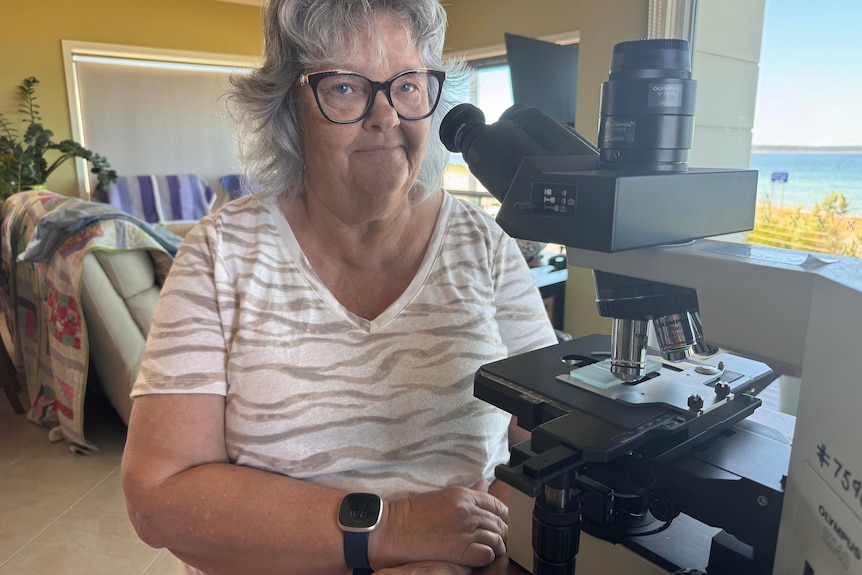
Wendy Lambert has been sampling the water near her North Shields home since the algal bloom broke out. (ABC Eyre Peninsula: Emma Pedler)
Ms Lambert said she felt unwell while the foam was present.
“I felt physically sick. I had a headache and felt physically ill. I had to come inside,” she said.
“It stayed in the seaweed and then it all went away.”
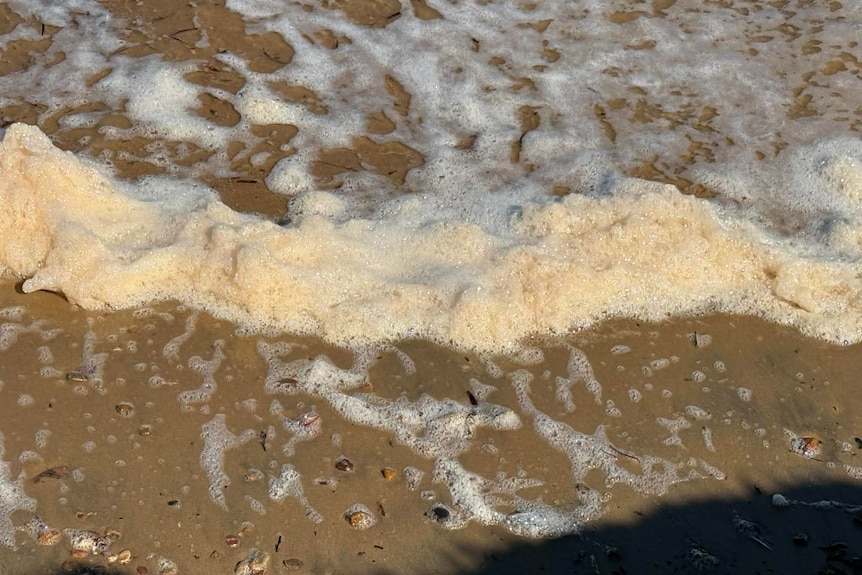
Foam at a beach in North Shields. (Supplied: Mark Wright)
Ms Lambert said she was hopeful the environment would bounce back from the algal bloom that is still impacting some SA coastlines.
“It’s the climate change stuff that I’m worried about,” she said.
“I think we will lose species, but I don’t think we know what we’re going to lose.”
The DEW spokesperson said the impacts of the algal bloom were being monitored.
“If you find sick or dead wildlife, including marine mammals and wild birds, call the Emergency Animal Disease Hotline on 1800 675 888,” they said.
“Report fish deaths to Fishwatch on 1800 065 522.”