
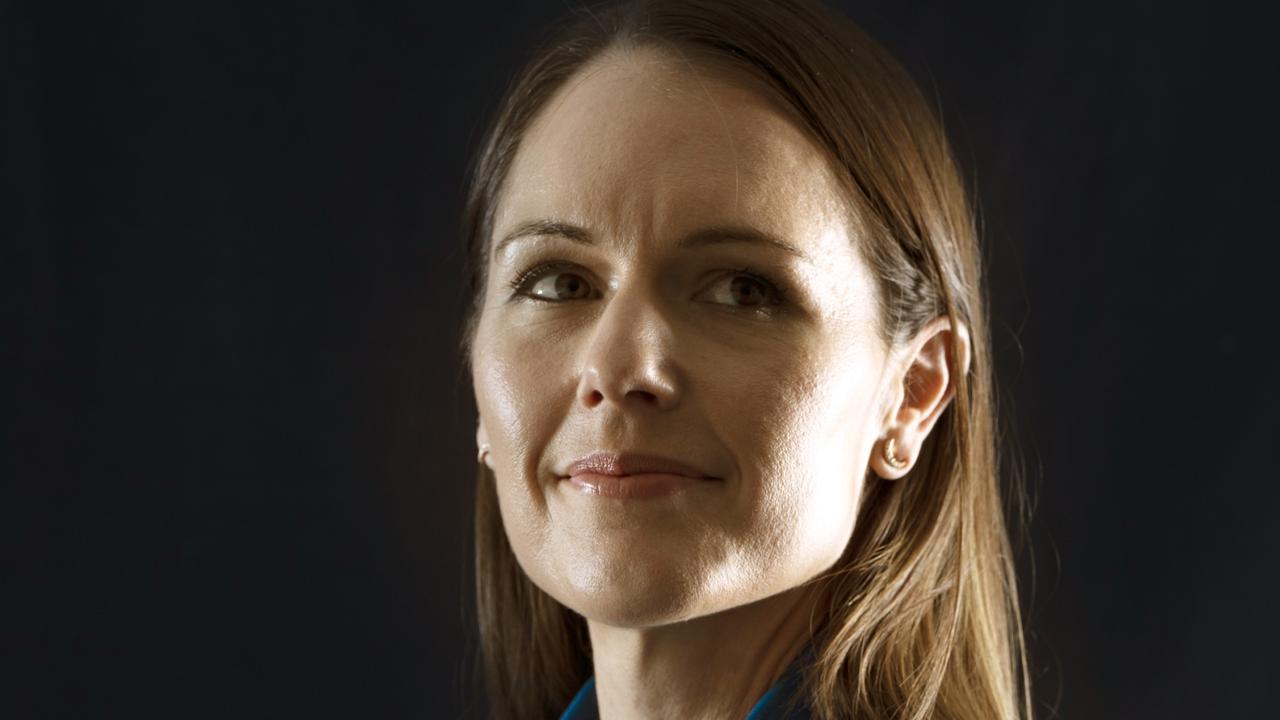
Australian of the Year Katherine Bennell-Pegg on blazing a trail for our space program, the trolls who questioned the honour, and closing her industry’s gender gap.
Stellar: This is the first in-depth interview you’ve done since being named Australian of the Year in January. Has the news sunk in yet?
Katherine Bennell-Pegg: I’m still as stunned as I was when my name was called out on stage on January 25, but it’s an incredible honour and it’s humbling and motivating. There were so many incredible finalists in that room and any one of us would have cheered on whoever was called to the stage. I encourage everyone to get on the Australian of the Year website and have a look at what they do. You’ll be so inspired.
Listen to the full interview on Something To Talk About below:
Stellar: You’re the first astronaut to officially represent Australia and the first Australian woman to receive professional astronaut wings. Which moment felt more surreal: qualifying as an astronaut or being named Australian of the Year?
Katherine Bennell-Pegg: Both are huge personally, but very, very different. Becoming an astronaut was a lifelong dream, something I’d hoped for but knew was very unlikely. I wanted to do my best in case the situation ever arose, and it did, but graduating as an astronaut is just the beginning.
Becoming Australian of the Year wasn’t something that was ever on my radar. It was one of the school mums, I found out, that nominated me – and it was such an honour. It’s been such an incredible journey and it’s really made me reflect on what it means to represent Australia. We’re so fortunate to live and grow and work on this country, and this makes me more determined than ever to use my platform to give back to the community.
Stellar: After your win there was some criticism online about how you shouldn’t have received the award because you haven’t been to space yet. How did that sort of commentary make you feel?
Katherine Bennell-Pegg: While it washes off me personally, it can be damaging for young people hearing it if they’re paying attention to it. It was disappointing. As women, we have to use so much energy up on considering and advocating for our gender, in addition to getting the job done. I found that while it’s important to do that, and I’m happy to do it, I have to limit the amount of time I spend on it because I have a job to do.
I can’t help the fact that I haven’t been to space. I didn’t nominate myself for Australian of the Year. But you know what? I’m going to use the platform gratefully, because it’s an important one to showcase. It’s easy to get caught up with the loud minority rather than focusing on getting the job done.
Stellar: You’re one of only 100 space-ready astronauts globally. How realistic is it that you’ll ever get to go to space?
Katherine Bennell-Pegg: I’m in the unusual situation of being an astronaut in a country without a human spaceflight program, so my focus right now is really here on the ground, making sure I remain as match fit as I can should an opportunity arise. It would be a decision for Australia, should Australia choose to take that.
Being an astronaut is a life of uncertainty, regardless of whether a mission is planned for you right away or not. It’s uncertainty in the selection process, the training, if you’ll pass, when your mission will be, what happens in space. So you’re selected for your ability to handle uncertainty, and then trained further on how to be resilient and perform through it. So I just see my situation as like another layer of the onion, the uncertainty onion, that is the life of an astronaut.
Should the opportunity ever arise, of course it would be incredible to have the chance to represent Australia in space. Many people think that I’ve already been to space, and I’m like, “Oh no, you wouldn’t have missed it.” Because it ignites a nation when someone goes up to space with [specialised equipment] into every technical field, and experiments that reach into the heart of every classroom.
Listen to the full episode below:
In April last year, pop star Katy Perry and journalist Gayle King, along with four other women, joined a Blue Origin rocket and went to space for 10 minutes.
It was the first all-female flight crew in more than six decades, but the flight received a lot of backlash, with people calling it a vanity project for celebrities and a waste of money in the midst of a cost of living crisis. What are your thoughts on it?
A lot of the women on that crew, they’re not professional astronauts, but they’re successful in their own right. I think that in itself sends a message. I’ve grown pretty thick skin. People can call me what they want. I’m busy being an astronaut; I won’t be calling them back.
You have to learn to put your shield up when you’re in a public position so that you don’t absorb too much of the good as well as too much of the bad, because otherwise you can be prone to narcissism or leave yourself vulnerable. You have to find your own steady centre. So I think that when women get to a position in which they are visible, we have a duty to help show that it is possible to get there, and that the journey to get there is worth it.
Today is International Women’s Day. I imagine there have been plenty of times when you have been the only woman in the room. Have you seen much progress in this area throughout your career?
For most of my career I’ve been the only woman in the room, to the point that I stopped noticing. I first realised that I didn’t fit the stereotype when I went to university. I enrolled in an engineering degree because it had the word “space” in the title, but I’d never used a drill or written a line of code. The boys in the class didn’t want to be in the group projects with the girls because they thought we didn’t know how to use the drill. In my case I didn’t, but I sure figured it out quickly.
Early in your career when you’re not yet confident in yourself and you’re underestimated, it’s really undermining. As I developed as an engineer, I grew more confident, and it became less of an issue. When I came back to Australia [after living overseas], about six years ago, to work at the Australian Space Agency, it was the first time I’d had a woman as a boss. I also saw there were a number of women in senior positions in the Australian space industry, and that gave me hope that we have the chance to grow our space industry in a more diverse way than I’d seen overseas.
I would say, though, that when it was announced I was going to train to become an astronaut, a lot of young women at [the nearby] Adelaide University came to speak to me, and it made me realise the challenges are still there. They’re going through the same challenges I did when I was younger.
You met your husband Campbell Pegg, a fellow spacecraft systems engineer, when you were both at university. How do you navigate having such big careers and your family life with your daughters, Clara, 9, and Hazel, 7?
It’s actually been an advantage that we’re in the same field. When we started out, we were on similar salaries, and when we had kids we took turns taking time off. We’ve been able to share that juggle in a way that has meant both of us have been able to move forward with what we do.
There are actually a lot of space couples here and around the world because the industry is such a bubble. We both worked at the Australian Space Agency at one point, and we’d find ourselves up at 2am brainstorming requirements for a robot on a whiteboard, or negotiating deals with NASA while throwing snacks at our kids off screen.
Twelve months from now, as you’re reflecting on your time as Australian of the Year, what would be your biggest hope of the impact and the legacy that your reign might leave behind?
Seven out of 10 primary-age kids in Australia say they would go to space if they could. I want each of those kids to know that no matter where they come from, no matter what their background or gender is, if they’re willing to give it a red-hot go, then there’s no insurmountable reason why they can’t pursue their dreams in space or STEM or to be an astronaut, or whatever they wish to pursue.
I’ve been out and about across the country and I’m going to get out even more this year with this wonderful platform. And I can tell you that talent and curiosity are everywhere. Aspiration isn’t, because opportunity isn’t. So I want to help change that. Right now we’re seeing the lowest ever enrolments in Year 12 maths and physics. We’re seeing gender gaps open early and persist through high school and again at university.
I want to start to move the needle on that, and for everyone to be able to see themselves in this future. In order to do that, we need to have a robust conversation about space in this country. We’ve never really done that – about what it means, what its purpose is. It’s not about going up there to take a selfie or to launch a suitcase of cash and a rocket to blow up above the atmosphere. It’s about supporting everything here on Earth. The work you do up there makes breakthroughs for life down here. So there are lots of things I’d like to see by the end of the year. I look forward to working to deliver them.
To find out more about Katherine Bennell-Pegg, visit space.gov.au. Listen to the full interview with her on a new episode of the Stellar podcast, Something To Talk About, out now.