
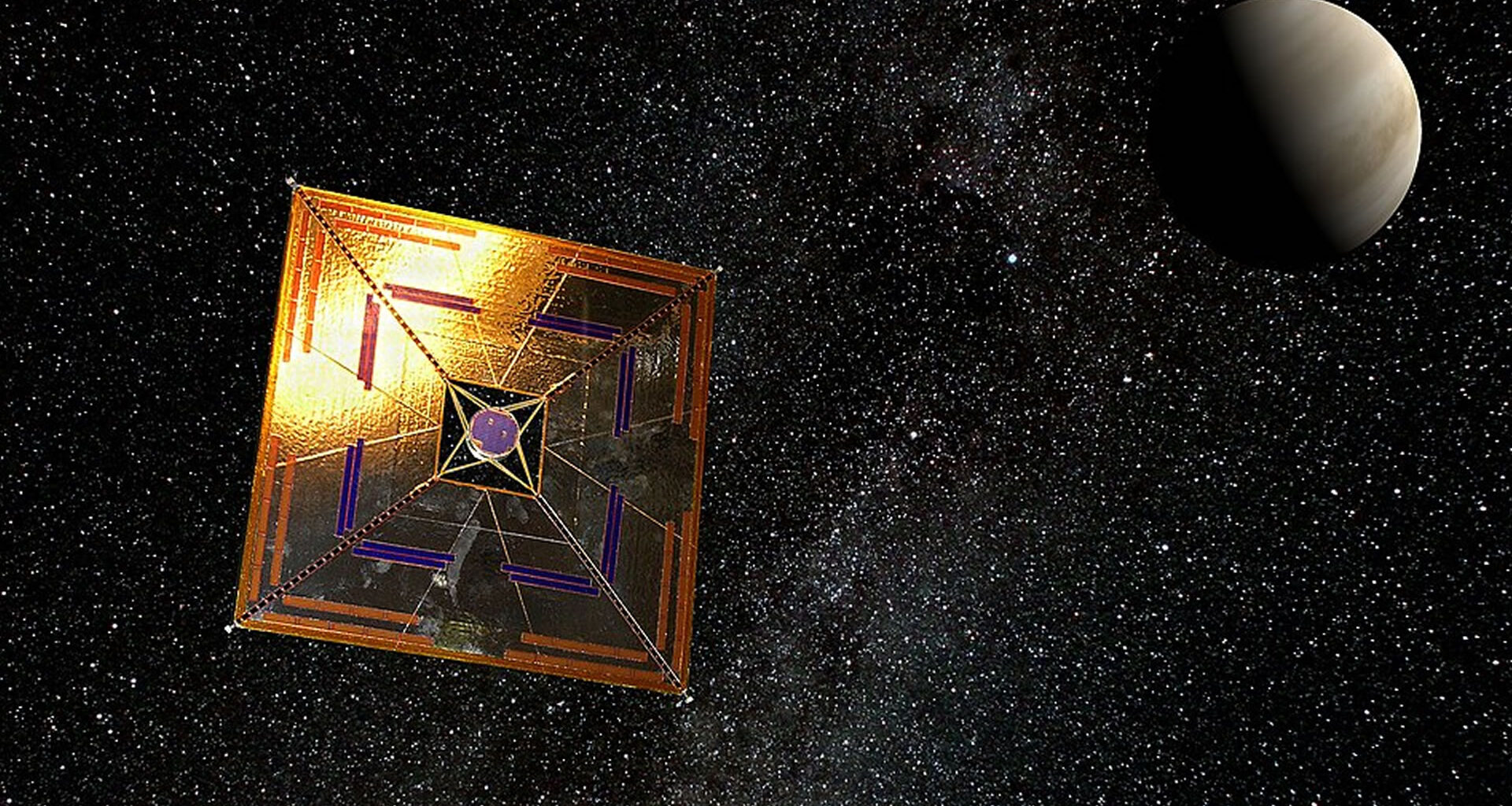
Researchers from Tuskegee University, Alabama, have developed a new photonic crystal (a kind of nanostructured material) light sail. This new sail could help solve problems of more conventional metal-coated polymer solar sails that tend to absorb light and degrade as they heat up.
As you are likely aware, most spacecraft today rely on chemical rockets for propulsion. These require fuel, and fuel is heavy, which limits the effective range (and size) of spacecraft.
Light sails, on the other hand, are designed to propel a spacecraft using radiation pressure. These work by reflecting light from their surface, creating a small force that propels the craft forward.
So, if you shine a powerful laser at a reflective sail, the photons bounce off and push the sail forward. You can liken it to wind pushing a sailboat, except the “wind” is actually photons.
This idea is the basis of projects like “Breakthrough Starshot” or NASA’s IKAROS, both of which are designed to accelerate tiny spacecraft to a fraction of light speed using photon power.
However, designs like these tend to consist of thin plastic films with a metal coating (usually something like aluminum). While effective, they tend to absorb some of the light that hits them, which is converted into heat.
Solving solar sail woes
If combined with a powerful directed laser, this could result in the sail melting over time. This can be overcome by adding more reflective material to the sails, but this adds extra weight (and cost to launch the craft).
To help solve this, the Tuskegee team wanted to discover if replacing the metal coating with a different material might help. They hit upon the idea of using photonic crystals that can control how light moves through them when hit.
The crystals in question contain tiny repeating patterns smaller than the wavelength of light. In this case, the team explains, the crystals are made up of three main components.
The first are germanium pillars, which have a high refractive index. The second is a series of air holes with a low refractive index, and the last is a polymer matrix to act as the base material.
All told, this new nanoscale structure is between about 100–400 nm wide, or about 1/1000 the thickness of a human hair. This polymer structure creates something called a photonic band gap.
This is similar to how semiconductors block certain electron energies, and a photonic band gap blocks certain wavelengths of light. In practice, this means that laser light is strongly reflected (creating thrust), with light from other sources (like the Sun) simply passing through.
90% efficiency achieved
During testing, the team found that a 1m2 piece of the material was able to achieve around 90% reflectivity at 1.2 µm wavelength from a 100kW laser. That is, the team explains, good enough for experimental propulsion systems.
This should result in continuous thrust, resulting in a potential velocity of hundreds of meters per second in around 1 hour. That isn’t interstellar speed yet, but it’s a useful demonstration.
“By designing a narrow photonic band gap aligned with the propulsion laser frequency, the proposed sail can stay mostly transparent to ambient solar radiation while maintaining high reflectivity in the specific operating band,” Dimitar Dimitrov, an assistant professor at Tuskegee University, explained.
“A key contribution of this work is demonstrating the feasibility of constructing multi-dielectric photonic crystal structures with controlled nanoscale features. The results show that these can be engineered to combine low mass, strong wavelength selectivity, and scalable fabrication potential,” he added.