
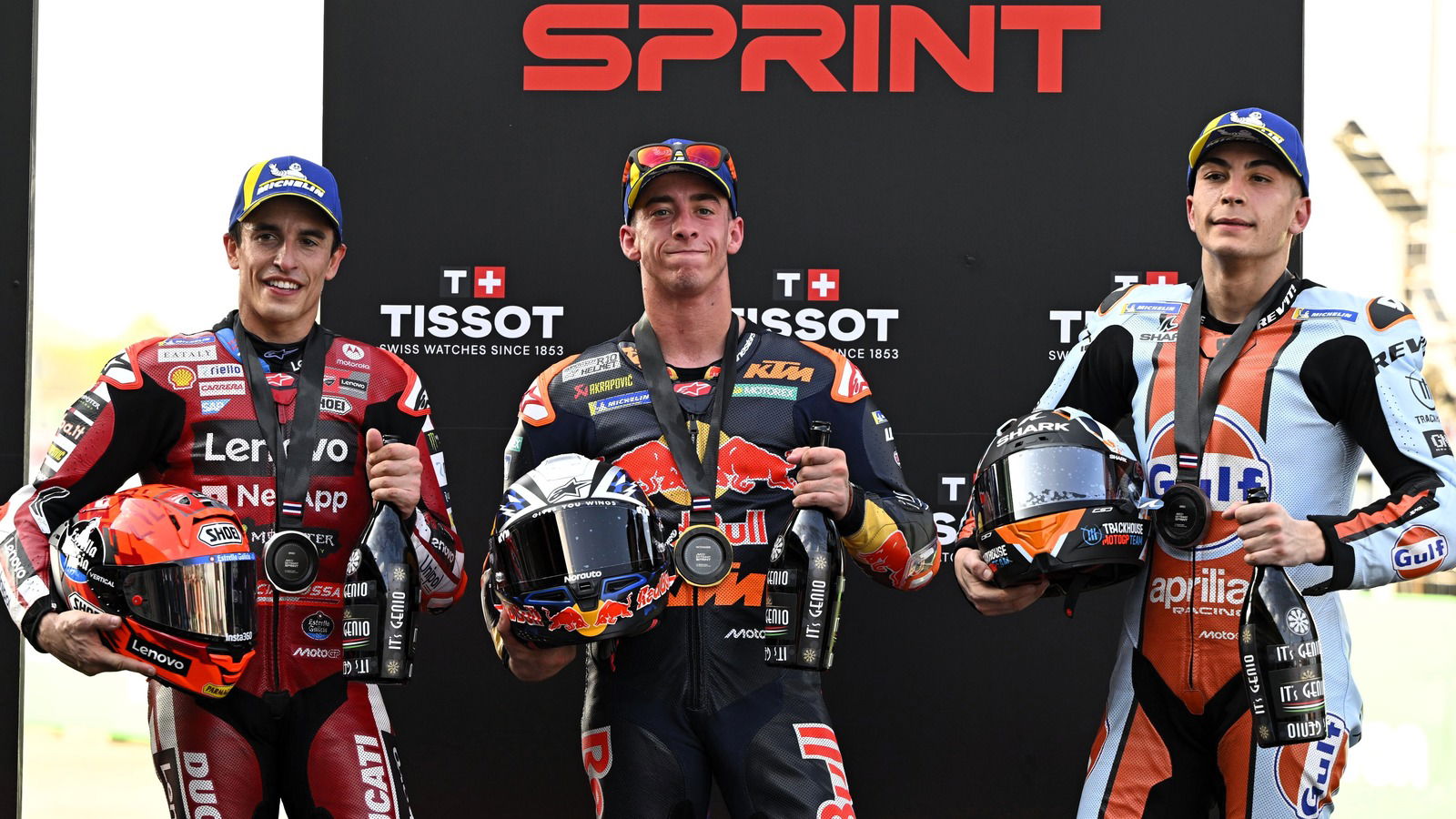
Pedro Acosta finally did it.
After a meteoric rise through the Moto3 and Moto2 ranks, the young Spaniard broke his MotoGP victory drought in the opening event of his third premier-class season.
Except, officially at least, he didn’t.
That’s because Acosta’s victory – after a thrilling battle and then penalty for Marc Marquez – came in the Saturday sprint race, not the Sunday grand prix, where he finished runner-up to Aprilia’s Marco Bezzecchi.
The debate over whether victory in the half-distance MotoGP Sprints should be credited as grand prix wins is nothing new.
Article continues below ADVERTISEMENT
Article continues below ADVERTISEMENT
Alex Marquez became a sprint winner at Sepang 2023, then had to wait until Jerez 2025 to be credited with a premier-class grand prix victory.
Looking on the positive side, it allowed Marquez to celebrate two ‘first’ MotoGP wins.
Acosta will be hoping to do the same, without such a long gap in between.
Then there’s KTM, which has taken its last two MotoGP ‘wins’ in sprints – at Jerez 2023 and now Buriram 2026.
So officially, the statistics show the RC16 hasn’t won in MotoGP since Miguel Oliveira at the 2022 Thai Grand Prix.
Article continues below ADVERTISEMENT
Article continues below ADVERTISEMENT
KTM Motorsport boss Pit Beirer backed the distinction between sprint and GP wins ahead of the introduction of Saturday races in 2023.
“I’m good with that. Sunday is showtime and that is the GP winner and Saturday is part of our weekend: you get some benefit for it, you get some points for it, but the GP winner is Sunday,” Beirer told Crash.net.
As the manufacturer most affected, it’s not known if Beirer’s stance has softened, but the Sprint/Grand Prix separation looks even stranger after multiple restarts marred the Buriram Moto2 Grand Prix.
Putting aside a lap count error that originally saw full points awarded rather than half, the following outcome remains:
Manuel Gonzalez was awarded a grand prix victory in a seven-lap restart, after completing a combined total of 10 racing laps on Sunday: 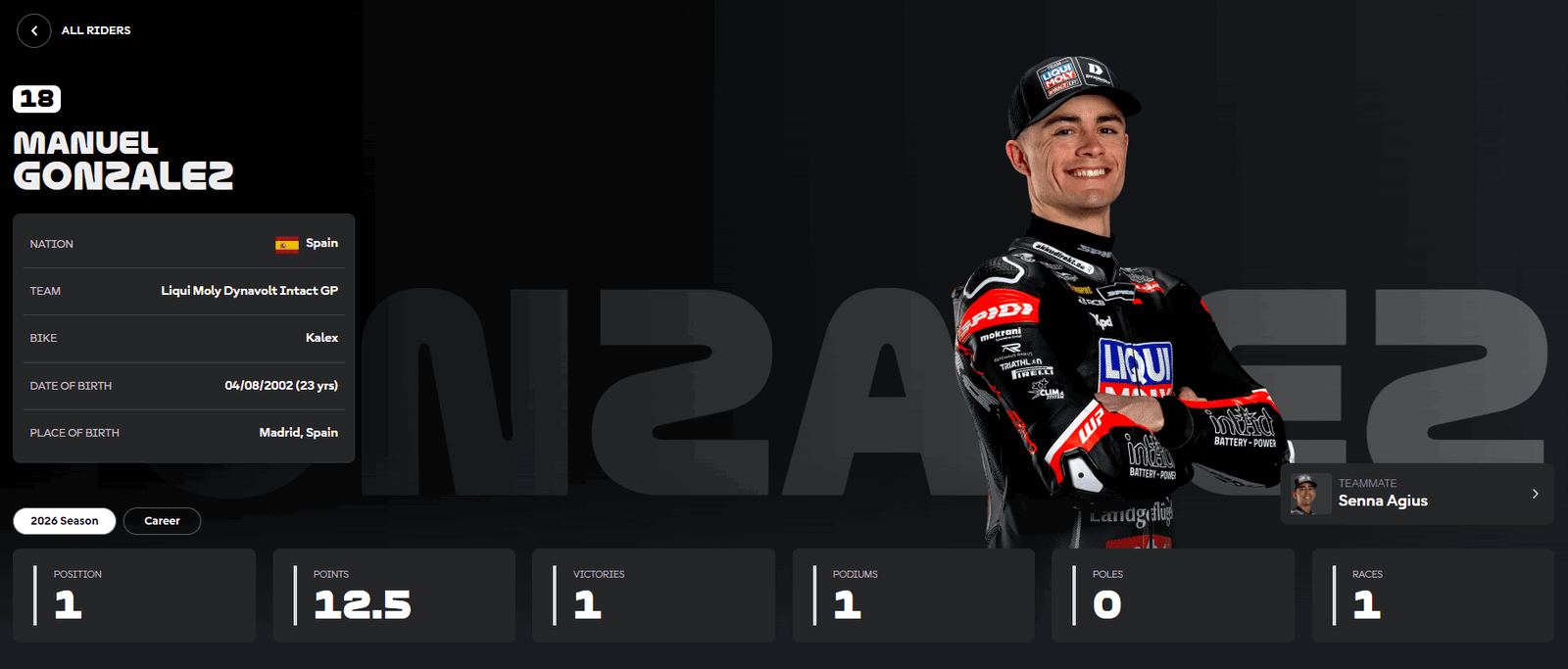
Manuel Gonzalez official 2026 Moto2 stats (MotoGP.com)
Article continues below ADVERTISEMENT
Article continues below ADVERTISEMENT
Meanwhile, Pedro Acosta is not a MotoGP winner, despite completing 13 consecutive racing laps in the Sprint: 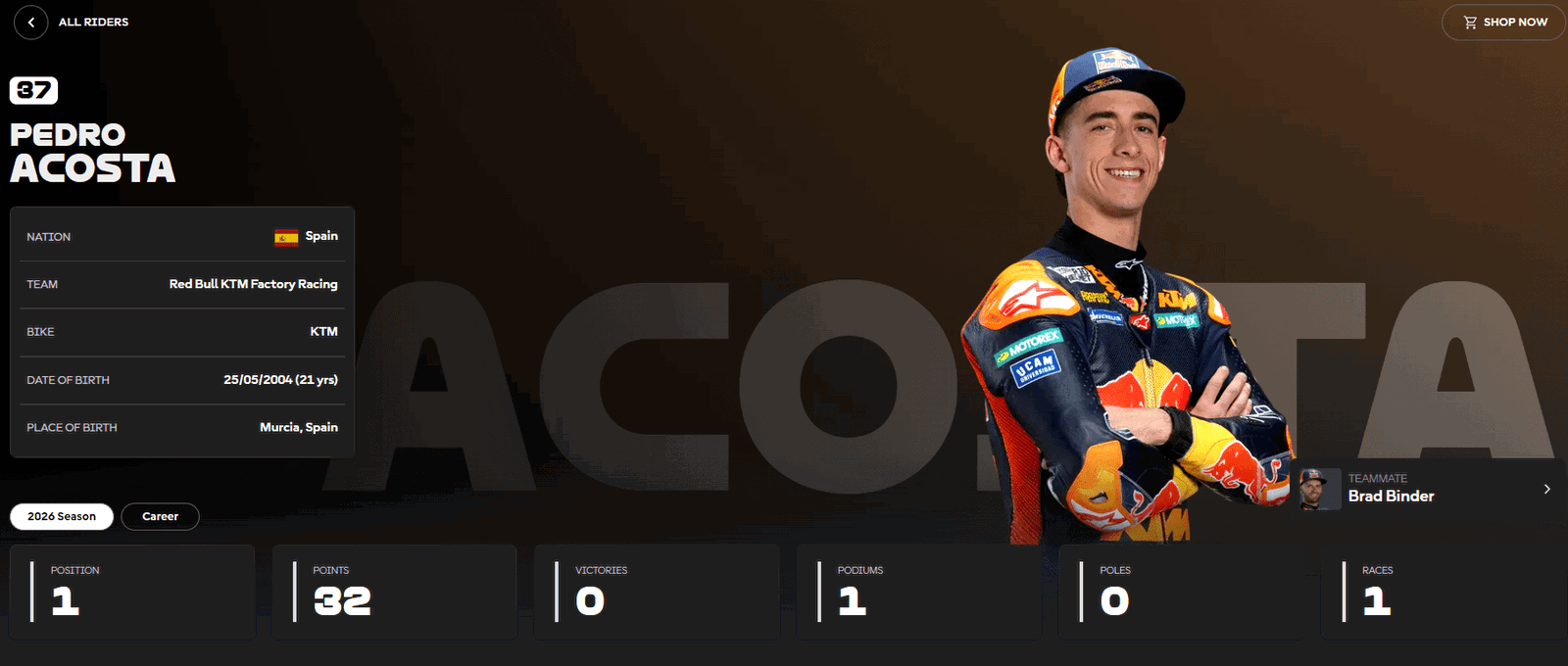
Pedro Acosta official 2026 MotoGP stats (MotoGP.com)
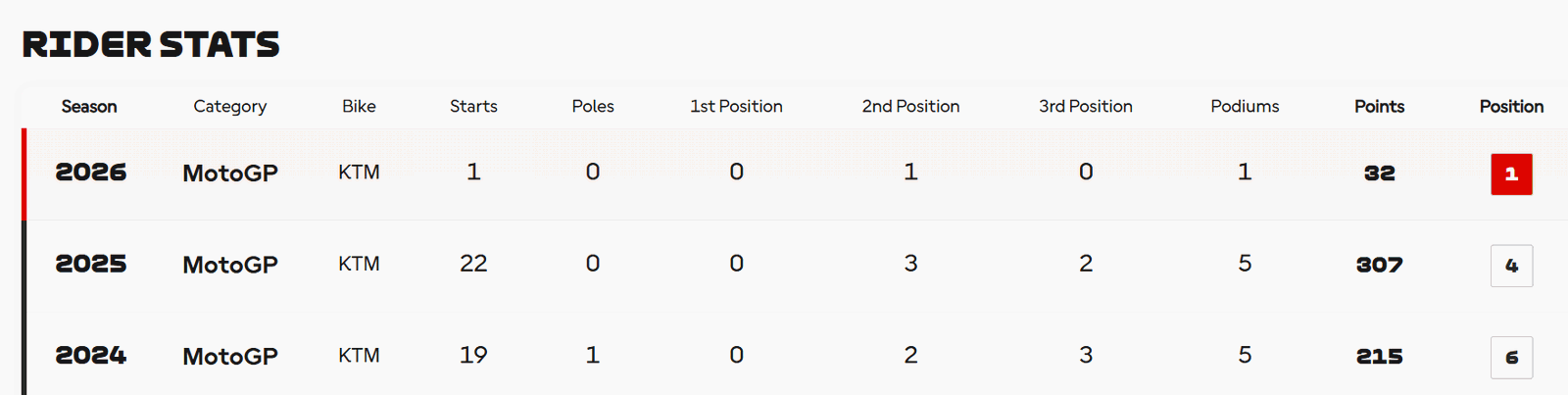
Pedro Acosta official 2026 MotoGP stats (MotoGP.com)
The Moto2 lap-count error only heightens the contrast, highlighting that, under such circumstances, only 50% of the original distance is needed to score full grand prix points.
Gonzalez and the other top 15 Moto2 scorers were originally given full points because the opening lap of the second restart was wrongly included in the calculations.
Before the correction, that ‘extra’ lap gave a total of 11 Moto2 racing laps on Sunday (3+1+7), meeting the combined 50% distance for full points, since the original race was due to be 22 laps.
Article continues below ADVERTISEMENT
Article continues below ADVERTISEMENT
Yet the day before, Acosta completed 50% of the full MotoGP grand prix distance in the sprint (13 laps vs 26 laps). But sprints only count for half points.
Unlike F1, sprint races are part of every MotoGP weekend, featuring the same machinery, riders, qualifying order (penalties aside) and technical rules as a grand prix (albeit a revised fuel limit).
The only difference is race distance. But as the Buriram Moto2 Grand Prix highlights, ‘Sunday’ races shorter than a Sprint can meet ‘grand prix’ winner status.
Rather than asking fans not to believe their eyes, why not keep things simple and credit each valid MotoGP race as a grand prix, while continuing to use distance to determine points?
The Sunday grand prix would remain more significant than the ‘Sprint Grand Prix’ due to the extra points on offer.
Article continues below ADVERTISEMENT
Article continues below ADVERTISEMENT
Classifying Sprint GPs as official GP wins would, however, mess up rider vs rider historical data.
But points-per-season records have already been blown out of the water by the addition of Sprints, while changes to the MotoGP calendar size make most ‘now and then’ comparisons largely meaningless.
The inaugural 1949 grand prix season featured just six rounds. There were only ten rounds as late as 1980. Now there are 22 events.
On the flip side, riders used to compete in multiple classes, giving the current competitors an uphill challenge in terms of total world championship titles.
How do you feel about MotoGP Sprints not being official MotoGP wins? Leave your comments below…
Article continues below ADVERTISEMENT
Article continues below ADVERTISEMENT
Subscribe to our MotoGP Newsletter