
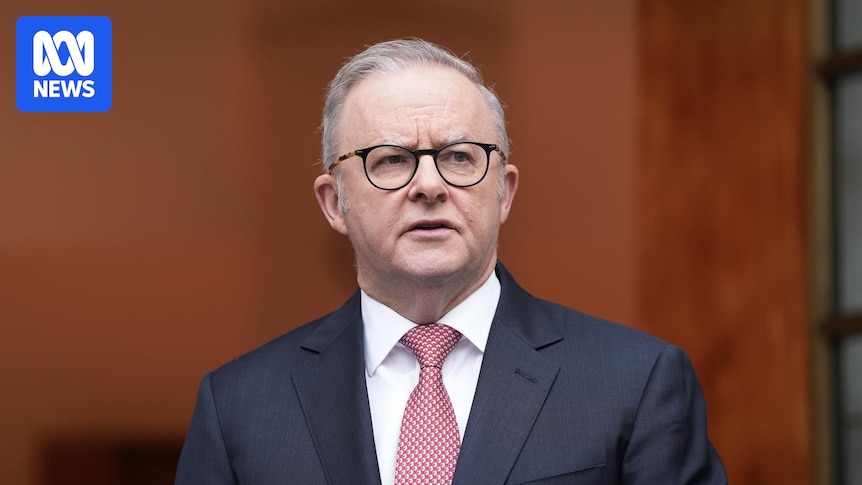
Australia will provide military assistance to Persian Gulf states impacted by Iranian missile and drone attacks.
Prime Minister Anthony Albanese said the Australian Defence Force will deploy an E-7A Wedgetail aircraft to the United Arab Emirates to protect and defend the region.
Iran war live updates: For the latest news on the Middle East crisis read our blog.
Last year, Australia sent a Wedgetail to Ukraine to help in the war against Russia, where it was deployed 45 times in three months.
Mr Albanese said the Wedgetail provided “long-range reconnaissance capabilities” which would “help protect and secure the airspace above the Gulf”.
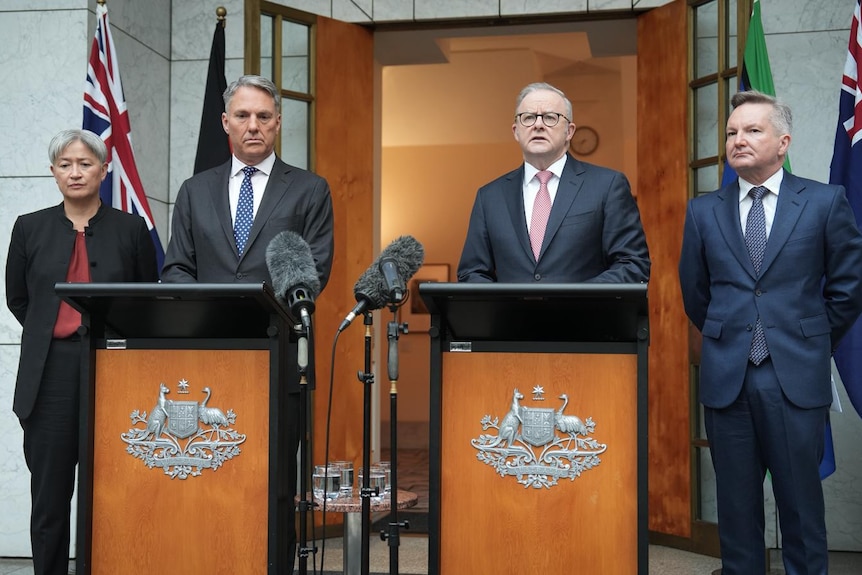
The prime minister has reiterated that Australia will only participate in a “self defence” capacity. (ABC News: Matt Roberts)
Eighty-five personnel will be deployed, leaving Australia today.
They will be operational by the end of the week for an initial four-week period for the “collective self-defence of Gulf nations”.
The government will also provide the UAE with medium-range air-to-air missiles.
Read more about the Iran war:
“The first priority of my government is and always will be to keep Australians safe. There are around 115,000 Australians in the Middle East, around 24,000 of those in the UAE,” Mr Albanese said.
“Helping Australians means helping the UAE and other nations to defend themselves.
“We are not protagonists. What we are doing is providing for the defence of the UAE and of Australian citizens.”
The opposition has not yet officially backed the deployment, but Coalition frontbencher Dan Tehan told Radio National: “Absolutely it’s the right thing in principle for Australia to be doing.”
“Obviously, we want to be doing our bit to keep the region safe and obviously bring this conflict to an end,” he said.
‘Bowing to pressure from the US’
But Liberal frontbencher Andrew Hastie sounded a more cautious note when asked about the announcement this morning.
“I’d like a briefing on what’s going on,” he said.
“I am really worried about the long-term impact [of this war] on our region, particularly given we import so much of our fuel.
“I’m worried about farmers, I’m worried about truckies, I’m worried about small businesses that rely on cheap access to fuel.”
The Greens slammed the commitment, with its foreign affairs spokesman David Shoebridge accusing Australia of “bowing to pressure from the United States”.
“This is Australia now actively involved in Donald Trump and Benjamin Netanyahu’s illegal war. We don’t have an alliance with the UAE,” he said.
“We know what this is for; this is to free up US military assets for their attack on Iran.”
Mr Shoebridge also suggested that more Australian military personnel could easily be drawn into the war.
“Look at the mixed messages coming out of Washington. Look at the response from Iran. This is not a ‘Boys home by Christmas’ proposition; this is a lengthy deployment, and this is likely just the start of it.”Loading
Defence Minister Richard Marles said the government would not take offensive action against Iran.
“What this aircraft will be doing is very similar to what it has been doing in recent times in Poland in respect to the defence of Ukraine,” he said.
“These are defensive weapons, I want to make that clear.
“The announcements that we are making today, all of this is in the defence of the Gulf countries. I want to be really clear about that.
“It is for the defence of the countries of the Gulf, in particular the UAE, where there are significant numbers of Australians who reside.”
Malcolm Davis from the Australian Strategic Policy Institute said the Wedgetail would “contribute to helping coordinating Gulf State missile defences to counter on-going Iranian missile and drone threats” and would “most likely support US and Israeli missile defence operations as well.”
“It will also likely fill an important gap in US missile defence capabilities after Iran destroyed two important radars in the Gulf States that help coordinate US Patriot and THAAD missile defence systems.”
The government hasn’t said how many air-to-air missiles it will send to UAE.
The government announced last year it was buying 200 or so AIM-120D-3 “supersonic air-launched tactical missiles” but it’s not clear if sending any of them, or drawing from stockpiles of older weapons.
Dr Davis said the missiles would help the UAE Air Force to “undertake air and missile defence, particularly against drone threats.”
But he said the announcement also “highlights the challenge of low stockpiles of guided weapons, which is an issue for Australia as well.”
“The US is also running low on guided weapons, and so the Iran war has highlighted a risk for the US and its allies in terms of insufficient stockpiles of guided weapons, be they land attack, anti ship or air to air missile system,” he said.
“Australia will need to carefully balance commitments overseas vs operational requirements here, and this will be made easier if government agrees to increase defence spending to allow additional stockpiles to be acquired.”
Iran escalates attacks on neighbours
Foreign Minister Penny Wong said Iran’s attacks on neighbouring countries had escalated overnight.
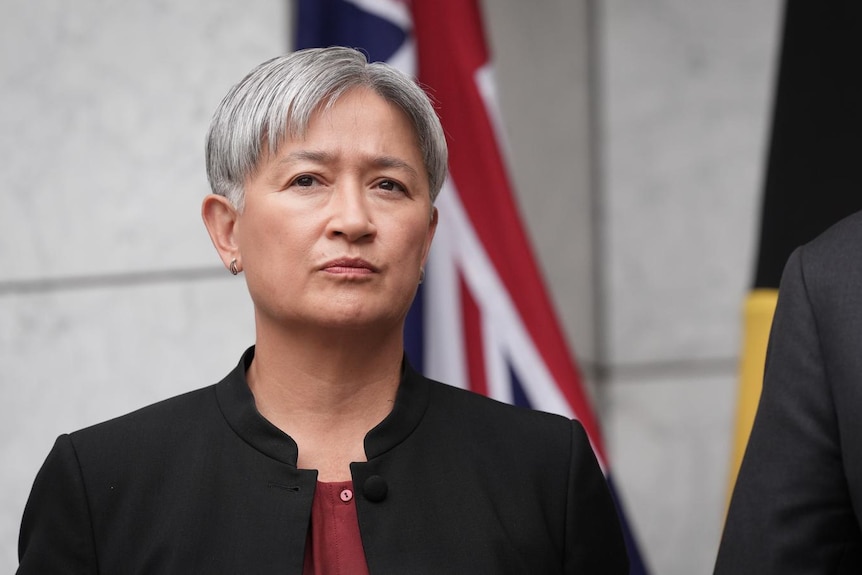
Penny Wong has warned Australians who want to leave the region to do so as soon as possible. (ABC News: Matt Roberts)
She urged Australians in the region who want to leave to attempt to return to Australia on commercial flights.
“Do so now. Do so while commercial flights are still available, however limited,” she said.
More than 27,000 flights to and from the Middle East have been cancelled since February 28.
All six Gulf States, including Oman, the UAE, Saudi Arabia, Bahrain, Kuwait and Qatar, have been impacted by Iranian strikes since the war began, which have targeted civilian infrastructure, including airports.
PM not considering escort for oil tankers
Mr Albanese said Australia was not considering providing security for oil tankers stranded in the Strait of Hormuz due to the conflict.
About 25 per cent of the world’s oil travels through the region.
France has deployed warships to the region to escort ships and has suggested further international efforts would be required.
But Mr Albanese said he was focused on the assistance provided to the Gulf states.
In 2019, Australia joined a US-led mission in the Strait of Hormuz to protect freedom of navigation in the region, which was at risk due to tensions with Iran.
Energy and Climate Change Minister Chris Bowen said on Tuesday that Australia’s diesel and petrol supplies remained “secure” at this time.
“We have as much diesel in Australia today as we had before this crisis began,” he said.
Mr Bowen said localised fuel shortages were being driven by a “big increase” in demand, rather than supply issues, noting all expected deliveries had arrived on schedule in recent days.
“There is no need for panic buying,” he said.
“I do have a great deal of concern and empathy for those farmers in particular who, because of the situation with the supply chain in regional Australia, are having difficulty getting diesel.
“This is managing a huge spike in demand, not an impact on supply at this time.”
Mr Bowen will convene a meeting of farming, trucking and other peak groups along with oil companies to “ensure the flow of communication between those groups is as strong as it can be”.
Loading…