
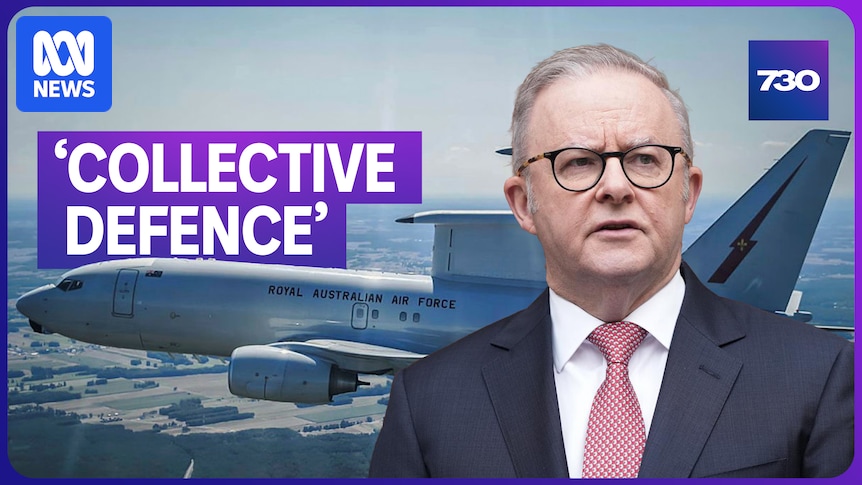
JACOB GREBER, POLITICAL EDITOR: Sucked into the vortex of an unpredictable war ignited by Australia’s mercurial ally.
ANTHONY ALBANESE, PRIME MINISTER: Iran’s reprisal attacks continue to escalate, already at a scale and depth we haven’t seen before. Twelve countries across the region, from Cyprus through to the Gulf are continuing to be targeted.
This growing wave of dangerous and destabilising attacks from Iran puts civilian lives at risk, of course, including Australian lives, of which there are more than 20,000 people based in the UAE.
JACOB GREBER: Cabinet this morning announcing the deployment into the Gulf of a long-range surveillance aircraft, air-to-air missiles and more than 80 military personnel after a request from the United Arab Emirates (UAE) for assistance.
ANTHONY ALBANESE: We are not protagonists. What we are doing is providing for defence of the UAE and of Australian citizens.
JACOB GREBER: But that does not hide the reality that it’s been triggered by unexpected fallout from a US and Israeli led conflict against Iran that began on a questionable legal basis – backed by a shifting set of White House justifications.
PROF. DON ROTHWELL, AUSTRALIAN NATIONAL UNIVERSITY: Certainly, Australia’s engaged in an armed conflict by committing this military asset and these ADF personnel, and as such, in common parlance, yes, we are at war.
JACOB GREBER: ANU international law expert Don Rothwell says Australia’s involvement in supporting Gulf states is consistent with the principles of collective self-defence.
In this case, against Iran’s retaliation towards nearly a dozen states in the region.
DON ROTHWELL: These other countries have been brought into the conflict without any legal basis or justification for Iran’s response. Those countries themselves can legitimately exercise self-defence from these Iranian attacks.
That’s entirely consistent with the United Nations Charter. There’s nothing illegal or improper about that, and the way in which the original conflict commenced on the 28th of February needs to be seen quite distinctively from the situation that’s evolved in the last few days.
JACOB GREBER: The dangers for the Australian service personnel are real.
DON ROTHWELL: Any military force, any state that engages its military force in an armed conflict and becomes a combatant in a conflict is a legitimate target for the purposes of the parties to the conflict. Australia is no longer a military neutral.
JACOB GREBER: While the Coalition is supportive.
ANGUS TAYLOR, OPPOSITION LEADER: We must stand together against a regime like this.
JACOB GREBER: The Greens have been scathing.
DAVID SHOEBRIDGE, GREENS SENATOR: Every asset that Australia puts into the theatre frees up another US military asset to continue its illegal war on Iran.
JACOB GREBER: One irony is that the Prime Minister’s careful coordination with the Gulf states is a stark contrast to how our biggest ally operates.
REPORTER: Breaking overnight, Anthony Albanese speaks with the US President.
JACOB GREBER: Donald Trump was quick to accuse Australia overnight of making a “terrible humanitarian mistake” by not granting asylum to the Iranian women’s soccer team.
A hastily arranged early morning phone call allowed Anthony Albanese to explain to the President that the issue was already well in hand.
ANTHONY ALBANESE: He was concerned about the Iranian women in the soccer team and their welfare and their safety if they returned home. He conveyed that to me.
I was able to convey to him the action that we’d undertaken over the previous 48 hours and that five of the team had asked for assistance and had received it and were safely located.
JACOB GREBER: The surprise is that the President has time in his day to care about the Iranian soccer team in Australia.
Questions about the war’s duration and purpose is a primary source of uncertainty on financial markets, which have whipsawed over recent days.
The president’s contradictory messaging clouding the future.
DONALD TRUMP, US PRESIDENT: We could call it a tremendous success right now, as we leave here, I could call it. Or we could go further, and we’re going to go further.
JACOB GREBER: The chaos is also driving uncertainty at home and putting pressure on the Albanese Government to explain the level of fuel stocks around the country.
DAN TEHAN, SHADOW ENERGY MINISTER: What is he doing to make sure it’s distributed evenly across the country, so that we don’t have certain areas and certain industries – and key industries – that are missing out?
CHRIS BOWEN, ENERGY MINISTER: They have seen demand increase in Mildura for example by 100 per cent at their service stations, and in the Adelaide Hills and Barossa by 280 per cent. Now, Mr Speaker, I think most reasonable people would understand that puts pressure on supply chains.
JACOB GREBER: With parliament largely focussed on the consequences of the war, it was left to Nationals Leader David Littleproud to deliver the political bombshell of the day.
DAVID LITTLEPROUD, OUTGOING NATIONALS LEADER: I’m buggered. I’m buggered, I’ve had enough. To lead this great party would be the wrong thing for me to do.
JACOB GREBER: Littleproud’s move follows a series of high-profile defections from the National Party, including Barnaby Joyce’s – and the rising threat from One Nation and independents in seats like Farrer.
He says his legacy includes fighting for nuclear power and ditching the Coalition’s support for net zero but he also wears some of the blame for Sussan Ley’s doomed leadership.
Still, today’s departure came as a surprise to colleagues.
BRIDGET MCKENZIE, NATIONALS FRONTBENCHER: I sat in a leadership meeting this morning with David, and there was no hint that he was planning to make this announcement today, so he let us all know prior to the announcement – that’s the calibre of man that he is.
JACOB GREBER: Queensland Senator Matt Canavan and Deputy Leader Kevin Hogan have declared their intention to run, and others will be weighing up their chances, including Senator Bridget McKenzie, Darren Chester and Michael McCormack.
SARAH FERGUSON, PRESENTER: Defence Minister Richard Marles joins me now.
Richard Marles, welcome to the program.
RICHARD MARLES, DEFENCE MINISTER: Good evening, Sarah.
SARAH FERGUSON: Are you concerned about possible repercussions for the women soccer players here but also for their families in Iran?
RICHARD MARLES: Well, obviously, this is a sensitive matter, and we’ve taken great care in walking through the steps up until this point. What we have done obviously, has been done with great care and we’ve made it clear to other members of the team that if they want to have a conversation with our government, then we are willing to have that conversation with them.
I think it’s, it doesn’t serve for me to speculate beyond that, but this is obviously a very sensitive matter. That said, for the five women who have made this decision, we are very much welcoming them to our country.
SARAH FERGUSON: Do you know, did the football team travel to Australia, the Iranian football team travel to Australia with members of the Islamic Revolutionary Guard or Guard Corp?
RICHARD MARLES: Look, I’m not in a position to able to answer that. Again, you know, we have been doing dealing with this in a very careful and sensitive way and the position that we have at the moment in terms of being willing to speak to other members is one we continue to maintain.
SARAH FERGUSON: Let’s go to the decision now to send Australian military assets to the Gulf. The Prime Minister said that the request came from United Arab Emirates. Was the United States also part of that request?
RICHARD MARLES: Well, look, the request that we’ve responded to is the UAE. I really want to be clear about that, and I spoke to my counterpart in the UAE over the course of the weekend and they were gratefully receiving the offer that we’ve made.
A number of other countries, including the US, have made requests which are centred on helping to provide for the defence of the Gulf countries, but the request that we were responding to in relation the deployment of both the E7, but also the provision of the AMRAAMs, the advanced medium range air-to-air missiles is a request from the United Arab Emirates.
SARAH FERGUSON: And just to be clear, the United States Central Command was not part of the discussion or Washington were not involved in this request.
RICHARD MARLES: Well, a number of countries have made requests to us …
SARAH FERGUSON: Does that include the United States?
RICHARD MARLES: It does. As I said, it does include the United States and the thrust of that has been in respect of helping to provide for the defence of the Gulf states but the person who I was speaking to was my counterpart, the Defence Minister of the UAE. It is that request that we are responding to.
And in responding to them, our strategic intent here is to make our contribution to the defence of the UAE but also the defence of the other Gulf states who have been under a sustained attack from Iran since the moment this began and they are, of course, states which themselves have not been protagonists against Iran.
SARAH FERGUSON: So you said the United States has been asking Australia. What were they asking Australia for specifically?
RICHARD MARLES: Oh, well, I’m not going to go into the specifics of it. I mean the thrust of their request and others has been fundamentally in respect of helping in the defence of the Gulf states but, as I say, the specific requests that we have responded to is the requests from the UAE. That is the request that we have worked through.
That’s the request that I have spoken to my counterpart in the UAE about, and that is the request that meets our strategic intent here and that is to help provide for the defence of the UAE and the states of the Gulf, you know, firstly, they are countries which have been under sustained attack from Iran, where they have not been protagonists themselves but the other point to make here is that there are 24,000 Australians who live in the UAE. This is one of our largest expat populations in the world and so, you know, we are very much focused the security of tens of thousands of Australians.
SARAH FERGUSON: What specific rules of engagement will the 85 Australians who are going with the deployment of that particular aircraft to the Gulf, what rules of engagement are they operating under?
RICHARD MARLES: Firstly, they’re operating under an Australian command, so that’s important to say. They are there to help provide for the defence of the UAE and the other Gulf states.
That is their purpose and they are the parameters of the way in which they will be engaging and that’s really important to understand.
But this is, you know, not unprecedented. It’s not our first time down this road. As I said this morning, the E7 is an exquisite airborne command and long-range reconnaissance capability. We are one of the leading E7 operators the world and so this capability which has been in high demand and our E7 has been deployed on a couple of occasions to Europe in support of Ukraine. First of all, in Germany and then last year operating out of Poland.
So the work that will be getting done in the Gulf is very similar to the work that has been done over the last couple of years in both of those deployments.
SARAH FERGUSON: And of course, it comes after a number of US surveillance positions were struck in the Gulf, were destroyed in the Gulf last week. Is that why we’re sending this asset now because US radar positions were hit?
RICHARD MARLES: No, we’re sending this because we’ve been requested by the UAE to do so. This is an exquisite capability. There are not many countries, if any, that operate the E7 in the way and at the level that we do. We are responding to a request of the United Arab Emirates and that is why we are sending this aircraft.
SARAH FERGUSON: Does it make Australia a target?
RICHARD MARLES: Well, I mean, what we’ve got right now is a situation where the UAE has been under sustained attack by Iraq since the moment that this conflict began in circumstances where the UAE has not been a protagonist themselves against Iran and where we’ve got tens of thousands of Australians living in the UAE. So right now, there are tens of thousands of Australians who are in harm’s way living in the UAE.
SARAH FERGUSON: I guess the burden of the question, Richard Marles, is does it more broadly make Australia a target? Do these assets become a target, do we become a target? More of a target?
RICHARD MARLES: Well, right now, what we’ve got is Australians in the UAE who are in a country which is being targeted Iran and we are helping in providing for and assisting in the defence that country to provide for the safety of those Australians and I think that far and away outweighs any of the aspects of the question you’re asking in terms of any additional targeting of Australia.
I fundamentally don’t think that’s case. I think what seizes us right now is the fact that we’ve got one of our largest expat populations in the world in harm’s way and we want provide help to them.
SARAH FERGUSON: Have you asked the Attorney-General for advice on whether this US-Israeli war against Iran is legal?
RICHARD MARLES: Oh, well, obviously we work very closely across government.
SARAH FERGUSON: Have you asked for that specific advice from Attorney-General?
RICHARD MARLES: Well, we work the Attorney-General, and it is the Attorney-General’s place to provide advice but we’re not about to through that in public. But what I would…
SARAH FERGUSON: Why not? Why couldn’t you share with us whether or not the Attorney-General determined whether this war was legal or not?
RICHARD MARLES: Well, it’s for the Attorney-General to speak. But what I really want to say is this, what Iran represented a risk to the world in terms of it acquiring a deployable nuclear weapon. The reason we support the United States in its actions against Iran is because this will prevent and is preventing Iran from being able to acquire that capability in flagrant violation of the Non-Proliferation Treaty.
Now, ultimately, it is a matter in terms of the legalities of the war, the actions that are being engaged in by the United States and Israel, for both of those countries to articulate that, but we are supporting that action because for Iran to acquire that capability would be a catastrophe for the world.
SARAH FERGUSON: Richard Marles, thank you very much indeed for joining us.
RICHARD MARLES: Thanks, Sarah.