
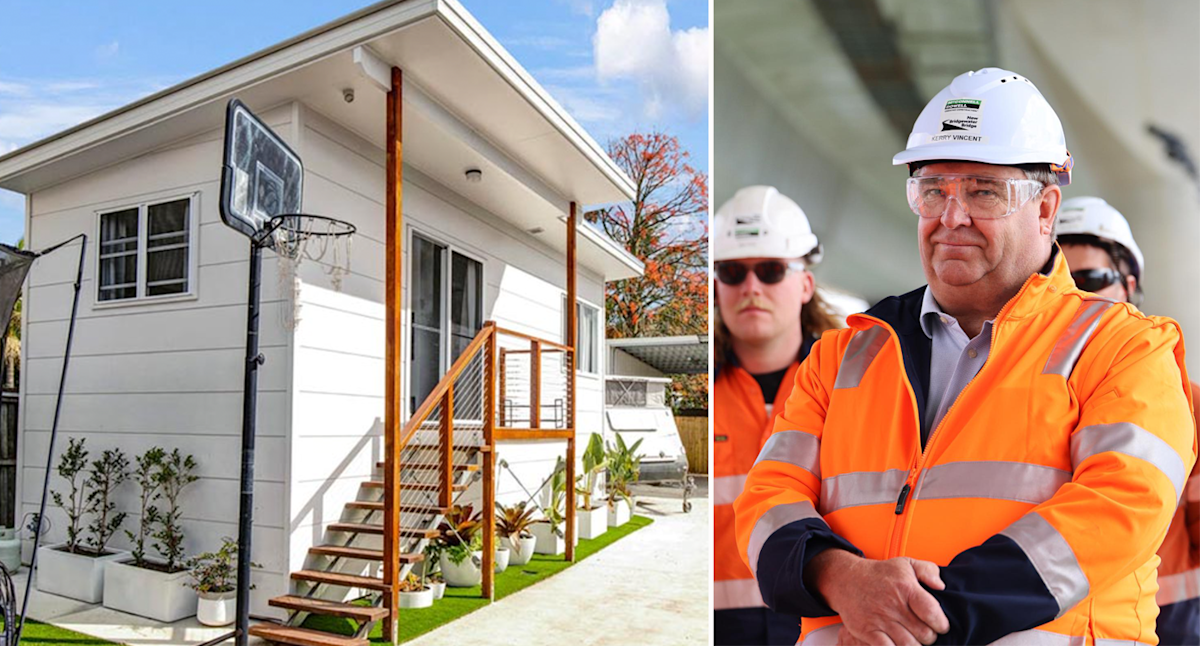
 Tasmania’s Planning Minister Kerry Vincent says the state will move to allow second dwellings up to 90 square metres. (Source: Queensland government/Kerry Vincent/Facebook)
In a bid to provide a boost to housing supply, one Aussie state is jumping on the granny flat frenzy by letting residents have bigger second dwellings on their property. The increase will see a 50 per cent jump in allowable floor space for backyard dwellings.
Tasmania is set to make amendments to the state’s planning scheme to boost the allowable size of granny flats from 60 square metres to 90 square metres. The government says the simple change is about improving the amount of housing options in the state.
“We need to be coming at housing from all angles,” Minister for Housing and Planning Kerry Vincent said.
RELATED
Under the current restrictions, most second dwellings only have a single bedroom if there is a bathroom and kitchenette. But the extra allowance is expected to see two bedroom granny flats become more common.
“There is significant demand for one and two-bedroom homes across the state, and we need to make it easier to deliver this type of accommodation,” Vincent said.
The state has the lowest vacancy rate in the country when it comes to rental properties, dropping to an alarming 0.3 per cent this year according to Domain data, although other measurements had it a bit higher. Increasingly, state and local governments are examining simple planning changes that can help alleviate the shortage of accomodation.
“Having a small, self-contained dwelling located on existing blocks represents low-hanging fruit as we look to increase our medium-density housing stock,” Vincent said.
“By expanding this size, we can create more diverse housing stock, giving Tasmanians greater options for where they can live.”
In recent months Bunnings has begun selling backyard ‘pod’ houses – which are well under the current size limits in Tasmania – for as little as $26,100 and $42,900 for a larger version.
Property industry expert James Fitzgerald believes the highly publicised product range has helped normalise backyard density, arguing such off-the-shelf products can be an appealing option for homeowners to increase their habitable space and generate rental income.
 More state government are looking to granny flat rules and second dwellings to improve housing supply. (Source: Queensland government)
“As affordability worsens, more owners will look at their existing land and ask how to make it work harder. Backyard density is one of the few levers available that doesn’t require moving, subdividing, or taking on a second mortgage,” he recently wrote for Yahoo Finance.
“In many markets, granny-flat style setups are already renting for around $400–$500 per week. That’s not theoretical upside. That’s real income.”
Domain recently revealed that “granny flat” had been the most popular search term on its platform in Sydney in 2025 and the second most searched term in the Perth housing market.
RELATED: Centrelink reminder for little-known granny flat rules that impact retirees
State governments around the country have been removing red tape around backyard granny flats and looking at simplifying approvals in recent years.
In late 2024, Queensland released a statewide building code to give councils more power and make it easier for residents to gain approval to build a second dwelling on their land. It followed changes in 2022 that made it easier for residents to rent out a granny flat to people outside their immediate family.
Victoria also recently made it easier to build a granny flat in residential and rural areas across the state through changes to the planning and building systems.
Meanwhile in January, the head of a NSW inquiry looking into reforms to allow second homes on rural land urged the changes to be made in order to ease the housing crisis. It could see a blanket rule to override councils that restrict the building of a second dwelling.
As the changing approach flows through various housing markets around the country, more granny flats and modular flat pack homes are expected to be built.
A recent survey by the Housing Industry Association found builders were expecting to build 10 times more granny flats this year compared to 2022.
Meanwhile analysis from market research firm Mordor Intelligence suggests Australia’s prefabricated buildings market – which includes modular flatpack builds – is projected to grow by around 7 per cent a year to hit $18 billion by 2030.
Advocates say backyard density can be part of the solution to a lack of supply due to construction delays related to tradie shortages, materials, and regulations.
“We are delivering for Tasmania by ensuring the planning system has a crucial role to play in how we deliver more homes,” Vincent said of the changes now being pushed through in Tasmania.
“By making considered tweaks just like this, we can continue to improve outcomes.”
Get the latest Yahoo Finance news – follow us on Facebook, LinkedIn and Instagram.