
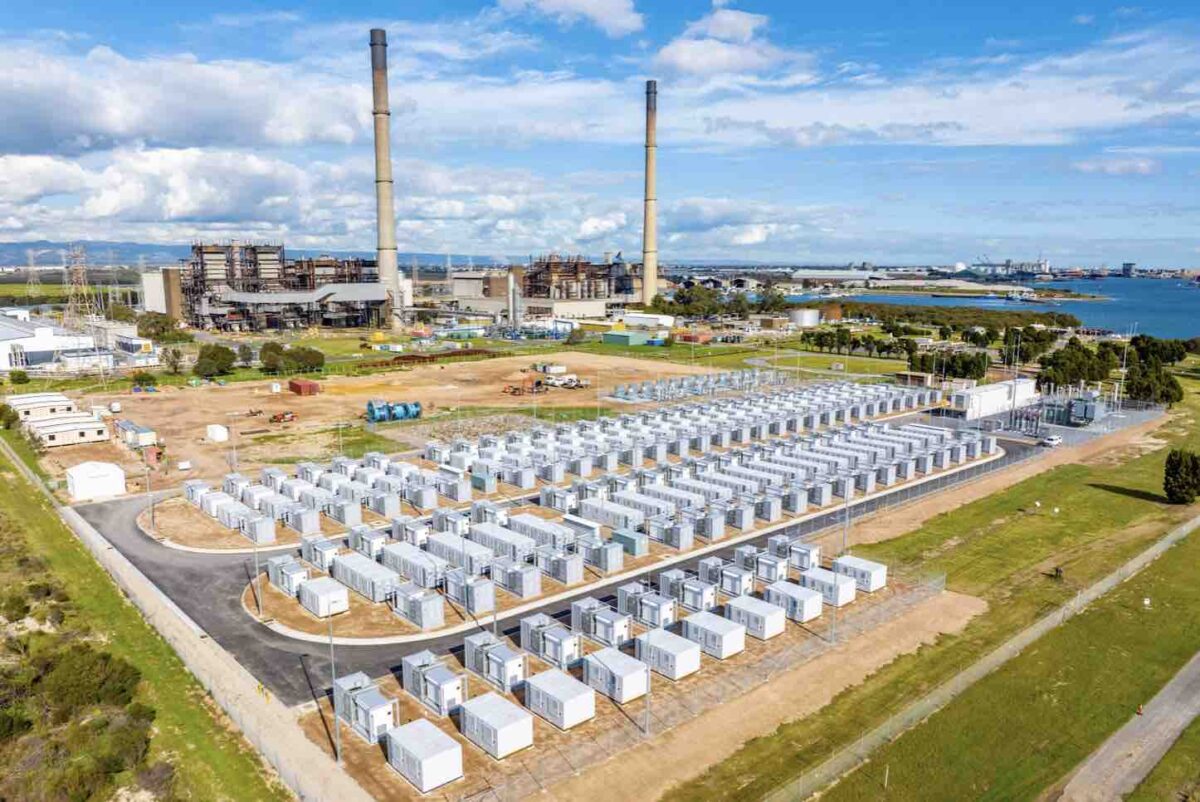
The Torrens Island big battery in South Australia has again been put on standby as rooftop PV sends local grid demand below zero – but it and other big batteries are yet to be activated or forced to charge to maintain grid security.
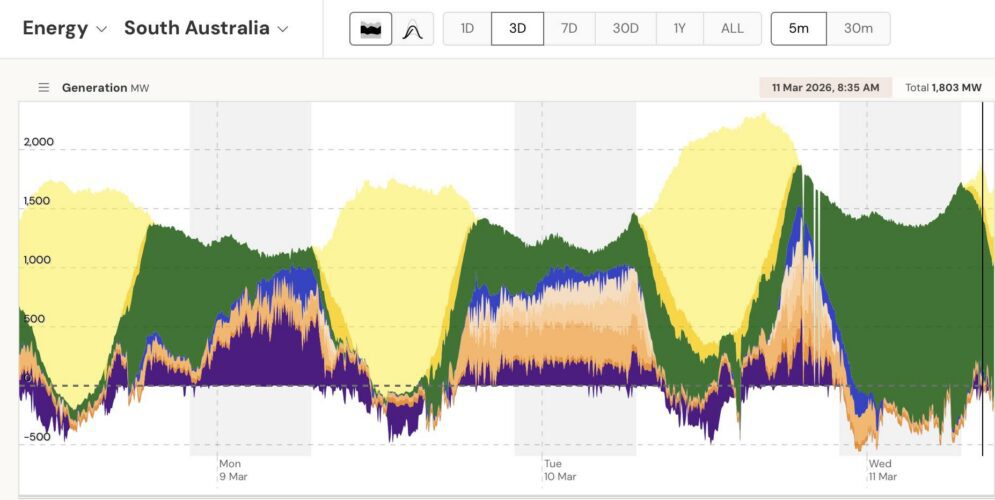
The latest intervention came on Monday when the Australian Energy Market Operator put out a MSL2 (minimum system load) warning with the expectation that grid demand in South Australia could fall to negative 144 megawatts (MW) in the early afternoon.
It is not the first time that the Torrens Island battery has been put on standby – essentially an instruction to stand by at a low charge so it can come in and create new demand if grid demand levels fall to a level that AEMO decides is a risk to system security.
It’s a relatively new phenomenon for the grid, driven by the extraordinary uptake of rooftop solar – one in two homes in South Australia has panels on the roof – although this is being partially mitigated by the boom in home batteries and the growth in grid scale batteries.
Previously, AEMO’s focus was on a lack of supply rather than too much supply, and it has for years been sending out LOR (lack of reserve notices) flagging potential supply crunches.
Most of the time this is resolved by someone deciding to switch on a peaking gas or even a diesel generator because the prices are too high to ignore. In the case of minimum system load, the problem is usually resolved because other batteries enter the market, taking advantage of low or mostly negative prices to charge their cells.
This appears to have been the case on Monday, when other batteries entered the market to charge up (why wouldn’t they when the price fell to as low as minus $235/MWh – they were being paid to charge!)
 Source: Open Electricity.
Grid demand hit a low of minus 93 MW in South Australia on Monday, which wasn’t enough to bother AEMO unduly and the direction to Torrens Island battery was cancelled at 2pm. The Torrens Island battery was not instructed to charge, and presumably will receive compensation for missing out on a market opportunity.
It may seem clunky and awkward at first glance, but this is the system at work. Generators and batteries and some demand centres generally respond to market signals, and AEMO directions are usually designed to cover their base, and to have a contingency plan in case an intervention is needed if something goes wrong.
In South Australia, AEMO needs to issue directions to big batteries – usually Torrens Island or the Blyth battery – because it tried and failed to agree contracts with big batteries in the state to do the same job, as it has succeeded in doing in Victoria.
That’s likely because the battery owners decided there was too great a market opportunity to forego in return for an AEMO contract. In the December quarter, there were six days when directions were given to Torrens Island and Blyth to remain at a low state of charge, although actual charging instructions were not activated.
South Australia, the most advanced renewable grid in the world, with an average 75 per cent wind and solar share over the last 12 months and a target of 100 per cent net renewables by the end of next year, is highly volatile, with prices often in negative territory, and then surging to the market cap in some evening demand peaks.
But it’s interesting to note that in the December quarter, most of the directions issued by AEMO across the main grid related to a potential lack of supply were given in the country’s biggest coal grid – NSW – while most directions for too much supply were given in the country’s most renewable grid, South Australia.

Giles Parkinson is founder and editor-in-chief of Renew Economy, and founder and editor of its EV-focused sister site The Driven. He is the co-host of the weekly Energy Insiders Podcast. Giles has been a journalist for more than 40 years and is a former deputy editor of the Australian Financial Review. You can find him on LinkedIn and on Twitter.