
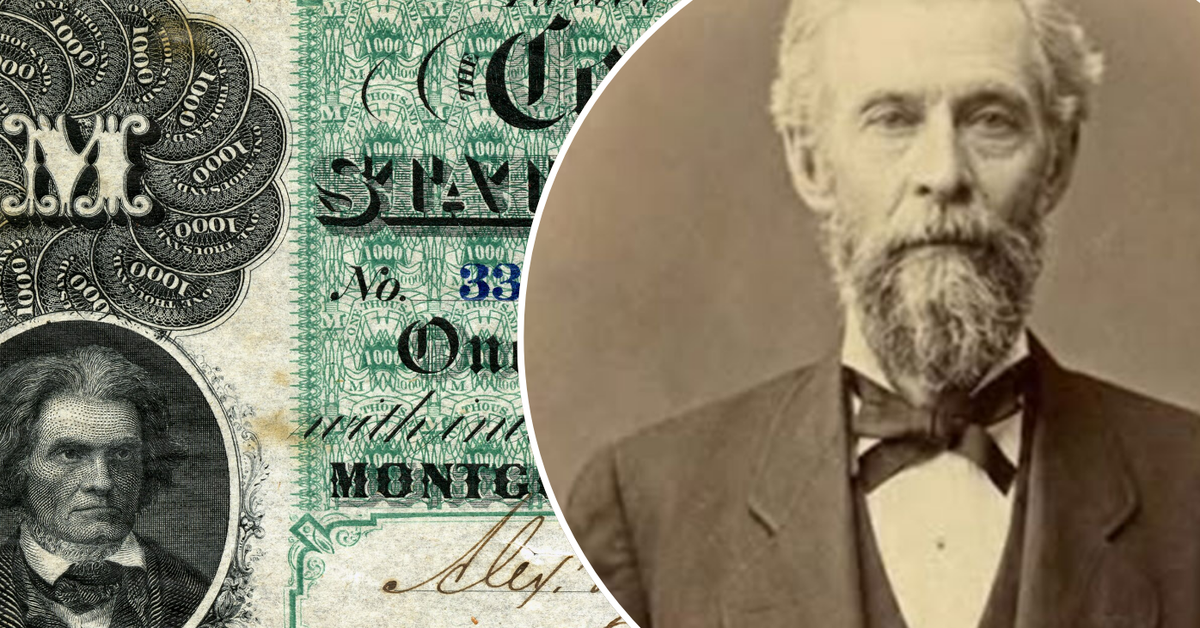
As the Confederate States of America broke away from the US during the Civil War, the new nation began to print its own banknotes.One of those notes ended up in the hands of Samuel Upham, a Philadelphia merchant. Samuel Upham forged so much counterfeit currency it broke the Confederate economy. (Public Domain)
With the means to make copies of the new money, Upham began printing his own version to sell as souvenirs to curious northerners.
Unlike in the loyal Northern states, the Confederacy did not have the technology to print high-quality currency.
Instead, it was printed on what was effectively newsprint – cheap, simple and remarkably easy to duplicate.
Upham’s duplicates were essentially identical to the Confederate legal tender, save for the note printed along the bottom: “Fac-simile Confederate Note – Sold wholesale and retail by S.C. Upham 403 Chestnut Street, Philadelphia”.
He started to sell the dollars as souvenirs for a penny each.
But he found people weren’t buying the cash as curiosities. Instead, buyers were seeking to buy his money in bulk.
So he started printing more and more. For two US dollars, you could buy a hundred Confederate notes. You could buy a thousand for $15.
 Samuel Upham’s Confederate money had a small-print disclaimer at the bottom. (Public Domain)
Savvy black market merchants were buying the money, snipping his name off the bottom, then using the cash to surreptitiously buy items in the South.
The Confederacy was flooded with these bogus notes, indistinguishable from the real thing.
The infusion of phony money caused massive inflation in the Confederacy at a time when a stable currency would be crucial to a budding new country.
In little more than a year, a Confederate dollar’s value had fallen more than 90 per cent.
Upham later estimated that three per cent of all cash in the Confederacy had been printed by his Philadelphia enterprise.
The Confederate government was well aware of his exploits, with eager black marketeers sometimes forgetting to cut his name off the fake money.
They ended up placing a $10,000 bounty on his head, though nobody attempted to murder him. Would-be assassins could buy that much money for $150 from the man himself.
 The counterfeiting in the South led to hyperinflation. (Public Domain)
And the US government in Washington considered charging Upham with forgery.
But the United States never formally recognised the Confederacy as a legitimate country. As far as the Treasury was concerned, Upham was printing fake money from a fake country.
By late 1863, his business had dried up for the simple reason that he had been too successful.
Confederate currency was so hyperinflated that nobody would accept it in the South.
He returned to selling perfume and stationery two years before the war ended, having successfully crashed the Confederate economy.