
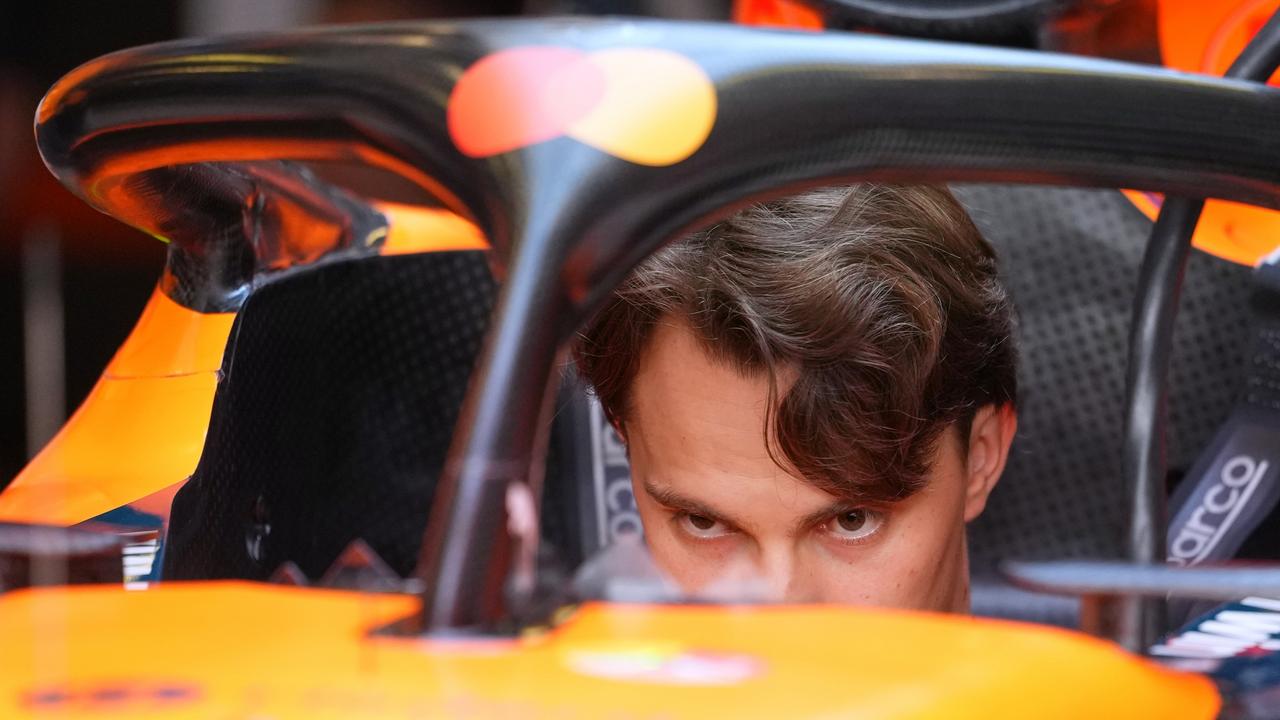
Victory celebrations had been going for almost a minute by the time Lando Norris took the chequered flag in the sole remaining McLaren car at the Australian Grand Prix.
George Russell, dominant winner from pole position, cruised to the finish line to enhance his pre-season status as title favourite in a Mercedes car-engine combination clearly a cut above the rest.
Fox Sports, available on Kayo Sports, is the only place to watch every practice, qualifying session and race in the 2026 FIA Formula One World Championship™ LIVE in 4K. New to Kayo? Join now and get your first month for just $1.

Norris, the defending world champion, was never in the fight. Instead his focus was on keeping behind him Max Verstappen, who had started the race 18th but by lap 20 was directly behind the McLaren.
He was successful in that endeavour, beating his championship predecessor by three seconds, but the margin to the lead was the far more significant number: 51.741 seconds.
It was McLaren’s largest defeat since the 2023 Belgian Grand Prix, almost three years ago.
Norris’s analysis of the situation was suitably dire.
“I think we maximised today,” he said of his most distant finish in 59 grands prix. “Clearly we’re a long way off.
“We have a lot to try and figure out. The good thing is we have a big gap to the cars behind, similar to Red Bull, but the bad thing is we have a big gap to the cars ahead.
“Today was more of an understanding that we’re nowhere near where we need to be with the car, and we need to improve that.”
Oscar Piastri was having a notably worse day, having not even made it to the grid after an engine-related driver error fired him into the wall on the reconnaissance lap.
This wasn’t the start to the season the defending two-time constructors champion was hoping for.
‘Tweaks’ to be made on new regulations? | 02:13
WHAT WENT WRONG?
The deep dive into the data at McLaren will have started immediately in a bid to understand as much as possible ahead of this weekend’s Chinese Grand Prix — a task made only more critical owing to the single-practice sprint weekend format in effect in Shanghai.
Speaking after the race in Melbourne, McLaren team principal Andrea Stella didn’t shy away from the fact McLaren’s car has rolled out of the factory in a fundamentally less competitive shape than its main rivals.
“There’s performance that needs to come from two main areas,” he said. “One is the power unit exploitation, and one is having more grip in the corners.
“When we look at the GPS overlays, we see that Mercedes is faster in some of the corners. Therefore we have clear objectives and priorities.
“We need to find a way to extract more out of the power unit and, on the other side, develop the car.
“There’s definitely work ahead of us, and the gap at the moment seems to be in the range between half a second and one second.”
Mercedes is the natural benchmark for the McLaren car given both use the same power unit. McLaren has been the better chassis builder for the last two years, having beaten the works team to the championship in 2024 and 2025. This year the German marque has reasserted itself.
But Stella allowed the engine part of the equation to linger.
“Still we remain a little puzzled by the difference we see in the data between the speed of our car and the speed of other cars using the same power unit,” he said. “Clearly it indicates that we should be doing a better job in understanding how to utilise the power unit with the complexities that came with the 2026 regulations, so there’s definitely work to do.”
Is McLaren the right place for Piastri? | 02:24
THE ENGINE QUESTION
It’s a matter that has been bubbling beneath the surface for weeks.
Though Mercedes is required to supply its customers with identical hardware and software, those customer teams don’t feel they’re accessing the same sort of engine performance.
The matter then came to a head in qualifying, when Mercedes was consistently faster down the straights, apparently with more electrical energy on tap, than its customer teams.
“We have work to do to exploit the potential of the power unit, which, once I see the potential that [Mercedes High Performance Powertrains] is extracting, looks like there’s more that is available,” Stella said.
But he added: “It’s not obvious how you do that.
“We are in a journey of knowledge — certainly a journey that is at an earlier stage than the works team.
“The works team and HPP will have worked together for a long time. They will have collaborated, talked about how to use the power unit — that’s fair enough. But we’ll definitely intensify the collaboration with HPP, because our understanding is that there is some low-hanging fruit that we should be able to cash in.
“I think we will need some more analysis to understand whether this is only about parameters that we can control or driver input that we can control or [whether] there are some other factors, more systemic, that not necessarily a customer team can control.”
MORE FORMULA 1
‘IT’S ABSOLUTELY WRONG’: Why F1 could make stunning backflip after Aus GP backlash
REVEALED: The ‘secret’ Supercars meeting behind Adelaide’s shock Aussie MotoGP poaching
STATE OF PLAY: Shock loser from rules shake-up; Piastri’s new McLaren reality
‘WON’T SERVE YOU’: Crash fallout exposes Piastri gag order fear as ‘Lando clause’ rumour emerges
The problem was exacerbated by Mercedes using the latest version of its power unit at the final week of testing in Bahrain while its customers used an older spec. The equality rules don’t apply during testing, and all four teams were using the same-spec engine in Melbourne.
Getting the most out of the 2026 engine isn’t just about the driver’s right foot. Their left foot is just as crucial now.
With almost 50 per cent of total power coming from the electrical motor, regenerating energy from braking and from lifting and coasting into corners is essential. Of course those techniques — along with ‘super clipping’, when the combustion engine diverts most of its power to charging the battery — slow the car down.
Understanding how to maximise regeneration while minimising speed loss is therefore critical to lap time. The deeper your understanding of how the engine recovers power, the better you’re going to be at that task.
But both McLaren and fellow Mercedes customer Williams have hinted that some of the information they feel is required hasn’t flowed as freely as they would like.
“In testing we were pretty much going on track, running the car, looking at the data: ‘Oh, that’s what we have. Good, now we react to what we have’. That’s not how you work in Formula 1,” Stella said.
“In Formula 1 you simulate, you know what is happening, you know what you are programming, you know how the car is going to behave. You also have your plans as to how you evolve it that you have figured out before because you know what you are expecting from the car.
“Since we [became] a customer team, this is the first time that we feel we are on the back foot even when it comes to the ability to predict how the car will behave and the ability to anticipate how we can improve the car.”
Williams boss James Vowles — the former Mercedes chief strategist — was more prosaic about the situation.
“It is not an open door, as you would imagine, because that’s where the performance is found,” he said. “It is down to us to try and work around it.”
‘That guy f****** sucks!’ | 00:26
WHAT ABOUT PIASTRI’S CRASH?
The engine question is likely to continue unfolding at upcoming races as teams and drivers better understand what they can and can’t do with their new motors.
In the background are a trio of incidents that further complicate the situation: Andrea Kimi Antonelli’s FP3 crash, Max Verstappen’s Q1 rear lockup, and Oscar Piastri’s reconnaissance lap smash.
All three appeared to be related in some way, even if not entirely, to the behaviour of the power unit — albeit only Piastri was driving with a customer motor.
Though Piastri took responsibility for “a large element” of the heart-wrenching home-race accident, admitting he got too keen on the kerbs on cold tyres, he said the engine had also given him an unexpected power kick at the worst possible moment.
“I also had 100 kilowatts more power than I expected, so you put all of those together and unfortunately it ends in the result we got,” he told Sky Sports.
“There’s a lot of rules about how the power units have to work, and essentially I was at less throttle than what I was in qualifying, and the way the rules stipulate how the torque demand has to work, I actually got 100 kilowatts more power than if I would have been at full throttle. It’s something to get used to.”
Stella explained it wasn’t a car or engine failure but rather a function of the complex way the new engines work, which drivers, just like the teams, aren’t fully across yet.
“It’s sort of expected to happen like that, but it is not something that you would do unless it’s — which I understand is the case — a requirement that you need to meet in terms of how you deploy your torque,” he said.
“In testing we might have seen some similar circumstances, but we didn’t have the combination of cold tyres and the kerb, which aggravated the fact that you may have these inconsistencies from a torque deployment point of view.”
It’s not quite the total exoneration Piastri fans may have hoped for, but it does explain how the usually rock-solid Australian — and the crash-averse Verstappen a day earlier — ended up in deeply unfamiliar territory.
Was OP’s crash a car or driver error? | 02:47
WHAT’S THE OUTLOOK?
Given the newness of the rules and the uncertainty around the power unit, it’s difficult to understand how large McLaren’s recovery project is.
We can, though, break it down into a few parts.
Vowles suggested that the knowledge gap between the Mercedes works team and its customers was worth around 0.3 seconds per lap. McLaren qualified 0.862 seconds off the pace.
A 0.3-second deficit significant on its own but especially when taken in the context of how engine performance knocks on to overall performance. More power means you can lift and coast without hurting lap time as severely and you can roll more speed through the corners while recovering electrical energy, which means you can be faster down the straights — and that in turn means you can lift and coast more easily in a virtuous circle.
Unlocking that performance is all down to how quickly McLaren can understand the power unit.
Aerodynamic development is more predictable but likely slower.
“This will take a few races in terms of seeing some major upgrades,” Stella said. “Therefore, I think in these few initial races we will have to make sure that we extract most from the car in its current configuration.”
Norris, thinking about the viability of his title defence, said it would be crucial to fast-track developments before the season got away from him.
“We have a lot of work to do,” he told Sky Sports. “There is nothing that’s going to happen overnight, or in one week or two weeks time.
“For us to match [the leaders] — zero chance at the minute, and we have to work very hard to understand things and learn as much as we can from this part of the season, because this part of the season now sets up the rest of it, basically.
“The more we can learn, the more we can understand, the better we’ll be at the end of the season.”
Piastri, meanwhile, is focused just on opening his account for the campaign, his crash putting him immediately 25 points off the title lead and 10 points adrift of Norris.
It’s familiar territory for the Australian, who scored just two points last year in Melbourne after spinning off the road in the wet.
His bounce-back, though, was instant.
Victor from pole in China — a track at which he’s struggled in previous years — and wins in Bahrain and Saudi Arabia saw him take the championship lead from Norris at the end of round 5, and he held top spot for 15 weekends.
“Oscar is a very tough guy mentally,” Stella said. “He will use all this to get even more concentrated and determined starting from China.”
A more conventional circuit for engine usage, it would be surprising if McLaren weren’t closer to the front in Shanghai this weekend.
McLaren’s challenge is significant as the only customer team among the frontrunning four.
But it didn’t win the last two constructors titles by accident.
Just as it would be brave to count out Piastri based on one clumsy crash at one race, it would be ambitious to discount McLaren’s odds of success just one round into a long and unpredictable season.