
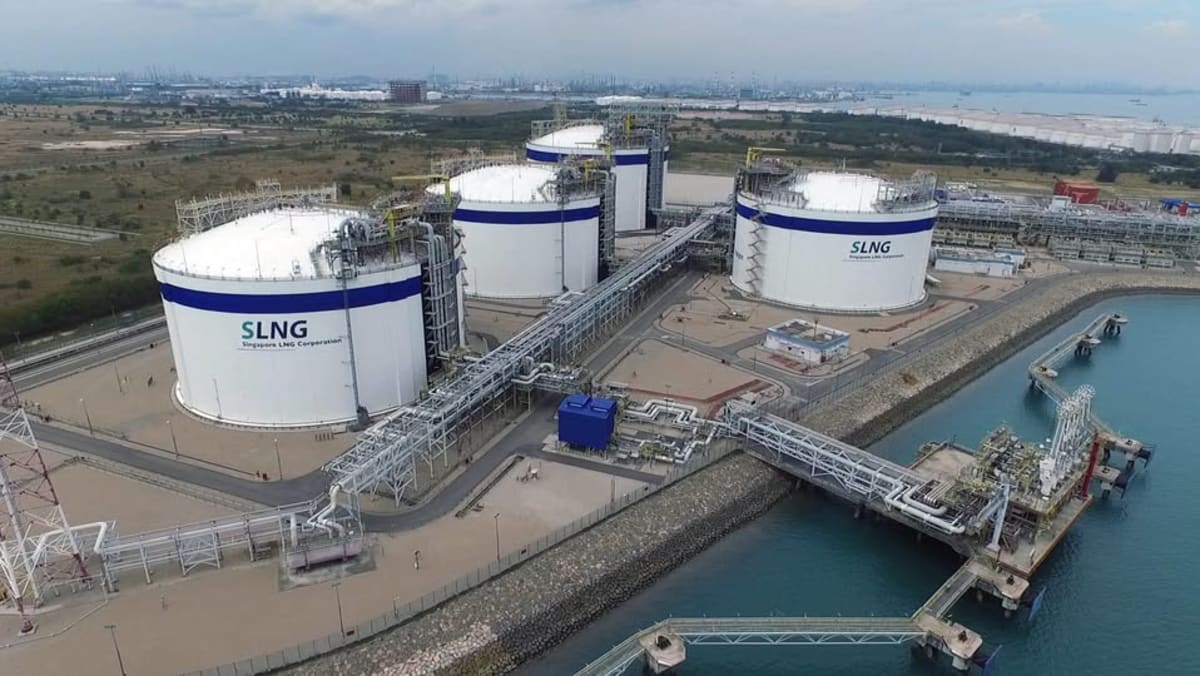
SINGAPORE: Singapore holds stockpiles of liquefied natural gas (LNG) and diesel sufficient to last for months, Minister-in-charge of Energy and Science and Technology Tan See Leng said on Wednesday (Mar 11) as the Middle East conflict continues to roil energy markets.
Speaking on CNA’s Deep Dive podcast with hosts Steven Chia and Tiffany Ang, Dr Tan said Singapore has actively diversified its energy sources since the global energy crunch of 2022 and is in a “much better position today”.
He declined to disclose exact stockpile figures for security reasons, but said the country is in a “relatively steady state”.
“The exact amount is a matter of our own security, so I’m not at liberty to share it to the public, but I think it’s enough to last for months,” he said.
Space is a constraint when it comes to storing energy reserves, said Dr Tan, but the country has several measures designed to bolster resilience: Singapore GasCo, which was set up to centralise the procurement of gas after the 2022 crunch; power generation companies’ own reserves; and a diversified portfolio of LNG and piped gas contracts.
“Through a meshwork of the different strategies, we are able to preserve that element of stability,” said Dr Tan, who is also Manpower Minister.
In a Facebook post on Thursday morning, Dr Tan gave additional details on Singapore’s buffers. He said power generation companies can draw from the stockpiles if there is a severe disruption to gas supplies, and that electricity-generating turbines here are capable of running on both gas and diesel.
He also sought to temper concerns about Singapore’s exposure to Middle East supply routes. About half of the country’s gas is piped from the region and is unaffected, he said.
“Our LNG importers have a global portfolio of sources, such as the US and Australia, which they can tap on to replace cargoes originally from the Middle East. For the one LNG cargo from the Middle East, efforts are underway with the importers to find replacement cargoes,” Dr Tan said.
RISING PRICES
On electricity prices, Dr Tan acknowledged during the podcast that the government’s ability to control costs is limited.
“What we can do as a government is to manage that gradient of increase … mitigate sharp spikes,” he said.
He pointed to the temporary price cap mechanism introduced in 2023, which functions as a “circuit breaker” during periods of sustained volatility in Singapore’s wholesale electricity market.
A separate programme that connected large industrial consumers directly with power generation companies for bulk pricing was discontinued in May 2023, though Dr Tan said the mechanism remains available if needed.
Help is also available in the form of the Energy Efficiency Grant for companies and U-Save rebates and climate vouchers for households, said Dr Tan.
He said the government was prepared to act if conditions worsen, even if it cannot commit to specific measures now.
“How we respond to it, what kind of measures that we set up – these are things, at this point in time, we are not able to commit to, because it hasn’t happened yet. But once it happens, we have the appropriate response and the nimbleness to be able to react quite quickly,” Dr Tan said.
In his Facebook post, he said: “As the situation in the Middle East is evolving, we are watching closely, especially for secondary effects of disruption.
“This conflict is a reminder that we live in an unpredictable world, and we cannot take our energy security for granted. We must therefore do what we can to economise on our use of energy, and everybody has a part in this.”