
[Photo: Orlando Ramirez]
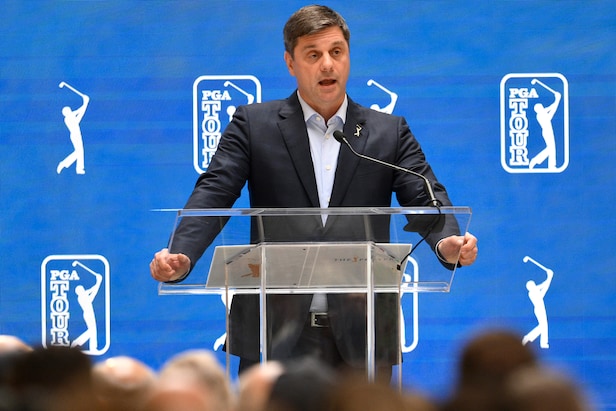
Change is coming. Eventually. Although nothing concrete was announced regarding the future on Wednesday at PGA Tour headquarters, new CEO Brian Rolapp spent the majority of his inaugural Players press conference signalling that the way things are will no longer be the way they are. Perhaps just as importantly, he signalled how. Here are the 11 takeaways from Rolapp’s remarks and what they mean for the tour’s future. The PGA Tour is splitting in two.
As Golf Digest reported earlier this year, the tour is creating a two-tiered system at its top level. Rolapp said the first tier will double the current eight signature events to 16 tournaments, alongside the four majors, the Players and the postseason. Running from late January to early September, the schedule will span 21 to 26 competitions. The second tier will function as a promotion-and-relegation tool, with events spread across the calendar year and into the fall. This system does not replace the Korn Ferry Tour and other PGA Tour feeder circuits, which remain intact.
Related: Players 2026: This Easter Egg from Brian Rolapp will have a certain kind of golf fan rejoicing
“We are evaluating the role of promotion and relegation across our competitive model,” Rolapp said. “We are further strengthening our merit-based system and leaning into what makes professional golf so compelling: players earning their way to the top, with every event having greater meaning.”
One of the recurring themes of Rolapp’s tenure has been scarcity, widely interpreted in the industry as the elimination of events. As Golf Digest has learned, the endangered events will likely be demoted to the second tier rather than cut entirely. The system essentially formalises what has effectively been a two-tour structure for years.
The non-answer answer on rollback
At the Tour Championship, Rolapp acknowledged he was still getting up to speed on the USGA and R&A’s proposed rollback of the golf ball. On Wednesday, he made clear neither he nor the tour is ready to take a position.
“I think this is clearly a complex issue,” Rolapp said. “From what I can tell, it comes down to two questions: Is distance a problem? Should it be addressed? Question number one. Question number two, does the current rule being proposed accomplish that. I’ve spoken with players; I’ve spoken with the governing bodies; I’ve spoken with golf ball manufacturers; I’ve spoken to fans. What’s clear to me is that everybody has an opinion, and those opinions are clearly not consistent on either question. As far as our players, I know they’re hitting prototypes. I hear all different things. Some are impacted; some that expected to be impacted are not. So as far as the PGA Tour is concerned, we have not taken a position. When we get comfortable with the rule and the data, we’ll make a decision.”
It’s a diplomatic answer, but it’s hardly an endorsement of the USGA’s proposal. Most of Rolapp’s membership, sponsored by OEMs, opposes rollback. Picking that fight while bigger battles loom would be an unusual opening move.
Bigger cities returning to the schedule
As previously reported, the tour is pushing to place events in larger markets. “The PGA Tour competes in only four of the top 10 largest US media markets,” Rolapp said. “That is an opportunity. We are evaluating markets like New York, Chicago, Philadelphia, San Francisco, Washington DC, Boston and many others, places where there is strong fan demand for our sport and a chance to reach new fans.” Possible match play in the playoffs
Adding match play to the Tour Championship is hardly a new idea, particularly after the tour eliminated the WGC-Match Play, yet the concept has historically been vetoed by broadcast partners wary of late-round matchups between non-marquee players. Rolapp said match play is back on the table, and possibly for the entire postseason.
“I think a lot of the motivation comes from our fans and our partners who want to see more drama in the events that they attend,” Rolapp said. “I mean, again, the sports business is not that hard; just think like a fan and nine and a half times out of ten, that’s probably the right answer.”
The tour may have new playoff sites
East Lake has hosted the season-ending Tour Championship for decades. The club has history but it has never quite captured the imagination of the broader golf public. Rolapp was careful to say the club has been a strong partner and that the tour will likely return to Atlanta, but the finale’s long-term future there is less certain. “What we do with the postseason, we’re still figuring out,” Rolapp said. “There’s clearly high demand in some of the discussions we’ve had. Some of these bigger markets would really like a postseason event. So I think everything is really on the table.”
That includes the venue itself. Sources tell Golf Digest that Riviera and Pebble Beach are among the possibilities for a more recognisable final stop.
No more limited fields, no cut events
One of the signature series’ most persistent criticisms from fans, media and players alike has been its closed field, no cut format, which drew unflattering comparisons to LIV Golf. Rolapp said the new top tier will feature full fields and a cut.
“Our best events will have larger fields. Ideally, we are targeting something closer to 120 player fields with a cut,” Rolapp said. “That consistently matters. It helps fans know who they will see and showcases the most competitive players they want to see. It helps partners know what they’re investing in and it helps players better understand the competitive landscape in their schedules, all while embracing meritocracy.” In a related note …
Sponsor exemptions may be on the outs
Another source of fan frustration, one that cuts against the meritocracy ethos Rolapp keeps invoking, is the sponsor exemption system, along with the politics surrounding it. Rolapp appears to recognise the tension.
“It is my opinion we need a better competitive model because we should be delivering fields to the sponsors,” he said. “We shouldn’t make them work hard to put together a field. We’re delivering them something, and they’re supporting that. I think we need to be better partners in that. I also have an appreciation for the fact that professional golfers are independent contractors. So their level of job security is in some part tied to the exemptions they have earned. It’s a balance. Those are all discussions we’re having with the committee—to provide for those things but also deliver the purest competition that fans want.” A strong opener
As Golf Digest reported in January, the Hawaii swing is in danger of being cut. Rolapp said the tour wants to open its season out west and close with a prime-time network television special at an iconic venue. Perhaps Kapalua qualifies as “iconic,” yet one possibility, sources told Golf Digest, is hosting the season opener at Torrey Pines.
Reunification with LIV is not a concern
Even before Rolapp arrived, the tour had quietly narrowed its reintegration focus to three players: Bryson DeChambeau, Jon Rahm and Brooks Koepka. Koepka has since returned, and DeChambeau’s LIV contract expires this year. As for the others, or any broader rapprochement with LIV, Rolapp expressed no interest.
“My brief is to make the PGA Tour better,” he said. “I’m open to whatever makes the PGA Tour better, better for fans, better for our members. That’s what I’m focused on and that’s where I put all my efforts.”
The tour may have a media rights fight ahead
The tour’s current media rights deal runs for several more years. It was negotiated in a pre LIV world with a different competitive picture and it predates the two tier structure now being assembled. There is also the small matter of the NFL, which appears poised to re enter the market aggressively. Rolapp, who came from the NFL, spoke candidly about what that landscape could mean.
“I’ve read the same reports you have, that they would like to go to the media market earlier. The US media rights market is $30 billion (approx. $45.6 billion AUD). The NFL currently accounts for $12 billion (approx. $18.2 billion AUD) of that. They have made their public intentions clear; they would like to double that,” Rolapp said. “So if you start doing that math and you’re anyone other than the National Football League, you ask yourself: Next time I go to market, how do I make sure I have the most compelling product so that we can compete in what is a very complicated media ecosystem that’s changing all the time? You see fans changing their habits, television versus streaming. You see the companies and the economics of the industry changing. So it’s a very dynamic time in media.
“If you are in the sports business, it behoves you to put your house in order as much as possible. That is a significant part of the work that the Future Competition Committee is doing, and it’s one of the reasons why it’s so important.” Don’t expect a new schedule for 2027
There had been hope in the industry that changes would arrive as soon as next year. Last month at the Genesis Invitational, Tiger Woods moved to temper those expectations. Rolapp echoed the sentiment. Expect some adjustments in 2026—not a wholesale transformation.
“Once decisions have been made and finalised, changes will be implemented through a rolling approach,” Rolapp said. “As Tiger has said recently, some elements could be addressed sooner for next season, with more significant change likely implemented for the 2028 season, pending the necessary work with our partners and other operational considerations.
“This is a complex process with many constituencies impacted. We will continue to move with urgency, but we are focused on getting it right.”