
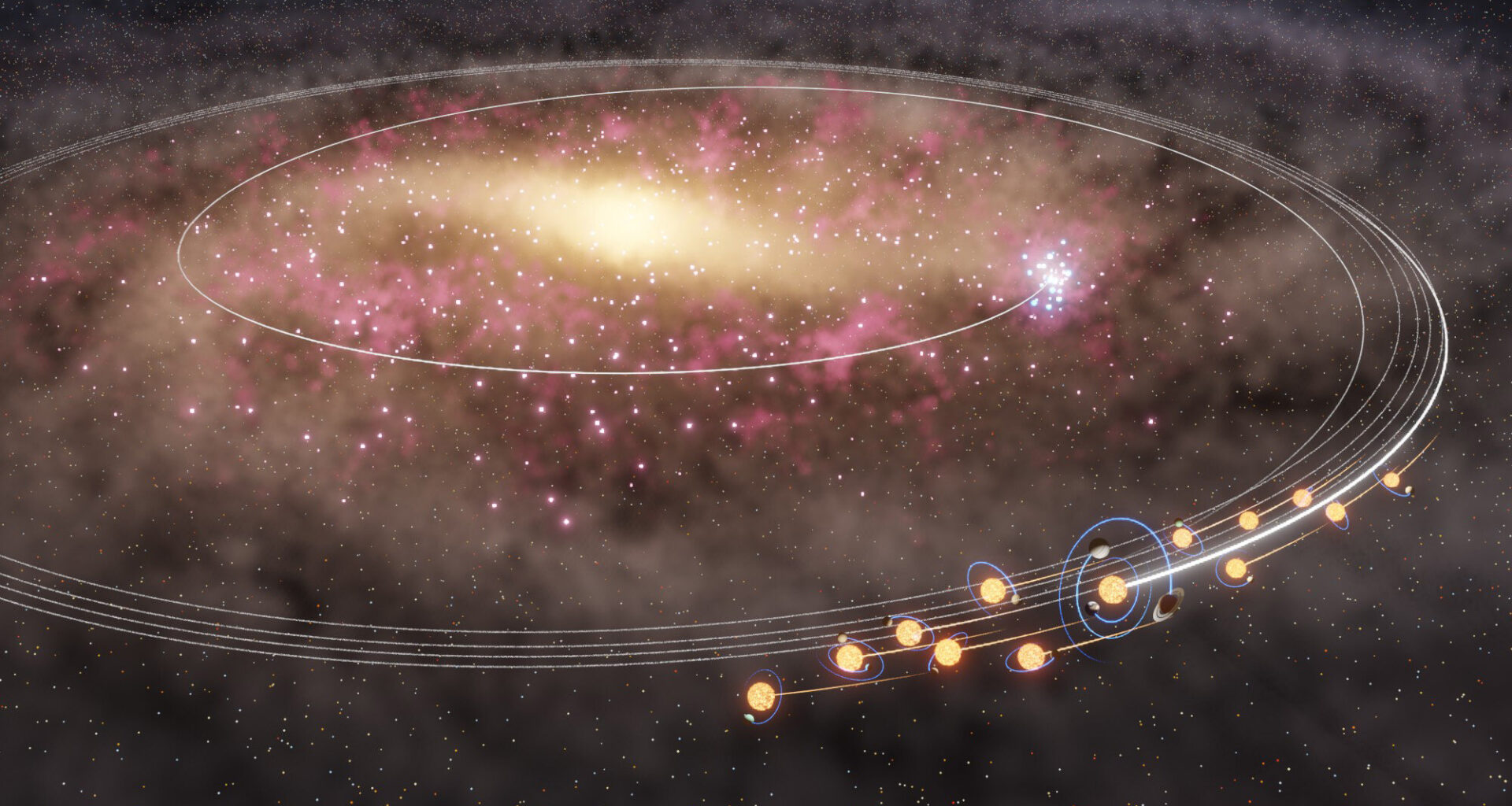
Our sun, born 4.6 billion years ago near the crowded, chaotic heart of the Milky Way, did not make its journey to the galaxy’s calmer outer suburbs alone. A pair of new studies published March 12, 2026, in Astronomy and Astrophysics reveal that thousands of “solar twin” stars — stars with nearly identical mass, age and chemical composition to the sun — migrated outward alongside it in a coordinated stellar exodus spanning roughly 10,000 light-years.
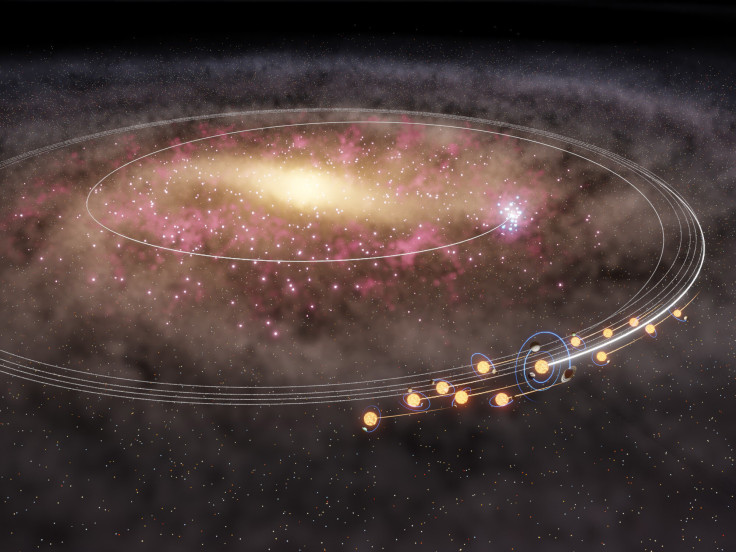
An illustration of the Milky Way between 4 billion and 6 billion years ago, when the “migration” of sunlike stars was taking place.
Image credit: NAOJ
Led by Daisuke Taniguchi of Tokyo Metropolitan University and Takuji Tsujimoto of the National Astronomical Observatory of Japan, the research draws on data from the European Space Agency’s Gaia space telescope, which has mapped positions, motions and compositions for billions of stars with unprecedented precision.
The team identified 6,594 solar twins in Gaia’s latest release, focusing on those matching the sun’s metallicity (a measure of elements heavier than helium) and age. Their orbital paths and chemical signatures point to a shared origin closer to the galactic center, followed by a synchronized outward drift that placed them in the sun’s current neighborhood — about 26,000 light-years from the Milky Way’s core.
Computer simulations had long suggested such a trek would be rare. Stars born in the dense inner regions face formidable barriers: intense radiation, frequent supernovae explosions and gravitational perturbations from the galaxy’s central bar and spiral arms. Models predicted only about 1 percent of stars from the sun’s presumed birthplace could reach the outer disk within 4.6 billion years without being destroyed or scattered.
Yet the Gaia data show thousands succeeded — far more than chance alone would allow. The researchers propose the explanation lies in a massive, galaxy-wide migration wave triggered by the formation and evolution of the Milky Way’s central bar roughly 4 to 6 billion years ago.
As the bar strengthened, it boosted star formation in the inner disk and launched large-scale radial migrations. Gravitational resonances — regions where orbital periods align with the bar’s rotation or spiral arms — funneled stars outward in groups rather than individually. The sun and its twins caught this wave, riding it to safer, less hazardous suburbs where cosmic rays and supernova blasts are less frequent.
This migration may help explain why Earth became habitable. The galactic center teems with dangers: gamma-ray bursts, black-hole activity and dense stellar crowds that could strip planetary atmospheres or trigger mass extinctions. By migrating outward just in time — before the solar system fully formed its planets — the sun escaped the worst risks, providing a stable environment for life to emerge.
Taniguchi told Live Science the pattern suggests “many solar twins of the same age migrated through the Milky Way around the same time as the sun, giving us new clues about when and how the sun moved from its birthplace to its current location.”
The studies build on decades of debate about the sun’s origins. Earlier work proposed the sun formed farther out or migrated via spiral-arm resonances, but the new evidence ties the movement to a specific galactic event: bar-driven migration.
Gaia’s third data release in 2022 and ongoing fourth-release updates have revolutionized stellar archaeology, allowing astronomers to rewind stellar orbits billions of years. By tracing chemical abundances — especially iron-peak elements forged in supernovae — researchers can fingerprint stars born in the same era and region.
The solar twins cluster in both kinematics (motion) and metallicity, supporting group migration over random drift. The wave likely peaked 4 to 6 billion years ago, coinciding with the sun’s youth and the Milky Way’s transition to a more stable barred-spiral structure.
Implications extend beyond our solar system. If many sun-like stars share this history, habitable zones may correlate with migration paths. Regions swept by such waves could host more life-friendly systems, as they escape inner-galaxy perils.
The findings also refine models of galactic evolution. The Milky Way’s bar, a peanut-shaped structure of older stars, drives radial mixing that reshapes the disk over cosmic time. Similar processes occur in other barred spirals, suggesting coordinated migrations are common.
No direct evidence links the migration to Earth’s habitability, but the timing aligns intriguingly. Planet formation took hundreds of millions of years after the sun’s birth; the outward journey may have positioned the nascent system in a quieter galactic suburb just as rocky worlds and oceans stabilized.
Future Gaia releases and upcoming telescopes like the Vera C. Rubin Observatory will test the hypothesis by mapping even fainter twins and refining orbital reconstructions.
For now, the studies paint a dynamic picture: the sun was not a solitary wanderer but part of a vast stellar caravan, carried by galactic forces to the peaceful outskirts where life could take root.
Astronomers say the work underscores how interconnected stellar lives are with their galaxy’s architecture — and how a timely migration may have been key to our existence.