

The rise of AI agents capable of doing real workplace tasks has sparked talk of a ‘SaaS-pocalypse’ across the software sector. Pic: Getty Images
AI plugins spark US$850bn ‘SaaS apocalypse’
Agentic AI starts rewriting the software playbook
Decidr builds the agents FortifAI builds the highways
February delivered a shock to the global technology market.
In the space of a few days, roughly US$850 billion was wiped from software stocks on Wall Street.
Investors dumped companies that had been market darlings for years.
Traders quickly found a name for the carnage: “The SaaS apocalypse” or “SaaS-pocalypse”.
The spark was AI company Anthropic, which had just released a new set of tools for its Claude platform called Cowork plugins.
At first glance, these tools looked like another AI feature. On closer inspection, they could actually perform real workplace tasks.
Like reviewing contracts, running financial analysis, managing compliance checks.
For investors, that changed the conversation overnight.
Because if AI agents can perform real work across legal, finance, marketing and operations, then a much bigger question emerges.
Why keep paying for dozens of expensive software subscriptions?
That possibility spooked investors.
The awkward economics of SaaS
For two decades, the SaaS (Software as a Service) model has been one of the most reliable engines of growth in the tech sector.
Companies build software. Businesses subscribe to it. And pricing is typically based on the number of employees using the platform – the famous “per-seat” model.
The more workers using the software, the more revenue the company generates.
But agentic AI changes that equation.
If AI allows one employee to do the work of two or three people, then the number of seats needed in those applications can shrink.
Productivity goes up, but subscription counts can fall.
Companies that once looked like dependable long-term compounders suddenly appeared exposed to a technology that might rewrite their economics.
The rise of agentic AI
Generative AI – the overarching term for the tools that write text or answer questions like ChatGPT – has grabbed the world’s attention over the past few years.
But those systems largely respond to prompts.
Agentic AI is different.
These systems can take a goal, break it into tasks, access tools and data, coordinate with other systems and complete work with minimal human involvement.
They don’t just respond to questions, they execute.
According to the Capgemini Research Institute, AI agents could generate US$450 billion in economic value by 2028 through productivity gains and cost savings.
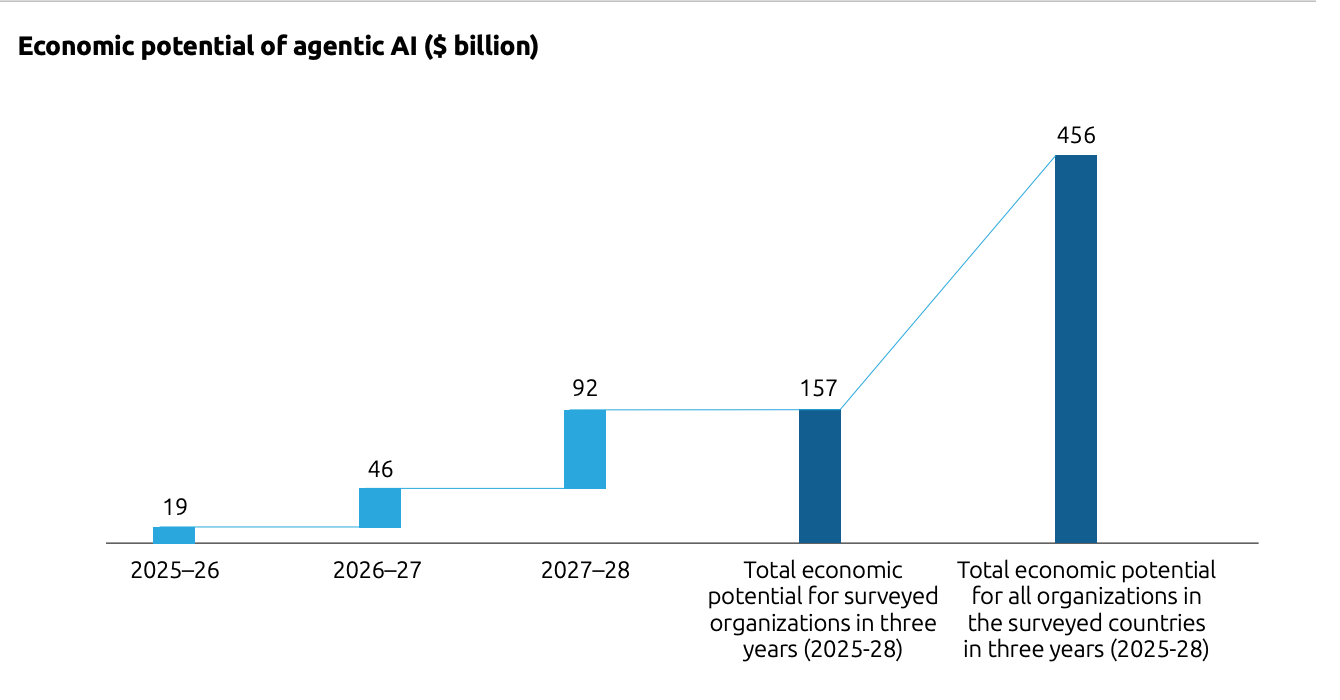 Source: Capgemini
Adoption is still early, as only a small percentage of organisations globally have deployed these systems at scale.
But momentum is building fast.
Many companies expect these AI agents to become part of everyday operations within the next few years.
The shift is already showing up inside major companies.
Commonwealth Bank (ASX:CBA) recently cut about 300 roles as it restructures for an AI-driven workforce.
Logistics software giant WiseTech Global (ASX:WTC) announced that it plans to slash around 2,000 jobs – nearly a third of its global staff.
Even fintech firm Block Inc (ASX:XYZ) is cutting roughly 4,000 employees after CEO Jack Dorsey said AI tools now allow much smaller teams to do the same work.
However, Nvidia CEO Jensen Huang has urged markets not to jump to conclusions.
“There’s this notion that the tool industry is in decline and will be replaced by AI… It is the most illogical thing in the world, and time will prove itself,” he said.
But either way, the structure of the industry is starting to shift.
Decidr builds tools for the agentic era
This is the environment where ASX-listed Decidr Ai Industries (ASX:DAI) is trying to build its position.
The company is developing systems designed to coordinate autonomous AI agents across business workflows.
Its flagship platform, DecidrOS, plugs into existing enterprise platforms such as Salesforce, HubSpot and Xero.
Give the system a goal – hiring staff, managing procurement, forecasting demand – and DecidrOS can organise the steps required to complete the task.
Decidr has already begun testing that idea in real environments.
Its partnership with Now Book It, which serves more than 11,000 venues across Australia and New Zealand, connects booking data with staffing and procurement tools.
Meanwhile, partnerships with ELMO Software, Go1 and The Growth Faculty are bringing agentic AI into recruitment and training.
Read later: Decidr.ai gets its passport stamped with US-focused global accelerator entry
FortifAI tackles the bottleneck behind AI
Yet while AI models get smarter by the month, another problem is emerging deeper in the technology stack: data.
Agentic AI systems operate continuously. They scan documents, process images, analyse data streams and trigger actions in real time.
But more than 90% of new AI-generated data is unstructured – text, PDFs, images, audio and video rather than neat rows in a database.
Traditional enterprise systems were simply not built for that.
This is the gap ASX-listed FortifAI (ASX:FTI) is targeting.
Through its Nol8 technology, the company is building a high-speed system that helps move and process data between business software, AI systems and applications.
Read later: The AI traffic jam is here but FortifAI x Nol8 is building the AI data plane opening new highways
In testing, Nol8 reportedly reduced the computing power needed from about 5,000 processors to just one specialised chip, while reportedly reduced response times from around half a second to just a few milliseconds.
When AI systems are working nonstop, those tiny time differences can make a big impact.
FortifAI’s technology is still in proof-of-concept stage, with enterprise trials expected before a commercial launch planned for late 2026.
The next era of software
Markets often behave dramatically when a new technology arrives.
But what seems increasingly clear now is that the software industry is entering a new phase.
The SaaS model that dominated the past two decades was built around subscription software used by humans.
The next phase may involve autonomous systems running continuously in the background, interacting with software, data and each other.
That shift may not destroy the software industry, but it may change where the value sits inside it.
Some companies, like Decidr, will build the agents that carry out the work.
And others like FortifAI will build the infrastructure that allows those AI agents to operate.
At Stockhead we tell it like it is. While Decidr and FortifAI are Stockhead advertisers, they did not sponsor this article.
This story does not constitute financial product advice. You should consider obtaining independent advice before making any financial decision.