

Updated March 13, 2026 — 2:24pm,first published 12:57pm
Save
You have reached your maximum number of saved items.
Remove items from your saved list to add more.
Save this article for later
Add articles to your saved list and come back to them anytime.
Got it
AAA
The Albanese government is under pressure to improve the way the GST is split between the states after the latest carve-up will leave NSW with $1.7 billion less than Victoria from the national pool, despite having about 1.5 million more people.
The independent Commonwealth Grants Commission, which oversees how the $103 billion GST pot is allocated, said that each state and territory will receive more GST in 2026-27 than the previous year due to forecast growth in overall GST revenue.
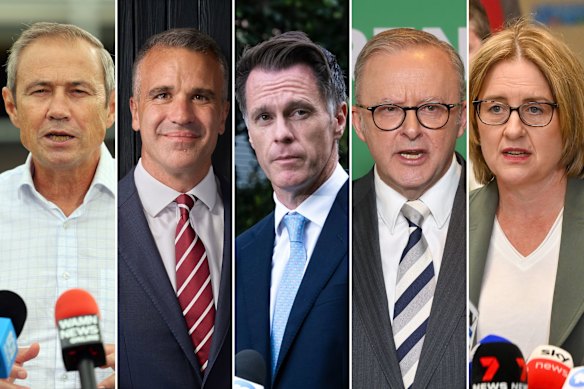 Prime Minister Anthony Albanese (second from right) and state premiers (from left) Roger Cook (WA), Peter Malinauskas (SA), Chris Minns (NSW) and Jacinta Allan (Vic).
Western Australia is a big winner from the latest distribution; its share of GST will rise from 8.3 to 9.1 per cent, even though it is the strongest state financially.
Queensland will receive the largest dollar increase in GST distribution of $1.7 billion.
But the NSW share of GST will fall to just 25.5 per cent of the national pool, even though the state has about 31 per cent of the Australian population. The commission said one reason for the decreased share was “above-average growth in land values” in NSW, which meant it has the capacity to raise more land tax revenue relative to other states. NSW also spent less on natural disaster relief than it had previously estimated.
Related Article
Victoria’s share of GST fell slightly, but it will still receive $1.5 billion more in 2026-27 than the previous year.
Victoria’s allocation for the coming year ($27.9 billion) will be about $1.7 billion more than NSW ($26.2 billion), even though the former has a smaller population.
State treasurers from NSW and Queensland reacted angrily to the commission’s recommendations.
NSW Acting Treasurer Courtney Houssos said the proposed carve-up showed the GST system was “broken and unfair” and called for urgent reform.
“This decision again demonstrates the need for a fairer allocation of how the GST is distributed across the states and territories,” she said.
How the GST is carved upWhen the GST was introduced in 2000, then-prime minister John Howard promised all of it would be shared among the states and territories. How it was allocated would be decided by the long-standing Commonwealth Grants Commission.Every year, the commission examines how much money each state and territory needs to deliver an “average” level of service to its residents, from education to policing.This is affected by a large range of factors, including population growth, mineral royalties and social factors such as Indigenous and remote populations.The commission recommends to the federal treasurer how the GST should be shared. No treasurer has ever overruled the commission’s findings.In 2019, amid fears that WA could end up with a very low portion of the GST, the Morrison government put in place a system that would guarantee its share while also injecting extra funds into the GST pool to ensure no other state or territory would be worse off.
“We will continue to engage with the Commonwealth and work towards a more transparent system which can deliver NSW our fair share.”
Queensland Treasurer David Janetzki said his state had been “dudded” by the latest GST allocation and also called for the model to be overhauled.
He said while the state’s headline share had increased, this was an uneven allocation from the national pool.
Janetzki noted that while the national GST pool had increased by 20 per cent over the past three years, Queensland was the only jurisdiction allocated less this round than in 2023-24.
“Queensland should be getting its fair share of the GST pie, not playing second-fiddle to a second-rate distribution model designed to dud us,” he said.
The GST is the biggest single source of revenue for state governments, meaning the Commonwealth’s distribution of the tax has a major bearing on state budget balances.
The Commonwealth Grants Commission uses a complex method to determine how the GST pool should be divided between the states. It aims to ensure that all states have an equal capacity to provide services to their populations. Small states traditionally receive more GST per head of population than larger states.
Related Article
However, economists have criticised the commission’s GST distribution method for being overly complicated and lacking in transparency.
A deal struck by the Morrison government to protect Western Australia’s share of GST, which had plummeted due to soaring iron ore prices in the 2010s, has also drawn fire from budget experts.
That overhaul in 2019 significantly changed how the GST was divided and required the introduction of a “no worse off” provision for states, which is now costing federal taxpayers billions of dollars a year.
The federal Productivity Commission is now reviewing how the GST is shared between states; its interim report will be published in November.
Cut through the noise of federal politics with news, views and expert analysis. Subscribers can sign up to our weekly Inside Politics newsletter.
Save
You have reached your maximum number of saved items.
Remove items from your saved list to add more.
 Matt Wade is a senior economics writer at The Sydney Morning Herald.Connect via X or email.
 James Hall is the News Director at the Brisbane Times. He is the former Queensland correspondent at The Australian Financial Review and has reported for a range of mastheads across the country, specialising on political and finance reporting.Connect via X or email.From our partners