
The combination of two achiral photonic membranes into a twisted bilayer breaks mirror symmetry and induces non-Hermitian coupling between counter-rotating collective modes, making laser emission chiral.
In light-matter interactions, chirality is traditionally associated with circular polarization or geometrical characteristics of the system. Generating chiral laser emission therefore usually relies on the excitation of circularly polarized modes, using chiral cavities or introducing asymmetric excitation1,2,3. Now writing in Nature Communications, Peng and co-workers demonstrate a fundamentally different mechanism to achieve chiral lasing, where the emission handedness arises from collective circulation of light in a twisted bilayer4.
A relative twist between two otherwise achiral photonic membranes (Fig. 1a) creates a moiré bilayer where isotropic guided resonances are localized by the pump into counter-rotating collective modes. The resulting broken mirror symmetry introduces non-Hermitian coupling between the modes that lifts their degeneracy and sets the handedness of the emission, resulting in deterministic lasing of a single chiral vortex state, without any chiral meta-atom, helical geometry or asymmetric pumping.
Fig. 1: Artistic views.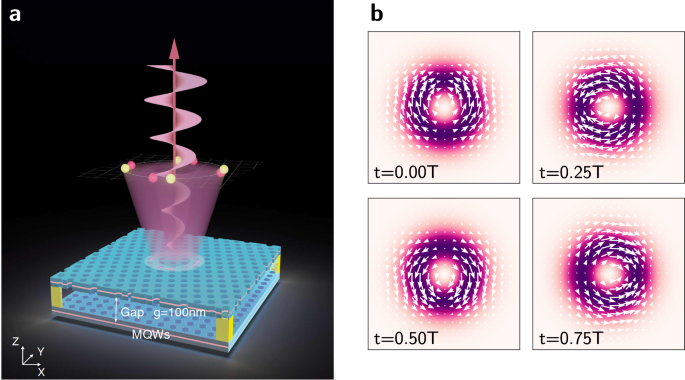
a Schematic of twisted photonic structure. The system comprises a pair of twisted and bonded metasurface membranes with InGaAsP multiple quantum wells (MQWs) separated by a gap distance of 100 nm (Adapted from Fig. 1 of ref. 4). b Artistic view of the ring-vortex mode at different time instants over one optical period. Electric field polarization is shown with arrows, intensity is shown with color.
Extending the reach of moiré photonics—already a powerful tool to control light-matter interactions5,6,7,8,9—this work further shows that, in twisted photonic structures, chirality can arise as a collective property, enabling angular momentum control and chiral light generation4.
Remarkably, the lasing mode obtained by Peng et al.4 from their twisted moiré metasurface is a ring-vortex mode10 (Fig. 1b) which combines a circulating phase with a polarization structure. It arises collectively from the symmetry and the coupling of two achiral building blocks.
The starting point is a single square-lattice (D4h) metasurface that supports a transverse-electric (TE) band, whose Γ-point mode transforms according to the A2g representation, responsible for the polarization structure of the final lasing mode. Microscopically, each meta-atom in this band behaves predominantly as a vertically oriented magnetic dipole11, giving rise to a symmetry-protected bound state in the continuum (BIC)12. In an infinite single structure of this kind, this mode is perfectly confined at the Γ-point and does not radiate.
However, the optical gain introduced at a finite pumping spot imposes a spatial confinement that effectively quantizes the guided states near the Γ-point, producing a family of collective guided resonances. Owing to the isotropic dispersion of the underlying TE band, these states naturally organize into modes with a well-defined angular phase winding of ± 2πℓ, \(\ell \in {\mathbb{N}}\), corresponding to clockwise and counter-clockwise rotating states, respectively. When two such metasurfaces are stacked with a relative twist, the resulting moiré superlattice couples the modes of the upper and lower layers, lifting the degeneracy between the counter-rotating states. Additionally, the moiré periodicity is chosen to make diffraction channels coincide with accidental BICs, reducing out-of-plane radiation losses. In this way, the moiré pattern simultaneously mediates interlayer coupling and engineers the system’s radiative landscape.
The combined effects of gain-induced quantization, twisted interlayer coupling and diffraction control give rise to a single lasing mode with a striking structure. Its intensity profile is doughnut-shaped, its phase winds by 2π around the beam axis (corresponding to ℓ = 1), and its polarization is predominantly azimuthal. Crucially, only one of the two possible azimuthal chiral modes reaches threshold, leading to deterministic selection of the lasing handedness without relying on chiral pumping or structural asymmetry at the meta-atom level.
Beyond demonstrating a vortex laser, the study links collective guided resonances, twist-induced symmetry breaking and non-Hermitian interlayer coupling into a single mechanism that selects a chiral lasing mode. More broadly, it suggests that moiré engineering can be used not only to tailor dispersion but also to control the very topology of optical motion, opening new directions for chiral light sources and collective photonic states.
By tuning and scaling the mechanism reported by Peng and co-workers, for example, by varying twist angle, layer spacing or pumping conditions, twisted bilayer metasurfaces could provide a compact route to on-chip chiral lasers and a broader variety of engineered emission states.