

A glorious end to the season beckons for Arsenal, on course for their first Premier League title in 22 years and still in the Champions League, the FA Cup and Carabao Cup.
But appreciation has been relatively scarce. In recent months, the well-worn taunts about their mentality — “Bottlers”, “They’ll blow it”— have gradually given way to gripes about their playing style and much else.
If it’s not former Manchester United icons declaring this Mikel Arteta’s team would be the “worst team to win the league”, it’s Brighton & Hove Albion coach Fabian Hurzeler taking issue with Arsenal’s approach to what might be called “game management”.
“That’s not football, what Arsenal did there,” Hurzeler told reporters after their 1-0 win at Brighton last week, citing the number of times goalkeeper David Raya went down asking for treatment and the amount of time Arteta’s players took over set pieces and restarts. “They (Arsenal) make their own rules, no matter how they’re playing.”
It got us at The Athletic thinking. Was Hurzeler merely articulating what others in the game are too diplomatic to say? Is respect for Arsenal’s progress under Arteta really as grudging within the football industry as it is among rival fans on social media?
To try to answer those questions, we spoke to various sources within the Premier League: two club executives, a senior recruitment figure, an academy coach, a player, a scout and a set-piece analyst — all of whom agreed to speak freely on the condition of anonymity in order to protect their position.
We also trawled through various interviews over the past couple of years to try to present a clearer picture of how perceptions of Arsenal have changed among some of their rivals — how respect has grown or, in some cases, diminished as Arteta’s team have become more uncompromising in pursuit of success.
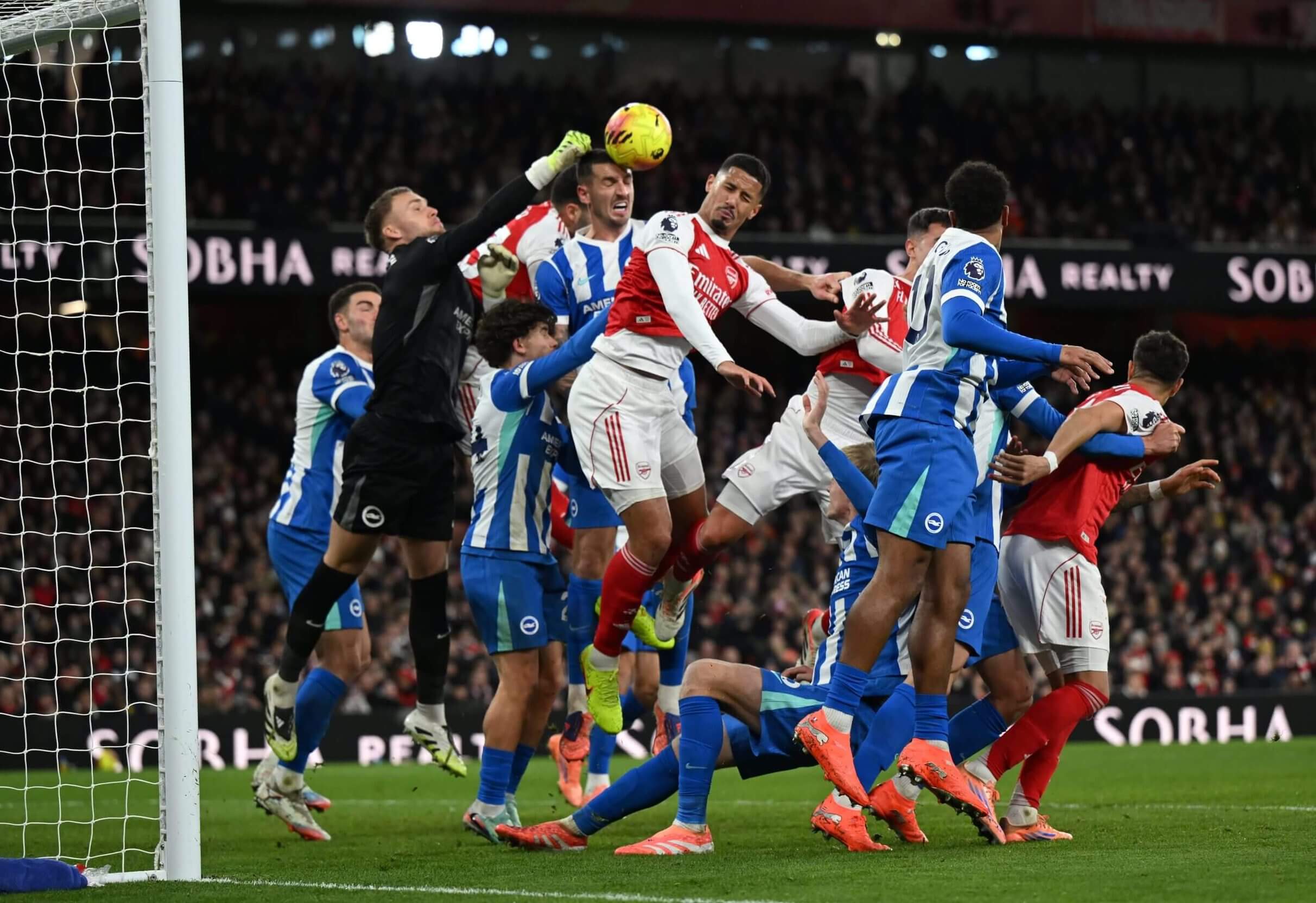
Bart Verbruggen punches the ball with many Arsenal and Brighton players around him (Shaun Botterill/Getty Images)
An analyst at a Premier League club had a sinking feeling. He had seen his team fall behind against Arsenal and, in the 15 minutes that followed, any potential route back into the game seemed to close.
“You analyse them beforehand and you look for weaknesses,” the analyst says. “You might see one player is more susceptible to being pressed in the build-up. You might feel you can restrict them if you can force them to play more down their left than their right, or if you can find certain spaces when you’re counter-attacking.
“At 0-0 you feel you’ve got a chance of frustrating them. But once you fall behind, different story. The gaps you thought were there are no longer there. With the Manchester City and Liverpool teams of recent years, their approach didn’t change massively from 0-0 to 1-0 to 2-0. But with this Arsenal team, everything becomes even more compact. It’s incredibly hard if you fall behind against them.”
An executive at another club offers a similar view. “They’re like a python,” he says. “They squeeze the life out of you. It’s strangulating. They play this very constricting, incredibly effective brand of football. The third-best defence in this league is Everton and they have conceded 50 per cent more goals (33) than Arsenal have (22). Arsenal are ruthlessly efficient and they capitalise on set pieces.”
If any of that sounds grudging, the executive insists it is not. “When I talk to people around our club or in the one degree away, there’s tremendous respect for Arsenal’s capability.”
The analyst shares that admiration. “Their set plays are elite,” he says. “Three things: 1) their analysis in pinpointing their strengths, the opposition’s weaknesses and how to exploit them, 2) the deliveries from (Bukayo) Saka and (Declan) Rice, 3) the number of aerial threats they have, their movement and the way Gabriel in particular attacks the ball.
“Until recently there was almost a 50/50 split across the league between inswinging and outswinging corners. You had teams like Liverpool scoring a lot from outswingers. Arsenal were an outlier in focusing so much on inswingers. But you look now and everyone is following what Arsenal do. I said earlier that you don’t mind them attacking down their left. But at the same time, you’re terrified of conceding corners down that side, with Rice whipping them in.”
The analyst says his own team have tried to replicate elements of Arsenal’s approach: not only the way they crowd the six-yard area and deliver their corners but also small details like “how slowly and deliberately their defenders walk up from the halfway line”, which is designed to build tension among their opponents.
“I love what they do,” the analyst says. “Analysts and data people love that side of the game — analysis, attention to detail, repetition, seeing pre-rehearsed routines work in a match situation. Whether coaches enjoy it so much, it probably depends who you ask. ”
As well as Hurzeler, Liverpool coach Arne Slot has been critical of this season’s trend towards increased emphasis on set pieces and the way they are policed — or not — by match officials. Last week, he told reporters that “most of the games I see in the Premier League” this season “are not for me a joy to watch”.
But Slot has not criticised Arsenal or any other club specifically. On the contrary he has urged his Liverpool team to embrace the set-piece trend, which has brought dividends in recent weeks.
Pep Guardiola, whom Arteta worked under at Manchester City as assistant coach, has said similar. “We are moving in that direction,” the Manchester City manager said. “I pay more attention to set-pieces than when I started my career in Barcelona, for sure. Much more.”
Others have praised Arsenal effusively. Brentford coach Keith Andrews has called them “the best team in the country”, citing “so many talented individuals”, “the mentality he (Arteta) has instilled in the group”, “the way Mikel has set them up” and “how they can hurt you in different phases of the game”.
Burnley’s Scott Parker has called them “an unbelievably well-coached team, a team that solves situations … a fluid team, (…) definitely not a team that just relies on set plays”. Bournemouth coach Andoni Iraola has highlighted the “elite” level of their goalkeeper Raya and central defenders William Saliba and Gabriel in particular.
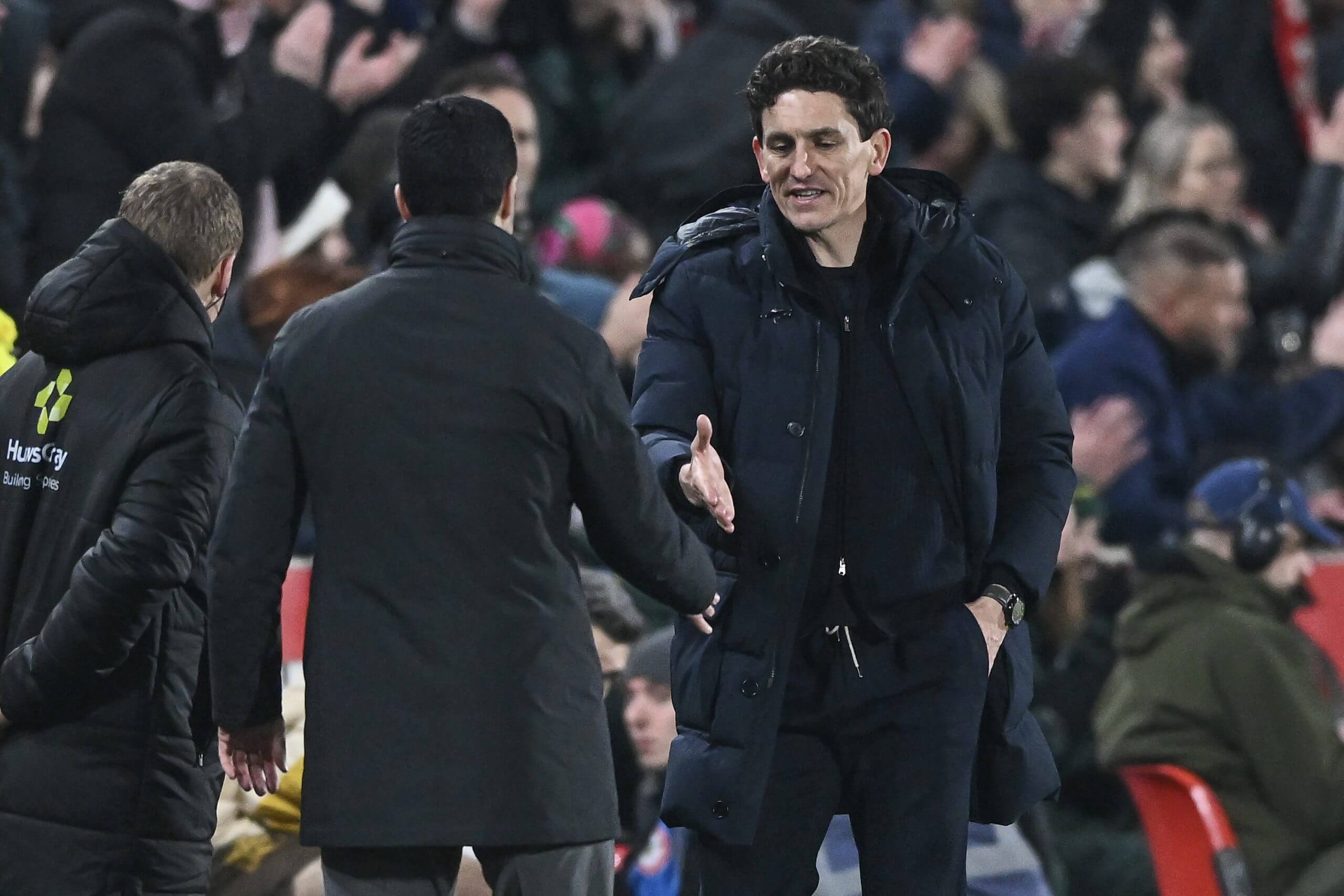
Other managers, such as Brentford’s Keith Andrews, have praised Mikel Arteta’s side (Vince Mignott/MB Media/Getty Images)
David Moyes, whose Everton team face them on Saturday, says Arsenal have been “brilliant” all season, “in the top one or two teams in Europe”. “I hear quite a lot of criticism of Arsenal,” he said. “(But) when you’re in football and you actually know what happens and what works, they’re doing amazing to be leading the league and being out there.”
As for Arsenal’s Champions League opponents, Diego Simeone described them earlier in October as “the best team Atletico Madrid have faced this season; they run and run and there’s quality all over the pitch”. Inter coach Cristian Chivu said Arsenal and Bayern Munich are the two best teams in Europe. Bayer Leverkusen coach Kasper Hjulmand called them “one of the best teams in the world” before their 1-1 draw on Wednesday.
In player recruitment circles, their transfer strategy draws plaudits, particularly in comparison with some of their rivals’ records. A senior recruitment figure at one club points out that Arsenal’s net transfer expenditure over the past three seasons is the highest in the Premier League — “They have been able to keep buying at a significant level without selling at a significant level” — but adds that, like Manchester City and Liverpool previously, they have succeeded in buying a group of players (notably Raya, Saliba, Gabriel, Rice, Jurrien Timber, Martin Odegaard) who have grown together under Arteta to form the nucleus of a title-challenging team.
“If you look at the squad Arteta inherited (in 2019) and the squad they have now, the difference is night and day,” the recruitment figure says. “They have evolved over that period and everything they have done — whether it’s player recruitment or the work they do on set pieces — has a real clarity to it. All of it has been driven by Arteta. You have to say he has done an exceptional job.”
The praise Arsenal’s performances attract at elite level, where the stakes are so high, is not necessarily echoed throughout the game.
An academy coach at a Premier League club suggests the football we are seeing in this season’s top flight — more physical, more attritional, more geared towards set pieces and choreographed routines, with a sharp drop in the number of goals scored from open play — is a concern and that Arsenal have become “poster boys” for this approach.
“It took English football years to get away from this mentality of wanting big, strong, powerful players — and to realise we needed to produce technical players who could do the same things the German, Spanish and French players were doing,” the coach says.
“I look at the technical players our academies have produced over the last 10 years and it’s been such a positive for English football. When I see the way Arsenal play, which obviously is very effective, I worry it will take us back towards this ultra-physical style we were trying to get away from.
“It also disappoints me that (Myles) Lewis-Skelly and (Ethan) Nwaneri, two of the best young players in the country, have barely had a kick in the Premier League this season. Nwaneri has ended up going on loan (to Marseille). I get that Arteta’s priority is to win trophies, but are you saying Lewis-Skelly and Nwaneri couldn’t contribute to that?
“I don’t want a situation where a brilliant academy is producing brilliant players and they can’t get a game in the Premier League. Again, that’s something I hoped we had moved away from.”

Ethan Nwaneri has been loaned out to Marseille (Catherine Steenkeste/Getty Images)
The academy coach echoes Hurzeler’s distaste for the delays that inevitably come with a heightened emphasis on set pieces. “It’s not just Arsenal — others are just as bad — but the time they take over every corner and every free kick bothers me as a coach,” he says.
“And the time-wasting. I watched their game at Brighton last week and it was as if they were only really happy when the ball was off the pitch. A lot of people won’t care, but it’s very different to the Manchester City team who have set the standard for the past 10 years.”
A scout at a leading Premier League club is similarly unimpressed. He too draws unflattering comparisons between recent title-winning teams at Manchester City (“a joy to watch, intricacy, fluidity”) and Liverpool (“chaotic, exciting, very much on the front foot”) and this Arsenal side (“efficient, pragmatic, nothing we haven’t seen before”). “But it’s working for them,” he adds.
Talk of time-wasting and “game management” is never far from the conversation these days where Arsenal are concerned.
In the game at Brighton that Hurzeler highlighted, Arsenal took a total of 30 minutes and 51 seconds to restart play, i.e. their 59 restarts (from goal kicks, throw-ins, free kicks and corner kicks) took an average of 31.4 seconds.
Those stoppages were analysed here by Stuart James, who pointed out that, however egregious it might seem for one team to eat up 30 minutes and 51 seconds of playing time, there had been 21 instances in the Premier League this season of sides taking even longer over their restarts. None of those 21 was Arsenal.
A Premier League player says he has “no issue” with any of it. It is frustrating when opponents run the clock down, he says. “But when you get to the closing stages and you’re 1-0 up, of course you’re going to do everything to try to break up the game and make it stop-start. Arsenal are good at it, but everyone does it. You would be naive not to do it.”
The player in question feels Manchester City might have a higher level “on their day” but that Arsenal are a much stronger and more consistent team. He adds that Rice’s qualities are hard to appreciate fully unless you have played against him and that the England midfielder, along with Gabriel, will be prominent in his thoughts for the Professional Footballers’ Association Player of the Year ballot.

Declan Rice’s ‘qualities are hard to appreciate fully unless you have played against him’ (Carl Recine/Getty Images)
Certain teams have been involved in flashpoints with Arsenal over recent seasons. They include Newcastle United, whose combustible assistant coach Jason Tindall has clashed with Arteta during some fiercely contested meetings between the two teams.
Arteta’s behaviour in the technical area — and at times beyond it — has put some backs up in the Premier League coaching fraternity. So too, certainly, has Tindall’s.
But Newcastle defender Dan Burn has suggested his team should take a leaf or two from Arsenal’s playbook. “We were well known a few years ago for … I won’t say the word, ‘something-housery’,” he told reporters recently.
“We could go ugly and bully teams and that was the way we went about it. As you progress and want to push on, you move away from that because you bring in better quality players and play better football. But there’s always a place for that in the game. Arsenal are quite good at doing that, but are playing very good football and are top of the league. Maybe we need to do more of the ugly side that we were known for at the time.”
There are long-established tensions between Arsenal and Manchester City at boardroom level, but in recent seasons that rivalry has extended to the pitch. There have been a series of flare-ups involving Erling Haaland: throwing the ball at Gabriel and telling Arteta to “stay humble, eh” after City’s stoppage-time equaliser in September 2024, before Arsenal youngster Lewis-Skelly mimicked “his” celebration during the London club’s 5-1 victory at the Emirates later that season.
Manchester City captain Bernardo Silva has said Liverpool are more worthy rivals because of their success and because they “always face us with the intention of winning the game”. Beyond that, his midfield partner Rodri has criticised Arsenal’s “mentality”, specifically in a 0-0 draw in Manchester in the run-in in March 2024. “I don’t think we would do it the same way,” Rodri said of that game.
But City’s set-up in the closing stages at Arsenal last September, as they held on to a 1-0 lead, was every bit as defensive; Guardiola replaced Phil Foden, Haaland and Jeremy Doku and switched to a 5-4-1 formation, ceding possession and defending deep, a move that backfired when Gabriel Martinelli equalised for Arsenal in stoppage time.
Just like two and three seasons ago, City are pursuing Arsenal as the Premier League campaign heads towards a climax. On those previous two occasions, Guardiola’s team successfully reeled them in. So far this season, Arsenal have appeared resolute in their bid to last the distance.
It appears instructive that none of those The Athletic spoke to for this article paid the slightest heed to the narrative peddled by rival fans and certain pundits — as well as Rodri — that Arsenal are beset by an ingrained mental fragility.
On the contrary, what shines through is an admiration — generous in some quarters, a little more grudging in others — for their resilience, their set-piece prowess and for the other qualities that have carried Arteta and his team this far.
An executive at another club proposes that Arsenal would be the most fitting champions for a Premier League season which he feels has been defined by dead-ball situations and the failures of the PGMOL and match officials to police them properly.
“Arsenal clearly have a lot of strengths, but one of them is that they have worked out, better than everyone else, what you can get away with in this league and how far you can push it,” he says. “And part of me thinks, ‘You know what? Fair play to them’.”