
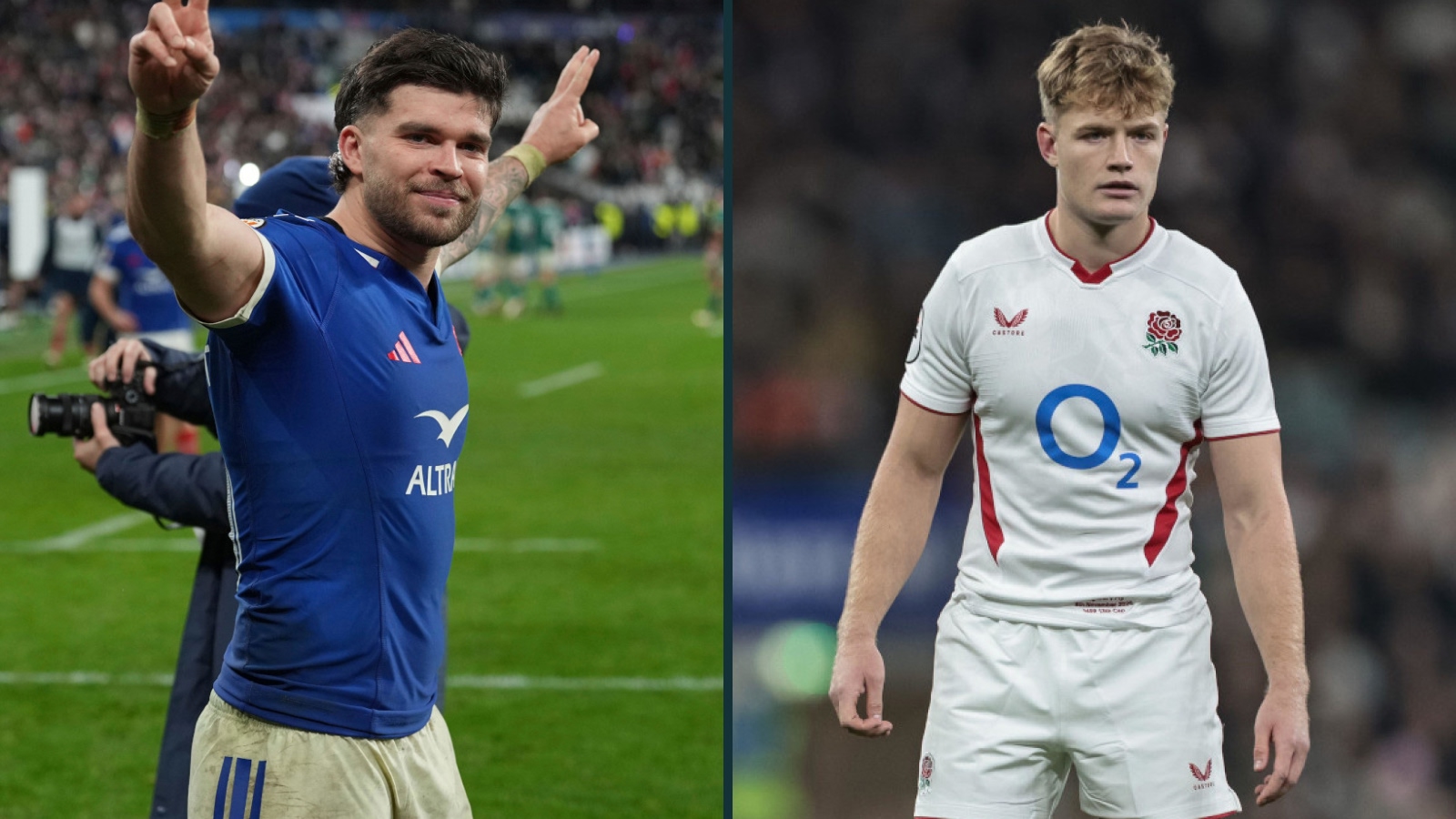
This was supposed to be the match of the tournament before the tournament began.
Two unbeaten sides, Paris under lights in March, a Grand Slam decider carrying 120 years of rivalry in every collision. But Scotland had other ideas at Murrayfield and Italy had other ideas in Rome.
And, as a by-product, the Grand Slam decider became something rawer and, in its way, more compelling. French redemption against English desperation on Super Saturday, both camps arriving at the Stade de France carrying wounds that will not have fully closed.
France lost 50-40 at Murrayfield and watched their Grand Slam evaporate in a second half that exposed the particular fragility lurking beneath this team’s brilliance. England lost 23-18 in Rome and made history of the worst possible kind, becoming the first England side in 33 attempts to fall to Italy.
Yet the Championship still hangs. If Ireland have beaten Scotland by the time Antoine Dupont leads France into the tunnel, any French victory secures the title. If Scotland have won in Dublin, France need a bonus-point victory and the mathematics become complicated. England need a win to avoid their joint-worst-ever Six Nations finish and would simultaneously gift the title to either Scotland or Ireland. The stakes could scarcely be higher, but for entirely different reasons on each side.
Stade de France under lights on a spring evening remains one of rugby’s great settings. There will be no shortage of motivation in either dressing room.
Where the game will be won
The primary battle is physical. France build their game on collision dominance, the capacity to hit hard enough in the first exchanges of every contest that the opposition’s defensive structure begins to splinter. England, with Ollie Chessum introduced at blindside and Ben Earl leading the tournament in carries with 79, will not be short of ambition in that department and that collision contest sets the template for everything that follows.
The secondary battle is the floor, and here a distinction that is rarely made properly becomes important. Jackaling is a reactive discipline; you can only contest a ruck that an opponent has created through a carry, which means the breakdown battle is entirely contingent on who has won the physical exchange that preceded it. Win the collision and you create the ruck. Lose it and you are contesting ball you should never have surrendered, so that jackal moment will be critical for England, and to their credit, they may have a competitive advantage there. France lose Oscar Jegou to suspension and Anthony Jelonch through a calf niggle, and the shape of their back-row has changed considerably. Temo Matiu, a fast, rangy athlete with outstanding lineout skills starts at right flanker on debut, with Charles Ollivon moving from lock to number eight. As a result, England may find more opportunity at the breakdown than they have been afforded all tournament, and the central expression of that contest is Francois Cros against Chessum. Cros is the consummate ruck monster, the player who imposes order around the ball with forensic efficiency that only years of operating at the highest level produces. Chessum brings power rather than system. Which quality proves more decisive on a title night in Paris is one of the genuine uncertainties of the evening.
The scrum presents a clearer opportunity. Ellis Genge will target Dorian Aldegheri, who has looked susceptible throughout this championship, his technique under sustained pressure falling short of the standard the rest of the French pack has consistently set. Ironically, France possesses the best scrum success rate in the tournament at 90.9% and are the only side to have scored multiple tries from scrum possession, but those numbers have been accumulated against opponents less forensically prepared than England will be. Genge knows the opportunity is there.
The kicking game is the third dimension and the most dangerous. Ben Spencer and Fin Smith operate a territory-based structure that has been England’s consistent tactical signature throughout the Borthwick era. Against most teams it generates pressure. Against France it has the danger that it generates transition. Dupont, Thomas Ramos as sweeper, Theo Attissogbe’s pace and aerial quality; France are the most dangerous counter-attacking team on the planet, and England have selected a kicking-oriented back three to face them. Execution has to be perfect and loose kicks will be punished at a speed that offers no time for correction.
Last time they met
What they said
Cros was perhaps the most forensically honest voice in the French camp after Murrayfield. The 40 points France accumulated, he said, “was almost incidental, almost a decoy. It was good that they had taken the bonus point because it might yet matter,” but Cros was in no mood to find comfort in arithmetic. Scotland had relaxed a little at the end, he acknowledged. What was certain, and he made no attempt to soften it, was that conceding 50 points at international level did not forgive. It was genuinely not what France had come to Edinburgh to do. The frustration was unambiguous.
Dupont was equally direct. He had made two mistakes that cost France dearly and said so plainly, without reaching for excuses. France had been undisciplined; they had absorbed collision after collision and found no way out. Discussing individual performances would advance nothing, he insisted. The work ahead was collective.
Want more from Planet Rugby? Add us as a preferred source on Google to your favourites list for world-class coverage you can trust.
Ramos had said earlier in the week that it was impossible to talk about a Grand Slam until France had played in Scotland. The evening provided the proof. France had not won back-to-back Championships in a very long time, he said, and they had no intention of leaving the trophy to another nation.
Steve Borthwick addressed a press conference in Rome that afforded little room for comfort. He insisted the team’s growth over the previous 12 months had been very, very strong. On Chessum, whose introduction is the one change to the starting XV, Borthwick was pointed: the Leicester forward had been disappointed and frustrated with his own performance against Ireland, came on against Italy and did a really good job, and has earned his recall. On Marcus Smith and Sam Underhill winning their 50th caps from the bench, Borthwick said reaching that landmark was a reflection of the consistency both had shown across their England careers. England go to Paris needing a performance that justifies all of it.
Maro Itoje, making his 50th Six Nations appearance, was direct about where responsibility lies. The players, he said, must take accountability. The occasion demands a response that the previous three weekends have not produced.
Players to watch
The floor battle between François Cros and Ollie Chessum will be decided long before most watching have noticed it is happening. Cros operates in the spaces between the obvious, the player who arrives at the ruck before the defence has reset, who clears the contact area with an efficiency that makes the next phase look easy. He is the connective tissue of the French forward effort and the reason their transition game fires as quickly as it does, when it does. Chessum brings a different proposition entirely; raw physical power, the capacity to disrupt through force rather than system. England will need him to impose himself early and sustain it. If Cros neutralises that disruption and controls the floor, France will move the ball at a tempo that England’s defence will struggle to organise against.
The fly-half contest carries the tactical weight of the match. Matthieu Jalibert against Fin Smith is the apex battle of the evening, two players operating under different kinds of pressure with different tools at their disposal. Jalibert leads the Championship in try assists, his instinctive Bordeaux game translating directly into Test rugby, running angles that force defenders into decisions they would rather not make. When Dupont is beside him and Louis Bielle-Biarrey is outside him, the combinations available are sufficient to trouble any defensive system on earth. Fin Smith has the range and intelligence to control territory and his kicking game is genuine, but he carries the weight of three defeats and a nation’s exasperation into the most pressurised atmosphere the Six Nations offers. The margin between them, in form and in context, is close to the margin of the match, and that’s before you factor in the relative success rates off the tee of Smith and Ramos for France.
The centre contest has a redemption dimension that gives it an edge beyond the positional. Yoram Moefana has been widely criticised in France following his display against Scotland, a performance that drew the kind of scrutiny reserved for players expected to be better than they were. Much of that criticism has been fair; Moefana is a powerful, direct ball-carrier whose best form for Bordeaux-Bègles is considerably more than he showed at Murrayfield, where his defence almost evaporated, and he will arrive at the Stade de France with something to prove to the people who have been loudest about his shortcomings.
Seb Atkinson, meanwhile, is still finding his feet at Test level, a young player of genuine promise asked to operate in the most demanding environment his career has offered. The contrast in experience and context between the two centres is stark. Moefana seeking to silence his critics on home soil against an opponent still establishing himself at this level is a contest that could produce something decisive in either direction.
Main head-to-head
Tom Roebuck against Louis Bielle-Biarrey is the contest that will either give England a foothold in this match or confirm France’s absolute superiority in the positions that matter most. Bielle-Biarrey’s strike rate is extraordinary, 25 tries in 27 appearances at this level, a ratio that puts him in a category occupied by very few players in the history of the Championship. For context, Cheslin Kolbe, long considered one of the most naturally gifted finishers of his generation, has scored 21 tries in 52 appearances. That is the scale of the difference.
Roebuck is a quality player. His try against Italy showed what he can produce when the execution is right and the moment is taken. The crossfield kick found him, he caught it clean, he stepped inside and finished with composure. It was exactly the kind of moment England need more of on Saturday. The problem is that Roebuck will arrive at the Stade de France with one shoulder closed, one foot braced, fully prepared for the aerial contest that his position demands. Bielle-Biarrey does not wait for the aerial contest. He creates the terms of engagement entirely on his own. Roebuck is a fine player. On this particular evening, against this particular opponent, that may not be close to enough.
Prediction
France win this tournament and they do so on Saturday night. The disruption to their back-row is real, the memory of Murrayfield is raw, but Fabien Galthie’s squad has the depth and the motivation to absorb both. Dupont will want to settle accounts after two costly errors in Edinburgh whilst Cros will want the scoreline never mentioned again. The Stade de France will do the rest.
England will compete in the forward exchanges and the set-piece will be more contested than France have encountered all tournament. The kicking game may produce moments of genuine danger if Spencer and Fin Smith are disciplined, and Marcus Smith and Sam Underhill arriving from the bench carrying their 50th caps will bring energy in the final quarter. The talent is present, but whether the emotion and execution assembles coherently in the one match that matters is the question that has haunted this England campaign since February.
On a night when France have a title to defend, a tournament to salvage and a humiliation to avenge, and with 80,000 demanding all three, it’s hard to see even the most unlikely of English rearguard victories. France by 22.
Previous results
2025: England won 26-25 in London
2024: France won 33-31 in Lyon
2023: France won 53-10 in London
2022: France won 25-13 in Paris
2021: England won 23-20 in London
2020: England won 22-19 in London
2020: France won 24-17 in Paris
2019: England won 44-8 in London
2018: France won 22-16 in Paris
2017: England won 19-16 in London
The teams
France: 15 Thomas Ramos, 14 Theo Attissogbe, 13 Pierre-Louis Barassi, 12 Yoram Moefana, 11 Louis Bielle-Biarrey, 10 Matthieu Jalibert, 9 Antoine Dupont (c), 8 Charles Ollivon, 7 Temo Matiu, 6 Francois Cros, 5 Emmanuel Meafou, 4 Thibaud Flament, 3 Dorian Aldegheri, 2 Julien Marchand, 1 Jean-Baptiste Gros
Replacements: 16 Peato Mauvaka, 17 Rodrigue Neti, 18 Demba Bamba, 19 Hugo Auradou, 20 Mickael Guillard, 21 Joshua Brennan, 22 Baptiste Serin, 23 Emilien Gailleton
England: 15 Elliot Daly, 14 Tom Roebuck, 13 Tommy Freeman, 12 Seb Atkinson, 11 Cadan Murley, 10 Fin Smith, 9 Ben Spencer, 8 Ben Earl, 7 Guy Pepper, 6 Ollie Chessum, 5 Alex Coles, 4 Maro Itoje (c), 3 Joe Heyes, 2 Jamie George, 1 Ellis Genge
Replacements: 16 Luke Cowan-Dickie, 17 Bevan Rodd, 18 Trevor Davison, 19 Chandler Cunningham-South, 20 Sam Underhill, 21 Henry Pollock, 22 Jack van Poortvliet, 23 Marcus Smith
Date: Saturday, March 14
Venue: Stade de France, Saint-Denis
Kick-off: 21:10 local (20:10 GMT)
Referee: Nika Amashukeli (GRU)
Assistant referees: Andrew Brace (IRFU), Hollie Davidson (SRU)
TMO: Brett Cronan (RA)
FPRO: Matteo Liperini (FIR)