
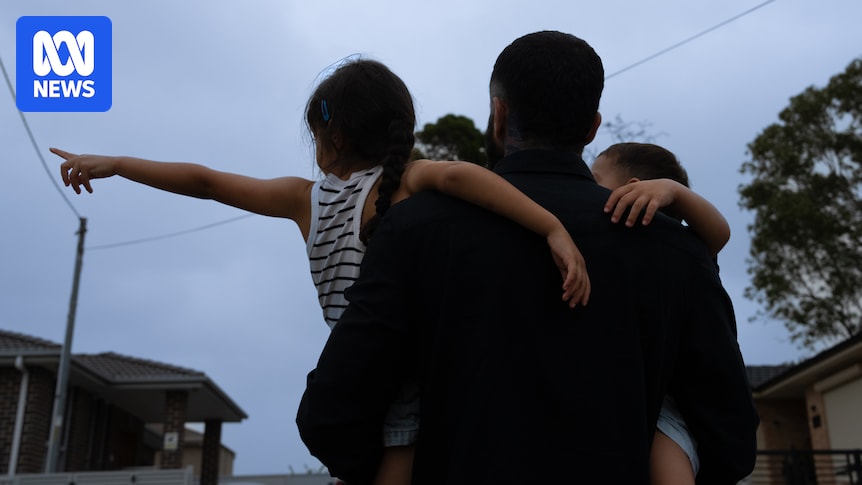
Twice in his life, AB has put his body on the line trying to stand up to violent extremists.
The first time, he won’t talk about.
That was in Iran where, as a young man, he was imprisoned and tortured after protesting against a theocratic regime.
The second time he has to talk about.
Homicide detectives have taken his witness statement about the Bondi terrorist attack on December 14 last year.
He told them how, in the final moments of the attack, he ran to disarm one of the Islamic State-inspired shooters, only to be shot at by police and assaulted by bystanders who mistook him for a terrorist.
AB, who for legal reasons can only be identified by a pseudonym, got out of a taxi on Campbell Drive at 6:42pm just as the massacre was unfolding.
He tells Background Briefing the spectacle of families fleeing the gunfire galvanised something in him.
“I’m running to [the] shooter until I saw him on the bridge,” he says.
“He’s like [a] professional, shooting, quick, quick, quick. Nonstop, nonstop, heavy, you know?
“Like he [is] dancing with [the] gun.”
From a car park below the bridge, AB could only see one shooter: Naveed Akram.
He didn’t realise there was a second gunman — Naveed’s father, Sajid — stalking towards the Jewish Hanukkah festival they were targeting.
The sound of gunfire ricocheted across the beachfront, seemingly endless. But suddenly, there was a lull.
AB saw his chance.
“I was thinking, OK, when he reloads, let me jump up,” he tells Background Briefing.
“It’s 50-50. You can catch his gun. Or he shoots you.”
He decided to rush the gunman.
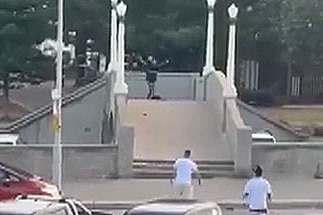
AB was shot at by police after he ran to disarm one of the gunmen in the final moments of the Bondi terrorist attack. (Supplied)
He moved to the bridge and ran up the stairs, where he found not one, but two gunmen, sprawled on the ground.
“I saw one of them. He’s laid down on his belly. He is bleeding,” AB says.
“But the other one, he’s still alive. He holds his gun.”
It was Naveed Akram.
AB, the first person to make it to the shooters on the bridge, says he kicked Naveed’s gun away.
And then a single shot rang out. It was the police.
AB says he heard the bullet fizz past his face: “Everything, like, in slow motion.”
In a split second, he went from good Samaritan to suspected villain.
He dropped to his knees, put his hands above his head, and screamed: “Don’t shoot!”
Armed police and furious locals swarmed him. He was punched, kicked and forced to the ground until a detective, who had seen him earlier, ran towards the scene.
“He starts yelling, ‘He’s not involved. He’s not involved,'” AB says.
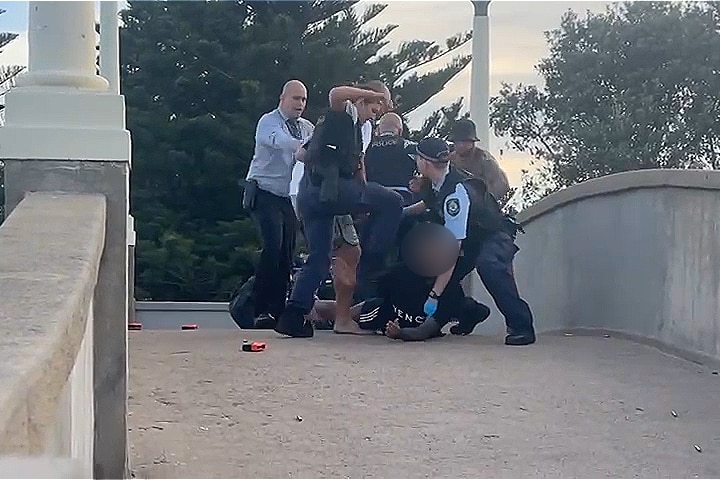
AB was accosted by police and assaulted by bystanders who mistook him for a terrorist in the moments after the Bondi attack. (Supplied: Nick Castellaro)
In the carnage after Bondi, AB walked among the bodies of those shot at the Hanukkah event.
He hailed paramedics, comforted the injured, and helped find towels and blankets to cover the faces of the dead.
“I’m in shock. I can’t handle it. I’m just thinking, I just want to hug my kids. I want to hug my missus. I want to hug my family. I just want to go home,” he says.
AB now carries the burden of Bondi.
A counsellor, writing in support of his application for support from NSW Victims Services, says AB reports having nightmares, flashes of the horrors he witnessed while rendering assistance in Bondi’s aftermath — only this time, it’s his own children he sees covered in blood.
“He screams in his sleep,” his partner, Sarah (not her real name), says.
“And then I don’t leave him alone. He’s not doing good.”
There’s another thought, though, which AB keeps turning over about Bondi that day.
He was not even supposed to be there.
From prisoner to political refugee
AB arrived in Australia in 2012, as a political refugee.
He was arrested by the Iranian regime at about the age of 20 after joining in massive anti-government protests. Then he was tortured in prison. He fled the country as soon as his father managed to get him out on bail.
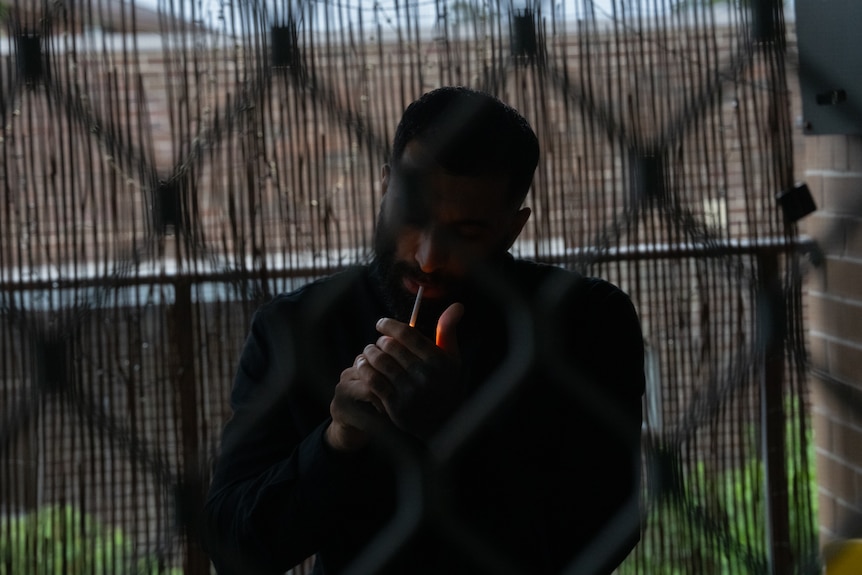
AB has struggled to shed the horrors he experienced in Iran. (ABC News: Jack Fisher)
“They caught me. I done jail, torture, everything,” he says.
But he can’t bring himself to detail what happened to him.
“I don’t want to talk about it because … I try to forget what they done to me,” he says.
“Mentally, physically, everything, everything …”
His immigration lawyer, Alison Battisson, says AB was “horrendously tortured by the Iranian regime”.
“He wasn’t just a protester, he was captured and they did terrible things to him over a period of time. We’re not talking one or two nights in a cell,” she says.
In the lucky country, AB struggled to put himself back together.
For the first time, he abused drugs and alcohol. He got into fights with a roommate and wound up in court, convicted of common assault and other minor offences.
Ms Battisson says it was the result of untreated trauma from Iran.
In the years that followed, his fortunes swung wildly.
AB, a Muslim, met Sarah, an Iranian Christian woman, and they built a life together.
“He was very honest. He was very gentle. And he was very kind,” she says.
He found stability in work, and even got paid to play indoor soccer.
But his issues resurfaced.
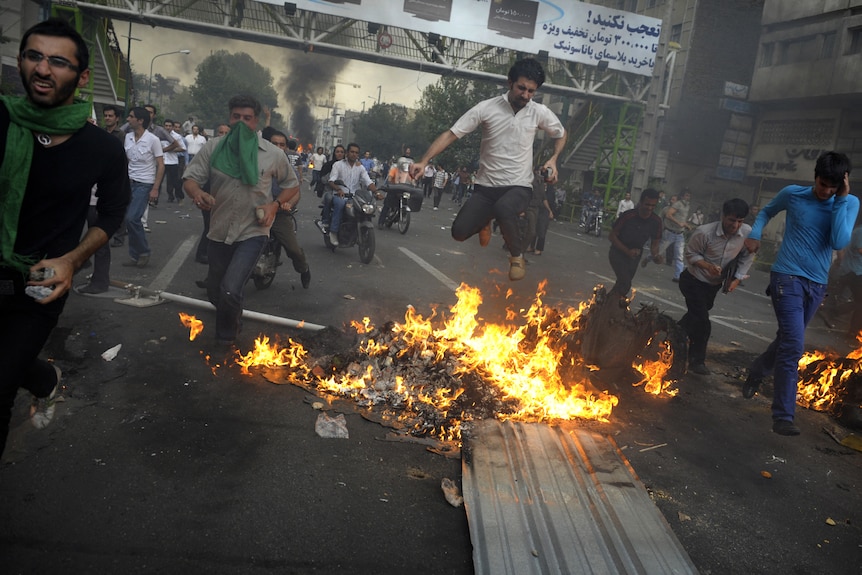
AB was one of thousands who took to the streets to protest against Iran’s government in 2009. (AFP: Olivier Laban-Mattei)
Two years after they met, AB pushed Sarah during a fight. She wasn’t injured. But, as a result, he was convicted of common assault and given a nine-month suspended jail sentence.
Three years later, he was convicted of stalking and intimidation over a text message he sent her.
He served three months in jail, with nine months’ parole.
For the next three years, he stayed out of trouble with police. But his good run ended late last year, when he was arrested and charged with minor drug supply offences.
On December 13, AB was picked up by authorities in Bondi and held overnight in a Surry Hills watch house.
Late the next day, a magistrate ordered AB’s release on bail with an important caveat: He couldn’t return to Bondi except to pick up his car left there the night before.
That’s how he came to arrive in a taxi in the first minute of a massacre, when he ran towards the danger while others around him fled.
“That’s why I say, God made it,” AB says.
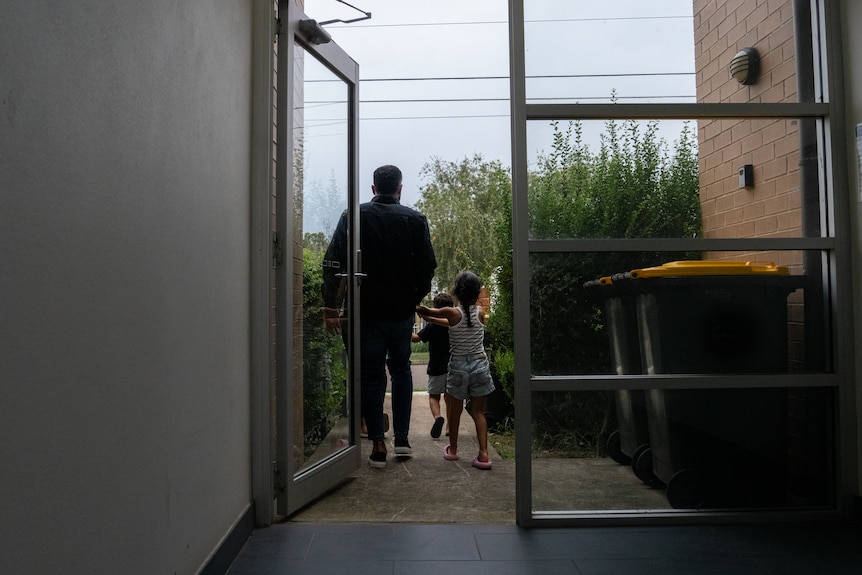
The couple raise their two young children — with another on the way — without any other family in Australia. (ABC News: Jack Fisher)
When he came home on the night of Bondi, Sarah says he was as white as a ghost. She had no idea what had happened to him.
“My kids are asking me, ‘Why are you crying?’ Because they never see I’m crying,” he says.
‘We fear they just come and take him away’
As a political refugee from Iran, AB once had safe haven in Australia.
While the United States and Israel attack his home country, more of his compatriots are being welcomed here.
This week, the Albanese government granted humanitarian visas to touring Iranian soccer players after concerns for their safety grew.
But AB’s story is more complicated.
While other Bondi heroes and survivors have been feted and fast-tracked for permanent residency on compassionate grounds, a different fate has hung over his head.
That year-long jail sentence before the Bondi attack meant he fell foul of immigration laws.
He failed the Australian government’s character test, and his humanitarian visa was cancelled.
He became an unlawful non-citizen and spent much of 2023 in immigration detention.
In another twist of fate, an independent tribunal restored his visa. It confirmed his refugee status and found Australia had to protect him.
AB was released back to his family. But soon, the political climate dramatically changed.
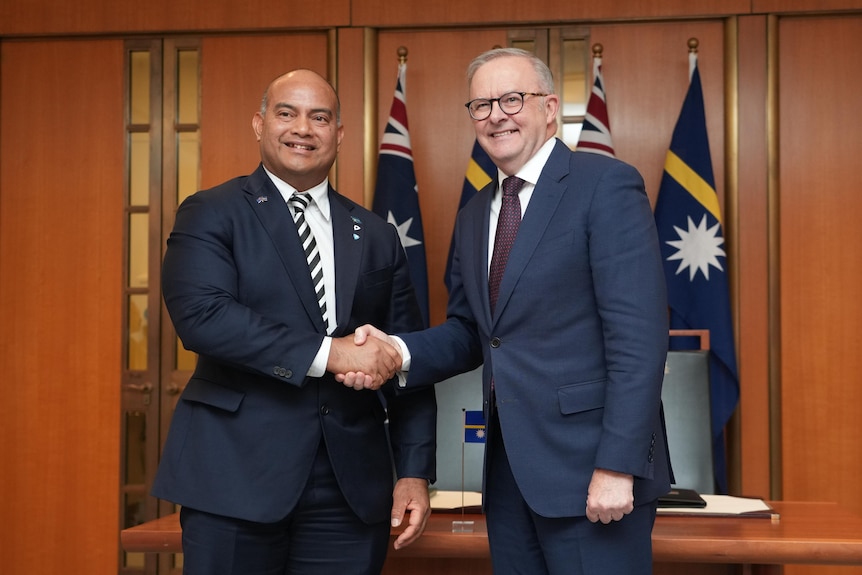
Nauruan President David Adeang and Prime Minister Anthony Albanese during a meeting months ahead of their countries signing a refugee resettlement deal. (ABC News: Ian Cutmore)
In November 2023, Australia’s High Court made a shock decision that would see dozens of refugees with criminal records set free from indefinite detention.
The issue became a media sensation and a political lightning rod.
And in the middle of this, the immigration minister intervened in AB’s case and stripped him of his visa once again.
Since last year — when Australia struck a resettlement deal for refugees and asylum seekers it doesn’t want — AB has faced deportation to Nauru.
“I think about it every day,” he tells Background Briefing, speaking publicly for the first time about his looming fate.
“When I hear something, when someone knocks on my door, when my phone is ringing.”
Sarah says they are raising their two young children — with another on the way — without any other family in Australia.
“We have that fear [that] they will just come and take him away,” she says.
A question of character
Ms Battisson says the Australian government should rethink its assessment of his character in light of what he did at Bondi and let him stay.
“People are complex, and there are grey areas. He has some adverse criminal records, but then in the moment that counts, he shows great, great bravery,” she says.
“His actions that day should absolutely count towards why someone like him should stay in Australia.”
Sarah stands by him despite their tumultuous relationship, swearing an affidavit in support of AB.
“It was very brave what he did,” she says.
“It’s very hard for anyone to risk their life. I’m proud of him for doing that. He’s a good man.”
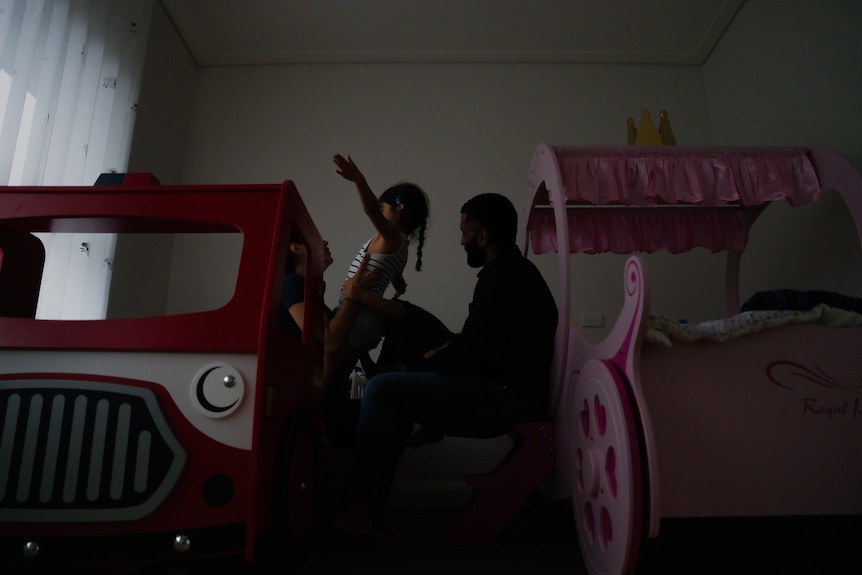
AB’s partner fears authorities will show up any day and take him away. (ABC News: Jack Fisher)
The Department of Home Affairs told Background Briefing it could not comment on individual cases for “privacy reasons”.
It says it assesses applications on a “case-by-case basis, against legal requirements set out in Australia’s migration legislation, including health, character and security criteria”.
But Ms Battisson says that last month the department made an “unusual” suggestion regarding his case, pointing out that AB had the right to ask Immigration Minister Tony Burke to allow him to apply for a spouse visa.
“We’re taking it as a very hopeful sign that my client’s actions in the Bondi massacre will be recognised by acknowledgement of his heroic behaviour, and to be allowed to stay in Australia with his family, which is all that he wants,” Ms Battisson says.
Bondi has left its mark on AB, even as his fate could hinge on it.
Not that any of this, he insists, crossed his mind when, instead of collecting his car, he ran towards the shooter on the bridge.
“I’m never thinking: ‘Am I [an] Australian citizen?’ or, ‘Am I on Bridging Visa R?'” he says.
“Nah. I’m a human. I’m living in Australia. I want this country always safe, for my kids, for myself too, for my missus, for everyone. I try to help people. That’s it.”