
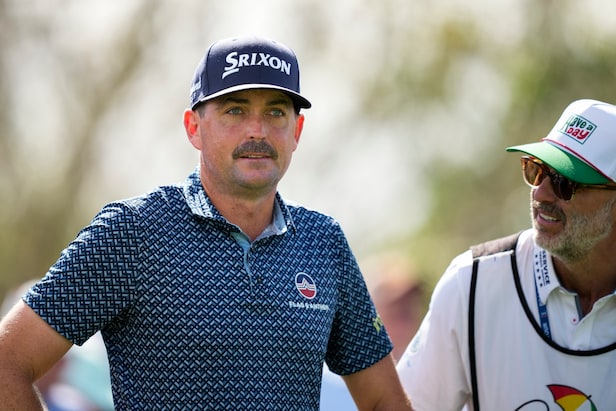
PONTE VEDRA BEACH — His opening shot ricocheted off a cart path into a bush. A little later, a drive vanished after clipping a tree. “No one knew where it went,” Keegan Bradley said Friday afternoon at the Players Championship, a day after a 77. “I didn’t even really look for it. We didn’t know where to look. It might be in the tree.”
Bad breaks, in isolation. Except they also encapsulate the struggle that has followed him here, across months and miles, inseparable as a shadow. That’s the risk when you give something your heart; it can come back in pieces.
Bradley’s surprise appointment as Ryder Cup captain had the makings of a dream. A chance to be a playing captain, to win at the course that he called home in college, sure. But Bradley resonated with the golf populace because in an era when American stars had been accused of treating the Ryder Cup as an obligation rather than a calling, he was a true believer—the kind of guy the Europeans had always seemed to produce naturally, someone for whom the event wasn’t a tangent to his career but the north star.
Instead, Bethpage became something he has to carry. The Americans Sunday comeback was extraordinary—a last-gasp surge that briefly made everything feel possible—but it couldn’t undo Friday and Saturday, couldn’t redeem an atmosphere that sullied the event’s reputation, couldn’t make the math work. He’d given the Ryder Cup everything. It wasn’t enough.
We love the Ryder Cup because it’s fleeting, because its moments ignite and vanish, leaving only what we carry forward. The problem is you don’t always get to choose what stays with you.
For Bradley, plenty has stayed. He entered that week ranked 11th in the world. The 39-year-old’s now outside the top 20, having missed three cuts in five starts on the PGA Tour this season with a T-29 in a limited field his best finish. He’s 111th in strokes gained overall, 156th in putting.
Bradley insists the numbers don’t fully reflect his golf and says he hasn’t been playing as poorly as the results suggest. But they do tell you where his head still is. Months later, a part of Bradley is still standing on that first tee at Bethpage, trying to figure out what went wrong.
“It’s been a little difficult. I’m still heartbroken from the Ryder Cup,” Bradley admitted on Friday. “So trying my best to separate myself and move on, but it’s hard. I think about it a lot. I think about the guys a lot, and I’m still in the process of getting past all that.”
Last year compounded everything. Bradley was trying to manage a team while simultaneously playing his way onto it, a division of self that would fracture anyone’s focus. But the harder challenge wasn’t logistical but emotional, and that didn’t end when the Euros left with the cup.
“Unless you’re a captain of the Ryder Cup team you just have no idea what goes into it and the emotional toll that it takes on you,” he said. “I think like a lot of guys that do it, they’re basically done playing, so they never again … I’m the first person to have to sort of deal with this, get back out there, try to be one of the best players in the world and make the next team.”
There is no blueprint for what he’s attempting. He gave everything to a destination he couldn’t reach, and now he has to find his way back to a game that requires its own total commitment. Those two things don’t easily coexist.
What’s notable is that he’s not bitter about any of it. Bradley acknowledges that the playing-captain arrangement “isn’t really what the position is about,” and understands that a future captaincy isn’t his to decide. He can’t undo Bethpage. But he can answer it.
Which made Friday feel like something. He was miles outside the cutline when the day began, and an opening bogey suggested the turnaround wasn’t coming today either. Then he eagled the second, got things rolling on the back nine with five birdies, and signed for a 66. One of the better rounds of the morning, conjured from a week that had offered him nothing.
“This course is as stressful of a golf course as we play anywhere in the world,” Bradley said afterward. “Every shot is brutal. So really proud of the way I played today. I really needed this round.”
A win is likely out of reach—he’s nine off the lead heading into the weekend—a good finish the more realistic goal. But for Bradley right now, a good finish is enough. It’s a foothold.
Healing doesn’t announce itself. It just shows up, sometimes as a 66 on a brutal golf course on a Friday afternoon in March, when you needed it most.
This article was originally published on golfdigest.com