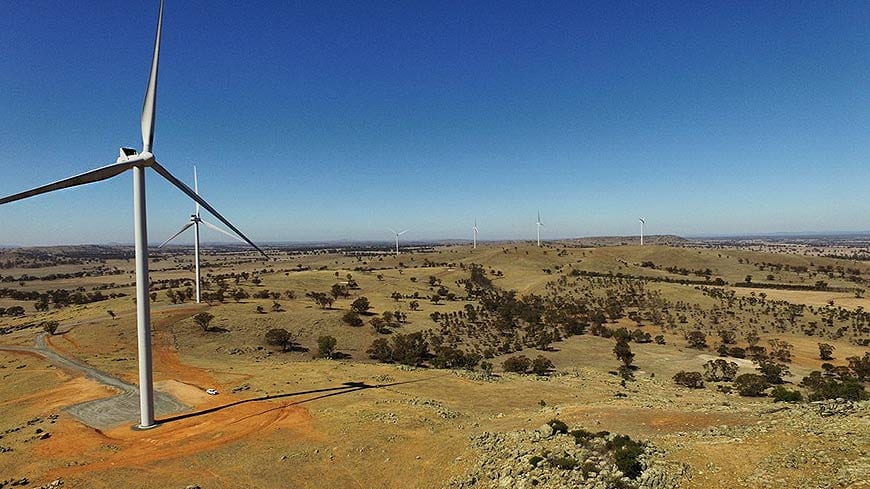
A huge Queensland wind farm that survived the state LNP government’s perilous project call-in process, and was awarded state development approval last March, has kicked off a full federal environmental assessment.
The 1.4 gigawatt (GW) Bungaban Renewable Energy Farm – owned by Windlab, which is majority owned by Andrew Forrest’s Squadron Energy – this week published 703 pages of planning documents on the EPBC website and opened them to public comment until March 20.
As Renew Economy has reported, Bungaban is a significant project, having signed the biggest power purchase agreement yet seen in Australia to help power Rio Tinto’s Gladstone minerals processing operations.
The smelter and refineries are the state’s biggest power consumers, and a major employer, and Rio Tinto has warned the facilities would not survive beyond the end of the decade without access to low cost renewable power.
See: Rio Tinto signs massive solar and battery deal to help secure future of smelters and refineries
The $3.9 billion project proposes to install up to 204 wind turbines on cattle grazing land around 35 kilometres (km) north-east of Wandoan and 55 km south-east of Taroom, in Queensland’s Western Downs Region.
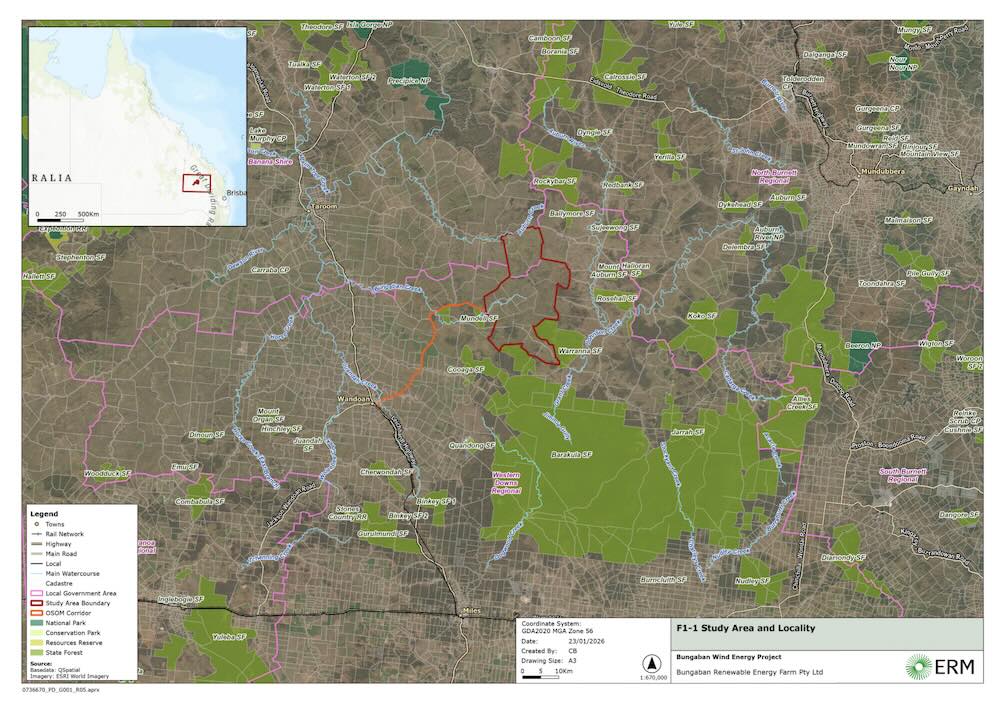
The preliminary documentation published on the EPBC website this week provides a description of the baseline ecological conditions and assessment of the potential impacts of the project on matters of national environmental significance (MNES).
In this case, the project has identified five key matters of concern, including the Brigalow ecological community – a nationally endangered, iconic ecosystem in Queensland and New South Wales, with only about 10% of its original extent remaining.
On the fauna side of the equation, the focus is on the assessing and minimising the potential impact the project could have on the Dunmall’s snake, the southern squatter pigeon, the greater glider (southern and central), and on the local koala population.
But the documents also go into finer detail on the project’s footprint and design, including the size and layout of the turbines and variations on the project’s plans for integrated battery energy storage.
Windlab says the turbines will have a capacity of up to 8 megawatts (MW) each, have a hub height of up to 200 metres (m) and a rotor diameter of up to 200m. The maximum turbine blade tip height will be 300m above ground level.
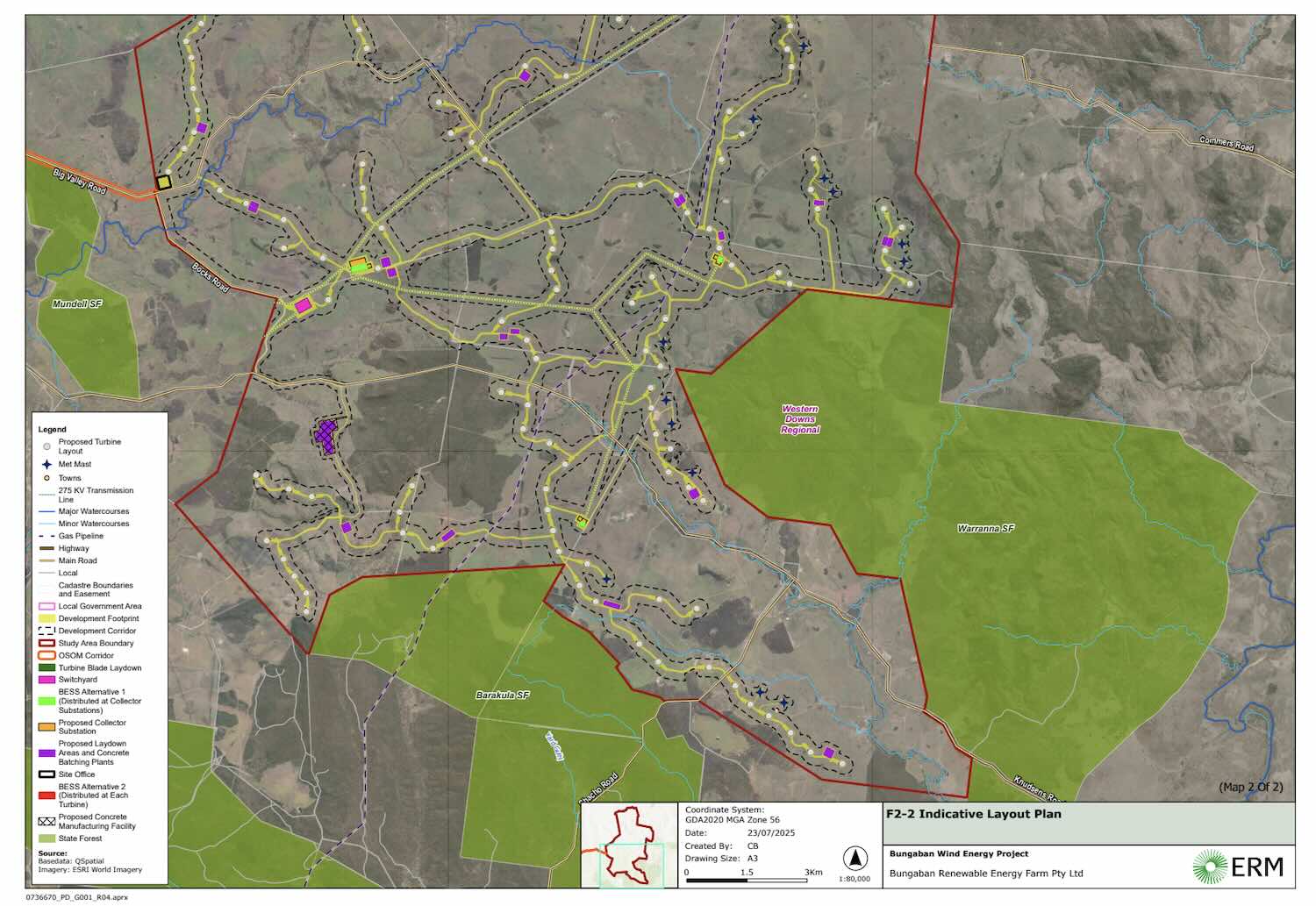
(Click on image to enlarge)
For storage, the plan is include battery energy storage systems (BESS) installed at the collection substations across the project, but Windlab says it is also considering distributing BESS at each wind turbine, adjacent to the hardstand area, within the current development footprint.
“Distributed BESS may be located at each [wind turbine generator] to utilise new technologies and to improve performance and function of the grid connection,” the documents say.
“If this new technology is utilised, the BESS would be located adjacent to the existing hardstand areas … and would mitigate the need to build standalone BESS infrastructure… No additional clearing will be required if the BESS is located adjacent to the existing hardstand areas.
“Either of the BESS options mentioned above will be designed to provide short-term storage for export, system reliability and firming support,” the documents add.
“During detailed design, an assessment will be undertaken to determine fire risks and refine the setbacks for each individual BESS,” it says.
Most new solar projects in Australia include a big battery behind the connection point, but are rarely proposed for wind projects, although turbine manufacturer Goldwind has been testing small batteries with individual turbines at the Moorabool wind farm in Victoria.
Windlab says the project – which last year gained a spot on the federal government’s National Renewable Energy Priority List – has been carefully designed to avoid and minimise environmental impact.
“The site does not contain large, connected areas of environmentally significant vegetation, allowing the project to proceed with minimal disruption to biodiversity and ecological values,” it says.
On the other hand, Bungaban promises to “deliver real impact” on state and federal efforts to decarbonise both the energy market and critical industry.
“Over 80% of the energy generated by the Project will directly support the decarbonisation of Australia’s critical minerals and manufacturing industries in Gladstone – sectors essential to Australia’s economic future and the global clean energy supply chain, employing thousands of people in regional and remote communities,” the documents say.
“The remaining 20% generation will have the capacity to power one in 13 Queensland homes.”
Meanwhile, as Bungaban makes its way through the federal approvals process with state approval in hand, other Queensland wind proposals have not been so fortunate.
The multi-billion dollar Middle Creek energy hub and Marmadua energy park have both been in state development limbo since June last year – along with three newly called in big battery projects – after being called in for full reassessment by Queensland planning minister Jarrod Bleijie.
A third wind project that was called in – the previously state-approved 450 MW Moonlight Range wind farm and battery – was cancelled by Bleijie last May. The project’s developer, Greenleaf Renewables, has nevertheless pushed ahead with the federal EPBC approvals process, hoping to find “the best way forward for the project.”
If you would like to join more than 29,000 others and get the latest clean energy news delivered straight to your inbox, for free, please click here to subscribe to our free daily newsletter.