
In November last year, Sotheby’s New York auctioned works from the collection of Leonard Lauder, the late Jewish cosmetics scion. The highlight of the collection was Lot 8: Gustav Klimt’s Portrait of Elisabeth Lederer, which changed hands at US$236.4 million, including premiums, making it the most valuable Klimt to appear on the market to date.
Some years earlier, Lauder’s younger brother, Ronald, was instrumental in acquiring Klimt’s iconic Portrait of Adele Bloch-Bauer, otherwise known as Woman in Gold, for US$135 million. At the time of him purchasing the picture for his New York-based Neue Galerie in 2006, it was the most valuable painting to have changed hands in history.
This is the story not of those pictures but of another wildly valuable Klimt portrait, which was offered as a gift to an Australian art gallery, and rejected.
When war loomed in Europe in the late 1930s, the children of wealthy Viennese industrialists Moriz and Hermine Gallia were seeking refuge from Nazi invasion. Despite having converted to Catholicism, their Jewish lineage haunted their paperwork and the family were aware they needed to flee.
As significant patrons of the arts in Austria during the early 20th century, Moriz and Hermine had amassed an enormous collection of work by Josef Hoffmann, Gustav Klimt, Carl Moll and Ferdinand Andri. Their three children meticulously packed their late parents’ priceless furniture, paintings, silverware and objets d’art ready for transportation to Sydney, Australia.
It’s thought the gallery rejected the painting because it believed that a portrait of a foreign Jewish woman would be of little interest to the Australian public.
At the time, Austria was annexed to Germany and their parents’ possessions were not viewed as culturally valuable. The work was seen as “new” and therefore of little historic value. Mercifully, the siblings were allowed to take their inherited collection out of Europe.
Upon arrival, two of the siblings, Kathe and Gretl, settled with Gretl’s daughter, Annelore, in a modest flat in Cremorne on Sydney’s lower north shore. This flat was to house one of the most complete collections of secessionist decorative arts and artwork the world had ever seen.
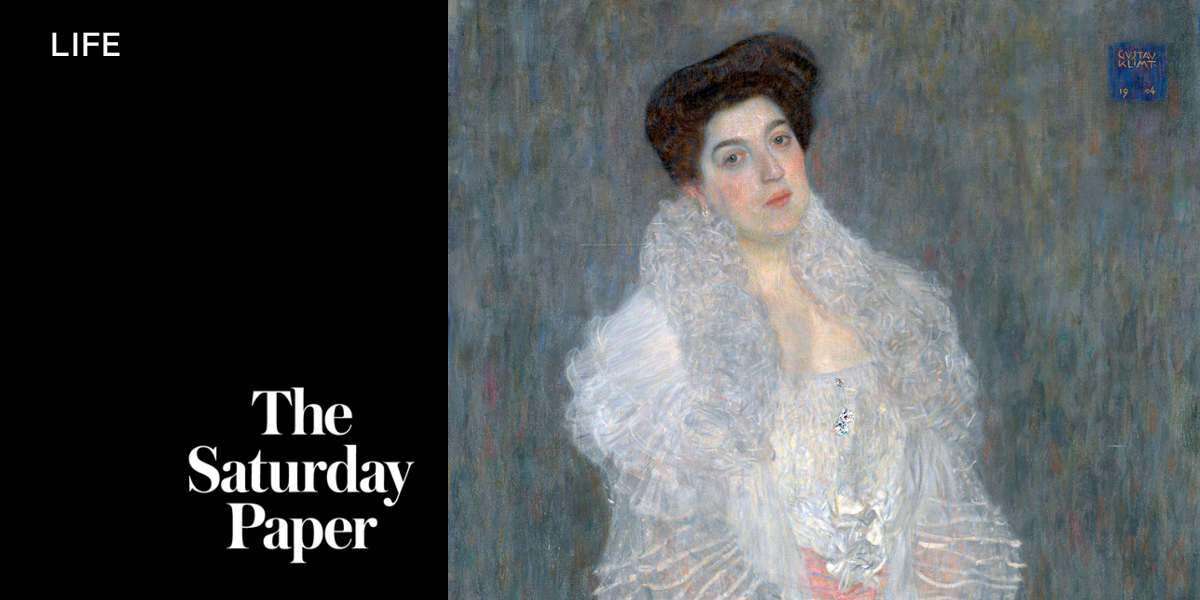
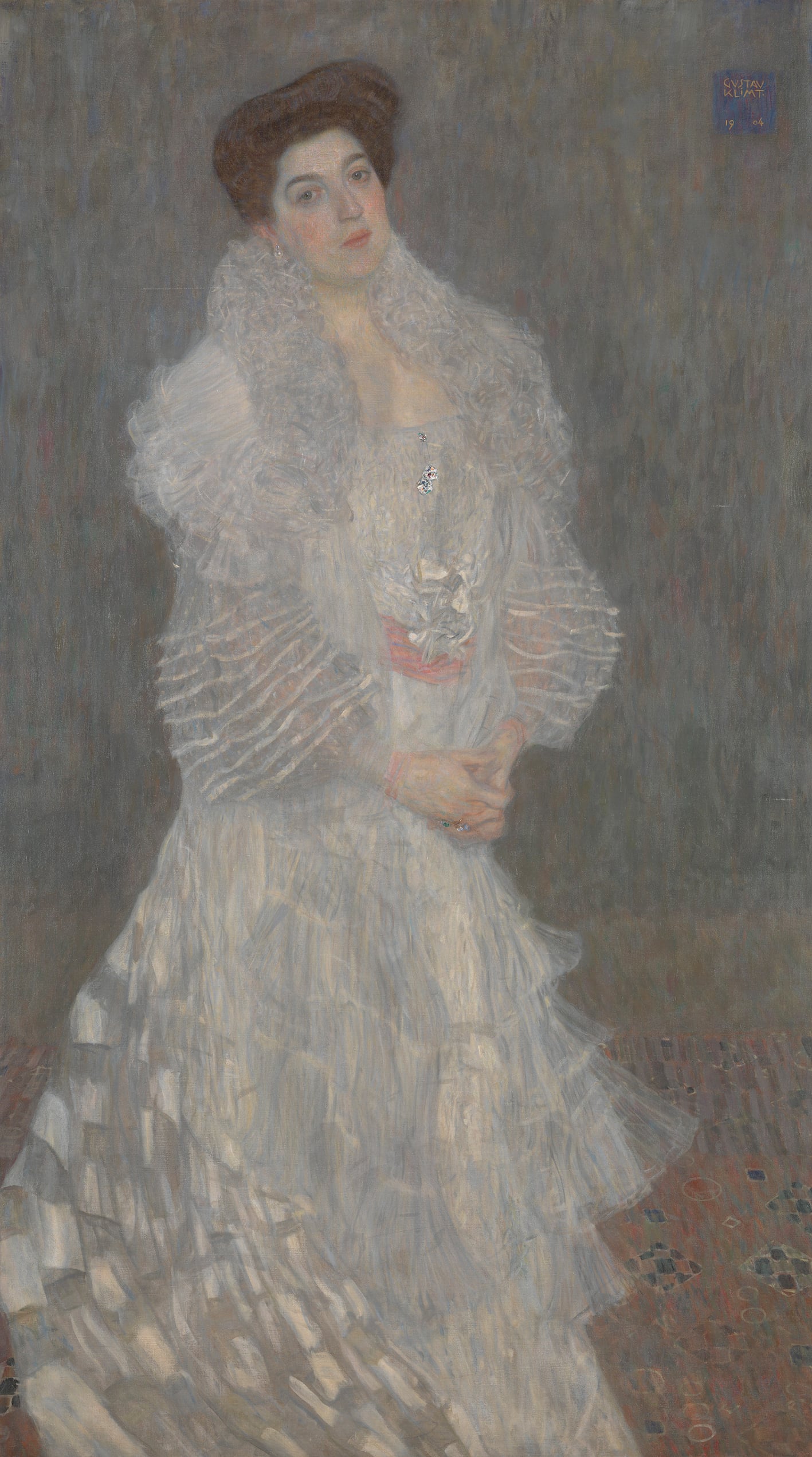
Come the 1960s, Kathe and Gretl were aware their small flat housed pieces of cultural importance. The stand-out work was Klimt’s Portrait of Hermine Gallia. Commissioned by their father, Moriz, this large painting of their mother was finished in 1904, at the very beginning of what has been dubbed Klimt’s golden era. The three-quarter-length painting depicts Hermine standing in an elaborate, flowing white gown, her hands clasped in front of her. It appears as though she is floating over a geometric rug, a recurring characteristic of Klimt’s work.
Thirty years after arriving in Australia, Kathe Gallia approached the Art Gallery of New South Wales and offered the portrait of Hermine as a gift. This attempted donation was, to the family’s amazement, declined by the gallery, under the directorship of Hal Missingham.
The episode is recounted in Good Living Street, written by Kathe’s great nephew, Tim Bonyhady, an art historian and director of the Australian Centre for Environmental Law at the Australian National University. He notes his Great Aunt Kathe felt she held a serious debt to Australia, and her newfound community, for taking in the family as refugees, and this was one reason for offering the picture to the state’s gallery.
It’s thought the gallery rejected the painting because it believed that a portrait of a foreign Jewish woman would be of little interest to the Australian public. The astonishing rejection undoubtedly reinstated to Kathe and Gretl Gallia that, despite having survived the Holocaust, having buried their background and assimilated into Sydney life, they were still seen as second-class citizens.
At the time, the gallery director had a very limited capacity to make his own acquisitions. He had won the right to make limited contemporary purchases, although these were subject to the veto of the institution’s trustees.
In the case of the Klimt portrait, it would have been the trustees who rejected the work. Missingham, however, would have been responsible for telling the sisters that the portrait of their mother was not wanted.
Writing in his memoir, published in 1973 and titled They Kill You in the End, Missingham said: “Early trustees were inordinately partisan about what they considered to be true art as opposed to all the horrible modern rubbish infiltrating the pure art of Australia. There was also a tremendously strong anti-Jewish feeling, so that not only were paintings by Jewish artists disregarded, but gifts or loans offered by Jews were smartly declined.”
At the time of the attempted donation, it should be noted that Klimt was not nearly as renowned as he is today, although any serious curator could recognise a secessionist renaissance in the air. It was a mere decade later, in 1973, that the Whitlam government acquired Jackson Pollock’s Blue Poles for the National Gallery in Canberra, at the controversial price of $1.3 million, a painting estimated to be worth $500 million today. The Pollock is now considered one of Australia’s most praised and respected art acquisitions, not to mention the most valuable work in any Australian public institution.
In many respects, Gretl, Kathe and Annelore had the last laugh. By 1971, the secessionist movement was picking up speed once again. London’s Royal Academy held the exhibition Vienna Secession, which put Klimt, Hoffmann and their contemporaries back on the map.
With the sisters’ health deteriorating and no security in their flat, Annelore sent Portrait of Hermine Gallia to Christie’s in London, where it sold for 20,000 guineas in November of the same year. In today’s currency, this amount equates to more than $500,000, and when it hammered down it was a world record price for a work by Klimt.
In 1976, Portrait of Hermine Gallia was bought for the permanent collection of the National Gallery in London. It is the only Klimt painting held in a public collection in Britain. The gallery describes it as “a fine example of the portraits of society women he painted in the early years of the twentieth century”. For further context, they add: “Hermine Gallia and her husband were also important patrons of the avant garde.”
What happened to the balance of the sisters’ estate? The bulk of what remained of Moriz and Hermine’s collection was purchased by the National Gallery of Victoria in the later part of the 1970s.
The then curator at the gallery, Terence Lane, advocated to acquire everything that remained and understood the importance of the Gallia collection. To date, it is considered one of if not the most complete collection of secessionist interiors and design in the world.
What is now known as the “Gallia Suite” remains on permanent display in the NGV and attracts visitors worldwide.
Ironically, when the Gallia Suite was first unveiled at the NGV, curators had to request for the Portrait of Hermine Gallia to be given on loan from London’s National Gallery. The picture should have been an interstate courier away.
This article was first published in the print edition of The Saturday Paper on
March 11, 2026 as “The Klimt Australia rejected”.
For almost a decade, The Saturday Paper has published Australia’s leading writers and thinkers.
We have pursued stories that are ignored elsewhere, covering them with sensitivity and depth.
We have done this on refugee policy, on government integrity, on robo-debt, on aged care,
on climate change, on the pandemic.
All our journalism is fiercely independent. It relies on the support of readers.
By subscribing to The Saturday Paper, you are ensuring that we can continue to produce essential,
issue-defining coverage, to dig out stories that take time, to doggedly hold to account
politicians and the political class.
There are very few titles that have the freedom and the space to produce journalism like this.
In a country with a concentration of media ownership unlike anything else in the world,
it is vitally important. Your subscription helps make it possible.
Send this article to a friend for free.
Share this subscriber exclusive article with a friend or family member using share credits.

Used 1 of … credits
use share credits to share this article with friend or family.
You’ve shared all of your credits for this month. They will refresh on April 1. If you would like to share more, you can buy a gift subscription for a friend.
SHARE WITH A FRIEND
? CREDITS REMAIN
SHARE WITH A SUBSCRIBER
UNLIMITED
Loading…
Art
The untold story of Sky Blue and Australia’s art heist
Mark Dapin
Fifty years ago, an ‘ordinary left-wing Melbourne hippie’ became embroiled in a daring and politically motivated burglary that made her Victoria’s most-wanted criminal.