
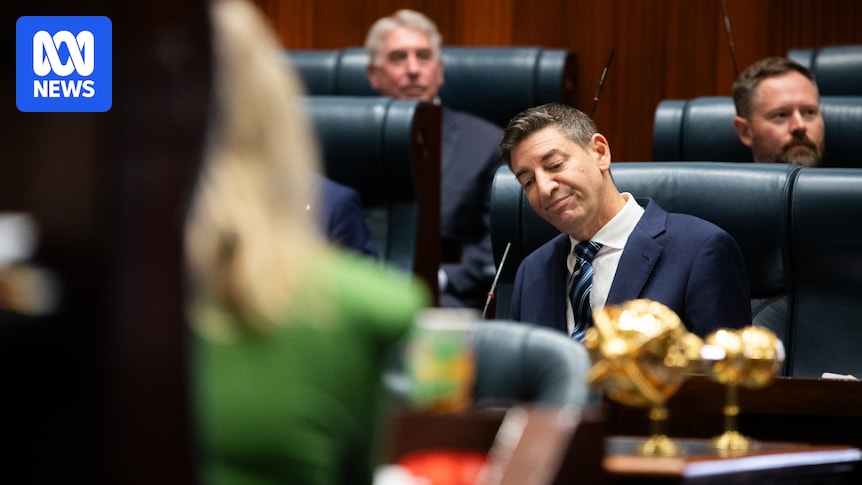
In a busy week dominated by growing concerns about Western Australia’s fuel supply, you might have expected it to be all work, no play for the state’s politicians.
But for about two-and-a-half hours, Western Australia’s political leaders were having some taxpayer-funded fun in Parliament House.
Question Time is often politics at its most colourful, when opposition MPs are meant to have a chance to directly scrutinise those in power and ministers use questions from their backbench to toot their own horn or have a crack at their opponents.
There was no shortage of that this week.
On Tuesday, Defence Industries Minister Paul Papalia managed to use a question about the state’s shipbuilding industry to say it was “unfair” to have called Opposition Leader Basil Zempilas “as tough as a cream puff” previously.
Loading…
“Perhaps the leader of the opposition is more akin to a croissant,” he declared, to the raucous laughter of his colleagues.
“What we are talking about here is a little bit flaky and brittle on the outside, puffed up and ultimately completely full of hot air!”
Liberal frontbencher Jonathon Huston attempted to make light of the premier moving from Kwinana to West Perth, in his electorate, asking “who is representing your electorate while I am representing you?”.
Questions about what was being done to make sure the state, and various industries, didn’t run out of fuel on Wednesday descended more into political point-scoring and shouting matches on both sides, rather than genuine policy debate.
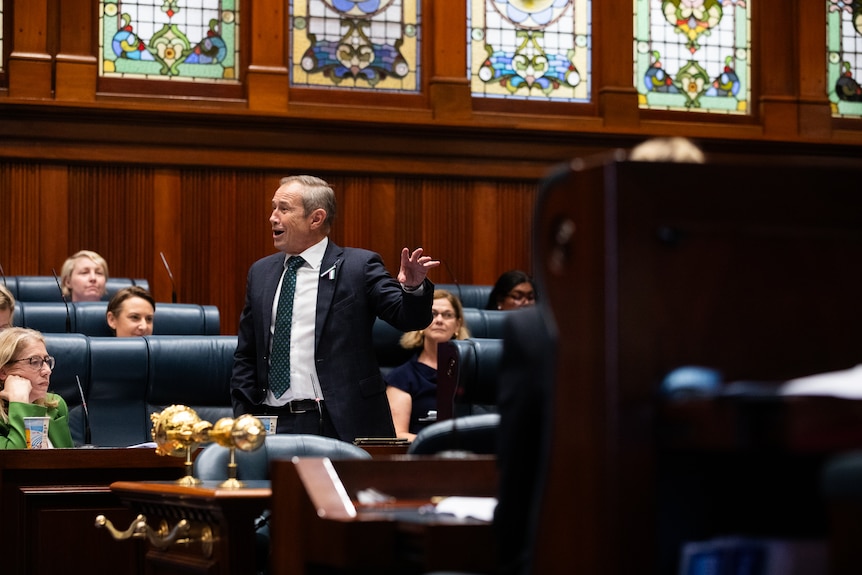
WA Premier Roger Cook gestures in parliament. (ABC News: Keane Bourke)
And when the opposition raised the example of a teacher running 100 kilometres in a day to raise money for school air conditioning on Thursday, the education minister spent more time talking about the opposition and the Barnett government (which ended nine years ago) than her own policy.
Behaviour ‘appalling’
Question Time is among the defining characteristics of the Westminster system of government adopted in places like Australia, the United Kingdom, New Zealand and Canada — giving the opposition direct, public access to question the executive.
The intention is sound, but the reality is often loud, occasionally funny, and rarely productive.
That’s despite the combined salaries of just the MPs in the chamber costing you and I some $3,660 each question time.
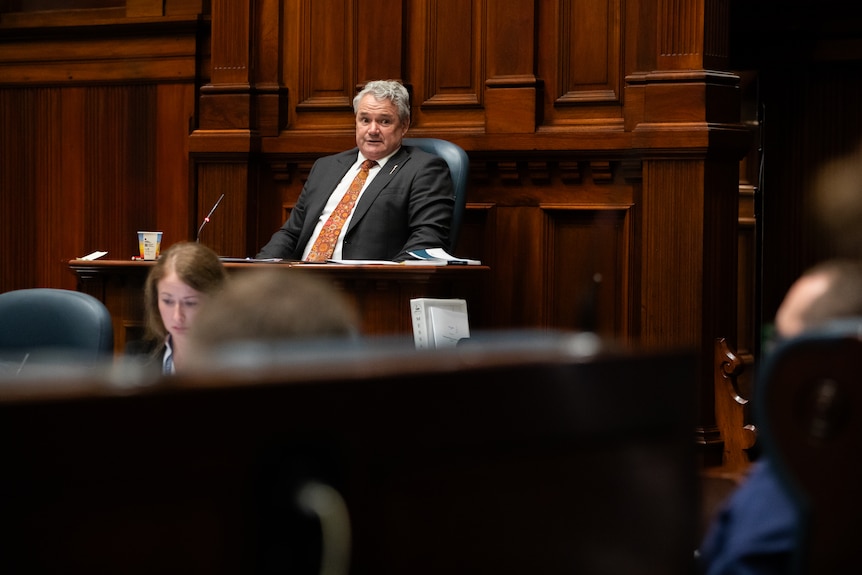
Stephen Price became frustrated with proceedings in parliament last week. (ABC News: Keane Bourke)
This week’s shenanigans prompted the man meant to keep everyone in line, Speaker Stephen Price, to describe Wednesday afternoon’s antics as particularly “appalling”.
“I do not want to be talking to the journalists in the morning about this, but I am sure they are going to want to ask me questions,” he told the lower house.
“It is not good enough. The people of Western Australia deserve better than what they are seeing in here during question time.”Zempilas a target
Despite wishing otherwise, Price did answer questions from journalists the following morning, explaining he took particular issue with the jabs being thrown across the chamber.
“In my view, it’s too personal and not policy focused, as it should be,” he said.
Zempilas — whose decades in public life as a broadcaster, then Lord Mayor, give the government plenty to play with — was glad to hear the speaker’s concern.
“Because I know where the personal comments come from and I know who they go to,” he said in a not-so-subtle reference to himself.
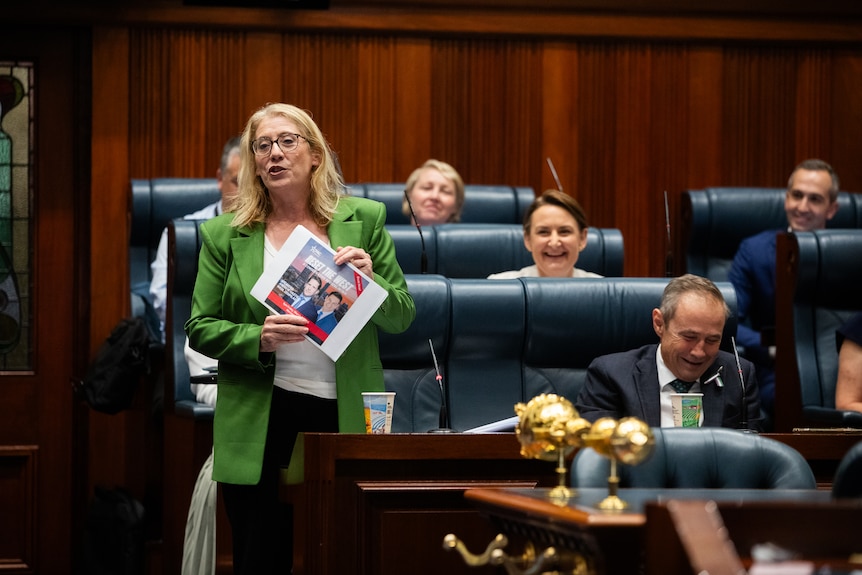
WA Deputy Premier Rita Saffioti holds a piece of paper with photos of Basil Zempilas and Andrew Hastie on it. (ABC News: Keane Bourke)
That included Housing Minister John Carey accusing Zempilas of “hypocrisy” over support for planning reforms and housing efforts, prompting him to yell: “You can just make stuff up, can you?”
Despite the barbs, the opposition leader had little appetite for a change in question time.
“I think we do all need to be a little bit careful about this line that somehow people are shocked by what takes place in question time,” he said.
“I mean, as a kid I used to watch the 7.30 Report, I used to see John Howard, I used to see Bob Hawke, I used to see Paul Keating put on incredible displays and I found it hugely motivating, entertaining and I loved the spirit of it.
“I know not everybody’s drawn to it, but it’s one of the reasons why people are drawn to [politics] and I think we have to be careful that we don’t take that right away.”
Constructive responses rare
And in fairness to the tradition of question time, it does have its moments.
A well-constructed strategy from the opposition can put pressure on ministers and highlight weaknesses in the government.
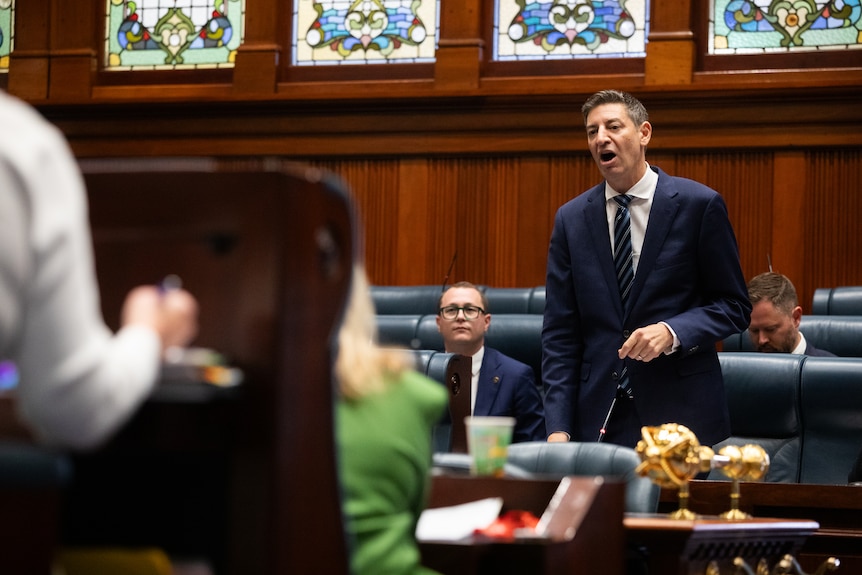
Basil Zempilas asks a question of the government in parliament. (ABC News: Keane Bourke)
“Not losing sight of the fact that question time is crucial for accountability of government is important in all of this, because that’s why it was set-up,” politics professor at Notre Dame University, Martin Drum said.
“I know it might sound like an ideal, but I still think it’s relevant in this day and age.”
On Thursday, a question from Deputy Liberal Leader Libby Mettam about the supervision of a criminal who violently sexually assaulted a woman a month after being released from prison for child sex offences did elicit a detailed answer from Papalia.
Basil Zempilas apologises to female MP
“Post that incident a thorough review was conducted and a change to processes has been enacted,” he explained, going on to explain in detail what those changes were.
Those kinds of answers are, unfortunately, rare.
Maybe that’s because Question Time has morphed more into a form of stress relief for those entrusted with the thankless job of leading the state through seismic shifts in the global order.
Maybe it’s just the way politics always has been and always will be.