

NASA’s SPARCS spacecraft has just sent back its first images, marking a major milestone in the mission to study low-mass stars and their potential to host habitable planets. Launched in January 2026, SPARCS is now set to start its real work: monitoring the energetic activity of some of the most common stars in the Milky Way to better understand how they could affect the planets around them. These images are the first step in what could be a groundbreaking mission to learn more about distant star systems.
SPARCS, which stands for Star-Planet Activity Research CubeSat, is the first mission dedicated to continuously observing ultraviolet (UV) radiation from low-mass stars. These stars, smaller and cooler than our Sun, flare up more often and their activity can have a big impact on any planets nearby. The images, received in early February 2026, show that SPARCS’ instruments are working well and ready to begin the mission’s full science operations.
New Way to Study Low-Mass Stars
Low-mass stars make up most of the stars in the Milky Way. While they’re smaller and dimmer than the Sun, they’re far more common, and many of them have planets in their habitable zones; areas where liquid water might be able to exist. Understanding how these ones behave, especially their frequent flares and sunspot activity, is key to figuring out whether the planets around them could support life.
Evgenya Shkolnik, SPARCS’ principal investigator, says the first images confirm that the spacecraft is capturing UV radiation from these stars just as planned.
“Seeing SPARCS’ first ultraviolet images from orbit is incredibly exciting,” Shkolnik said. “They tell us the spacecraft, the telescope, and the detectors are performing as tested on the ground and we are ready to begin the science we built this mission to do.”
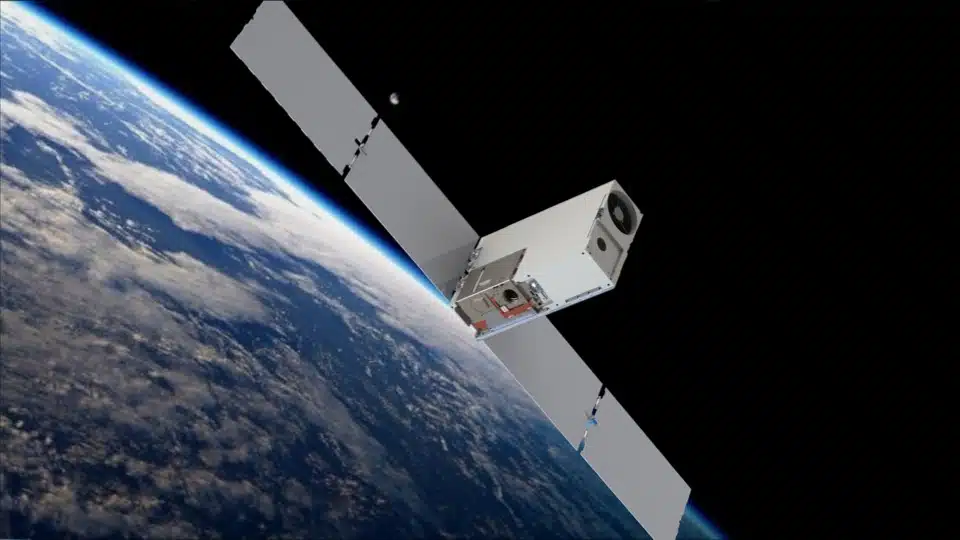 SPARCS telescope in orbit. Credit: Arizona State University
High-Tech Tools on Board SPARCS
One of the standout features of SPARCS is its advanced technology. The spacecraft is equipped with UV-sensitive detectors that allow it to observe the radiation from low-mass stars in great detail.
These detectors are made of silicon, much like the sensors in smartphone cameras, but they’ve been specially designed to capture UV light with much higher sensitivity. This makes it possible for SPARCS to take clear images while avoiding interference from other light sources.
Shouleh Nikzad, the lead developer of SPARCS’ camera system at NASA’s Jet Propulsion Laboratory, explained that the spacecraft’s filters are built directly into the detectors. This design boosts the system’s sensitivity and eliminates the need for separate filter components.
“I am so excited that we are on the brink of learning about exoplanets’ host stars and the effect of their activities on the planets’ potential habitability,” Nikzad said.
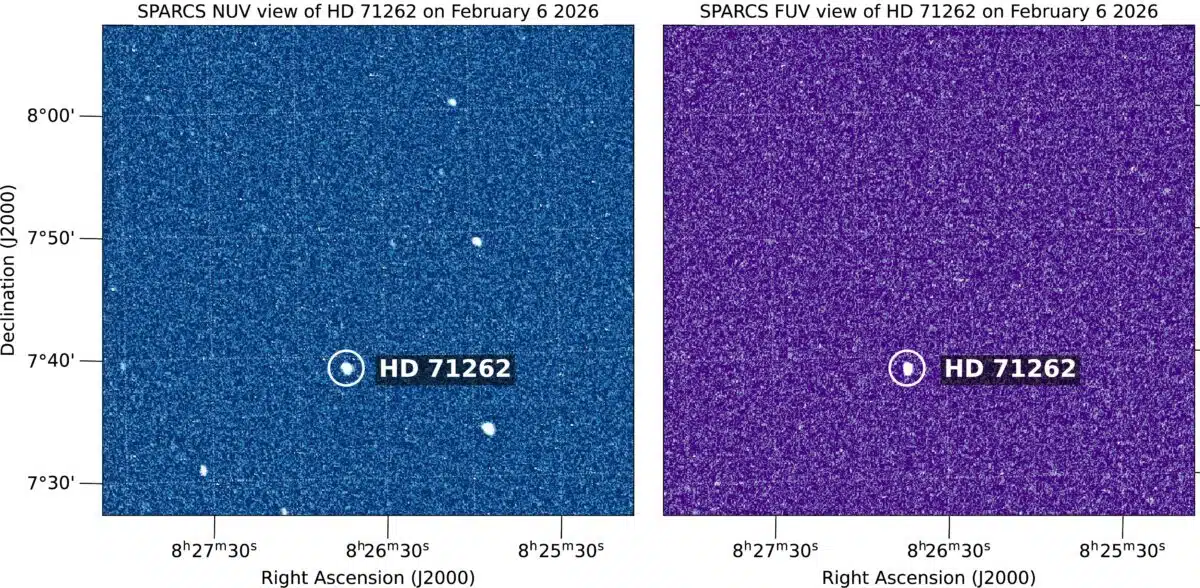 On February 6, 2026, the SPARCS telescope captured stars in near-ultraviolet (left) and far-ultraviolet (right). Credit: NASA/JPL-Caltech/ASU
SPARCS: What’s on the Horizon?
SPARCS will spend the next year focusing on around 20 low-mass stars, studying them for periods ranging from five to 45 days. The goal is to observe how their flares and energetic activity affect any exoplanets that orbit them. This research is crucial because the intense radiation from these flares can change the atmospheres of planets, potentially making them less habitable.
The data SPARCS collects will help scientists learn more about these distant star systems and how their environments could influence the potential for life. SPARCS is part of NASA’s CubeSat Launch Initiative, which allows for low-cost missions that make space research more accessible. David Ardila, SPARCS instrument scientist at JPL, added that
“By watching these stars in ultraviolet light in a way we’ve never done before, we’re not just studying flares. These observations will sharpen our picture of stellar environments and help future missions interpret the habitability of distant worlds.”