
This car has to deliver. Hyundai’s Elexio is the latest in a run of electric machines that n eed to step up in order for the company to keep offering customers a broad choice of vehicles.
The government’s New Vehicle Efficiency Standard essentially requires conventionally powered cars to be offset by green models, so if Hyundai doesn’t sell a lot of electric cars, it can’t sell a lot of its more popular petrol, diesel or hybrid models.
Hyundai chief operating officer, Gavin Donaldson, hopes the Elexio can attract enough customers to offset demand for machines like the Palisade or i30 N.
If Hyundai can’t get an EV to fire, then some petrol-powered models may have to be cut from the range.
The brand only holds about two per cent of the electric vehicle market today.
“We’re coming off an OK base for EVs,” Donaldson said. “If we just get to six or six and a half per cent of EV sales … we can keep three powertrains going, and I think for us, we’re in a great position to be able to do that.
“If we continue to grow our EV sales and get them to a level that we believe is successful, we can keep ICE [internal combustion engine] and hybrid cars going, basically, for as long as we like.”
That is a big if. But the Elexio has a fighting chance of success, underpinned by an attractive price tag of $59,990 drive-away.
You get a lot of gear for the money, including heated and cooled leather seats with 14-way driver’s memory adjustment, a powered tailgate and three-zone climate control. Yes, it costs about $5000 more than a similar-sized BYD. But a huge percentage of electric car customers lease their cars, and Hyundai reckons the Elexio’s circa-$205 per week cost is just $5 more than you might pay for a BYD Sealion 7, or $11 less than a Tesla Model Y.
Unlike those cars, the Elexio offers just one motor option. Powered by a 160kW and 310Nm electric motor driving the front wheels, the Elexio is propelled by an 88kWh lithium-ion phosphate battery sourced through BYD. The battery isn’t the only part of the car made in China. In fact, the whole car is, as part of an increasingly popular strategy that amounts to “if you can’t beat them, join them”.
Kia’s most popular electric car is the China-made EV5, Mazda has turned to China for its new electric duo, and you can guess where Ford will build its upcoming RAV4 rival based on the Bronco Sport.
So this Elexio represents a new approach for the brand.
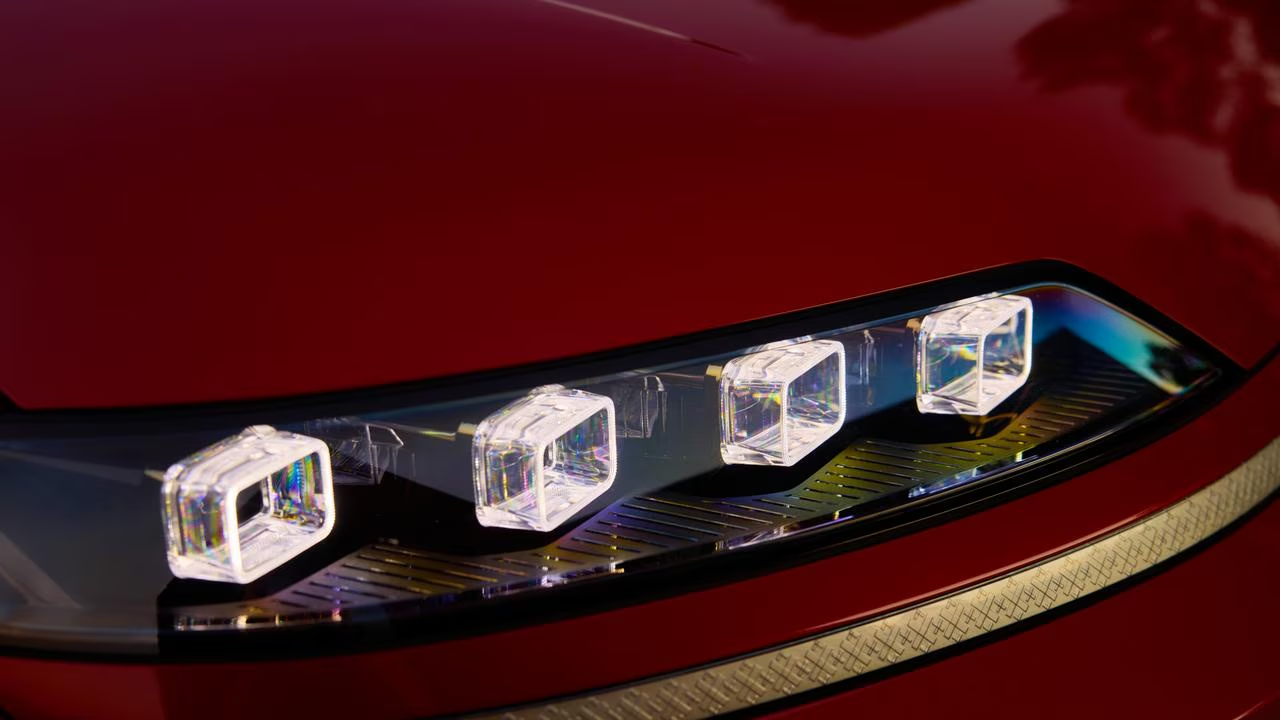
It looks handsome enough on the outside, particularly if you appreciate ice cube headlights that evoke the 1980s look of Alfa Romeo’s SZ.
But it’s much more interesting on the inside, where a truly enormous 27-inch panoramic wide-screen display goes beyond the usual features such as sat nav, Apple CarPlay and Android Auto to deliver video games, interactive wallpapers and a completely different user interface to other models.
The Elexio might be the most passenger-friendly car Hyundai has made. Which is a good thing, as it tends to frustrate drivers from time to time. Hyundai’s driver assistance technology lacks finesse. The lane-centring system is heavy-handed, tugging at the wheel in an unsettling manner.
And its camera-based speed sign detection is a shocker, regularly mistaking other numbers, such as corner speed advisory signs, for the speed limit.
Riding on 20-inch wheels as standard – at least until a cheaper model arrives – the Elexio’s low-profile tyres offer little cushioning over bumps. It’s firmer than we would have hoped, though the trade-off is that it doesn’t list from side to side like an ocean liner when you tip into a corner.
It has effortless torque compared to regular SUVs such as the Tucson, but folks looking for the high-voltage punch of an all-wheel-drive EV need to whop elsewhere – you can only have this car with front-wheel-drive, and only 160kW.
And there’s just one battery size, with a claimed range of about 550km.
I’m not sure that amounts to enough to pull customers away from rival showrooms.