
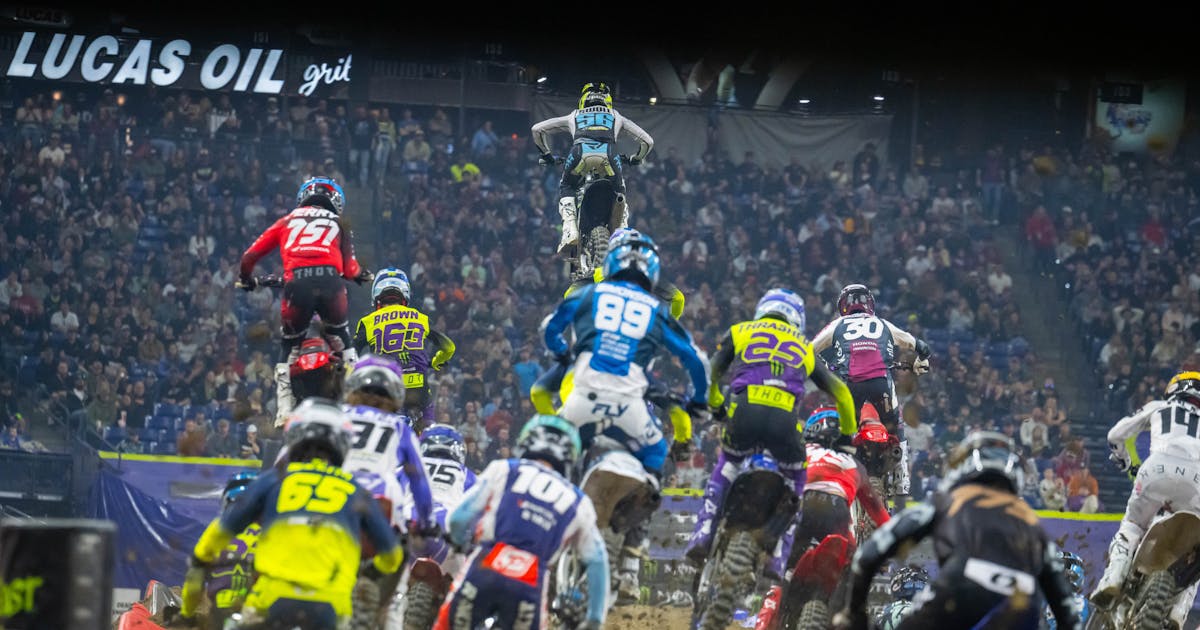
Does the series really have a chronic problem with lapped riders, or was what happened in Indianapolis something of an outlier? Personally, I’m going to go with the latter. As mentioned above, the Indy round was a Triple Crown race, which meant three mains, each 12 minutes plus one lap in length for the 450s. However, the track was one of the more compact ones we’ve seen this year, with the fastest qualifier (Tomac) dropping a 45.434 lap time. A lap that long was asking for trouble because even though these were the 22 best—and currently healthy—450SX riders on the planet, there would be lapping on such a short track. The last man to qualify directly to the main was Twisted Tea Suzuki Presented by Progressive Insurance’s Colt Nichols, who qualified 18th with a 47.525 lap. That’s 104.6 percent of the fastest time in qualifying.
In the first main event, 12 of the 22 riders completed all 17 laps. The winner was Roczen, whose best time was a blistering 44.931. The slowest best lap of the 22 riders was last-place Tristan Lane‘s 49.746. He was the only rider lapped twice in that first main. Lane, #711, was also one of only two riders in the entire main with a three-digit number; the other was #719 Vince Friese, who finished 15th.
I’m sure the very mention of Vince Friese triggered a few readers, as he has a long history of being problematic when lapped (especially when he and Tomac barely avoided disaster in Indiana), but the ISRT Kawasaki rider has also qualified for dozens of supercross races, going back to 2009. Sure, he’s a controversy waiting to happen, but he’s also one of the 20 best SX riders in the world right now, so he belongs out there; he just needs to be more cognizant of what’s happening around him with other riders. For instance, when a leader laps you, you can safely assume that someone is chasing that leader and that the blue flag counts for that rider too.
Speaking of blue flags, maybe part of the problem is the fact that it’s waved often—sometimes as far back as fifth or sixth place. That probably creates some confusion and frustration for the riders it’s being waved at, as they are racing for positions and points too. Tightening up how and when it’s thrown might be a step in the right direction, and I’m guessing that was a topic of discussion between the AMA and team managers throughout this Lapper Week. The same goes for helmet communications, which is not exactly a new topic—Team USA used radios as far back as the 1988 Motocross of Nations—but the technology is now at hand to begin at least experimenting with official-to-rider race communications.
I mentioned Vince Friese above. He’s a repeat offender here—he was given those new license penalty points back at San Diego for “disregarding the blue flag and blue flag protocol on multiple occasions during the main event. Friese received a warning and two license penalty points as a result…” Should he have been penalized in Indianapolis too? It depends on whom you ask. Friese was lapped in all three mains at Indy, which meant three times as many situations that could become problematic. But Vince also finished 13th overall on the night, which again shows that he has the talent and skill to be out there, though he could probably work on some blue flag etiquette. Unfortunately, his list of priors is so long that many feel he shouldn’t get the benefit of the doubt, but in this case, he did—no license penalty points.
So, we’re back where we started, with a historic problem in motorsports: What to do about lappers? I think the best approach is not to start pulling riders off the track or eliminating them as Triple Crown—or regular format—races wind down, but rather to define the deployment of the blue flag and what the proper protocol is for the lapped rider. I’ve heard suggestions of going from 22 riders in the main to just 20, but I hate limiting opportunities for privateers; had that been the case Saturday night, neither Tristan Lane nor Freddie Noren would have been out there, as they finished third and fourth in the LCQ. And by all means, let’s see where we are with helmet communications and give them some field testing—I’m sure Tristan and Freddie would prefer trying that more than having to pack up early. (I spoke to “6-Time” Jeff Stanton in Daytona about the Cardo System device he uses to communicate with riders for his Adventure Tours, and he thinks it’s time to bring it to the SuperMotocross League.) And Triple Crown races might work better on plus-sized tracks like Glendale, not smaller ones like Indy.
So, Lapper Week ends without a real solution but with a lot of interesting ideas, as well as a pressing need. And since it’s an off weekend for racing, and before we get into whatever the next topic of the week is—Deegan vs. Davies Week has a nice ring to it—what changes would you make?