
Geologists around the world may be in for a shock.
As our technological prowess improves with every passing year, new findings both in space and down here on our home have been made. Science has provided us with the tools to study our planet and unearth long-standing mysteries that have confounded us for generations.
How might this strange signal reshape the behavior of animal life all around the globe?
How our planet has evolved alongside us as a species
Science has taught us that the Earth is not a stagnant rock in space and is actually evolving over time, just as we do.
Our impact on the planet has been profound. We have essentially created a “human mineral era” as scientists around the world have identified over 200 new types of minerals that only exist thanks to human activity.
We have also affected the immediate atmosphere around our planet.
Saturn has its rings of dust and ice. Earth, however, is surrounded by thousands of satellites, revealing that we have our own man-made ring around our planet, albeit a self-serving one.
The third rock from the sun has a few surprises for us
The planet we live on is filled with unexplained mysteries that are only now coming to light.
For instance, did you know that there is a “hidden ocean” deep within the Earth’s mantle? Scientists have found a huge body of water nearly 500 miles beneath our feet. The blue mineral known as ringwoodite could contain as much as three times the volume of surface water combined.
Astronomers spend their days studying our star’s cycle and other mysteries in space, while geologists focus on the unexplained down here on Earth.
The study of space and our own planet work hand in hand, as without the satellites and space-based telescopes in space, geologists would have struggled to get an accurate, large-scale image of our planet.
From the recent blood moon event to the never-ending cycle of eclipses that occur on a regular basis, there is still so much we do not understand.
However, a recent finding by the ESA may provide some answers to questions about a strange magnetic “tug-of-war” that is taking place beneath us. What could the reasons be for this competition between parts of the world?
Geologists identify a “dent” in Earth’s shield of protection
Geologists have noted that a strange signal has been affecting the planet’s magnetic field.
Known as the South Atlantic Anomaly, this dent in our protective shield has been growing at a rapid pace since it was first discovered way back in 2014. It has created reverse flux patches that see the magnetic field lines in our planet pointing inwards instead of the normal outwards direction.
In this particular weak spot, geologists have found field lines reversing, creating a magnetic tug-of-war between certain regions.
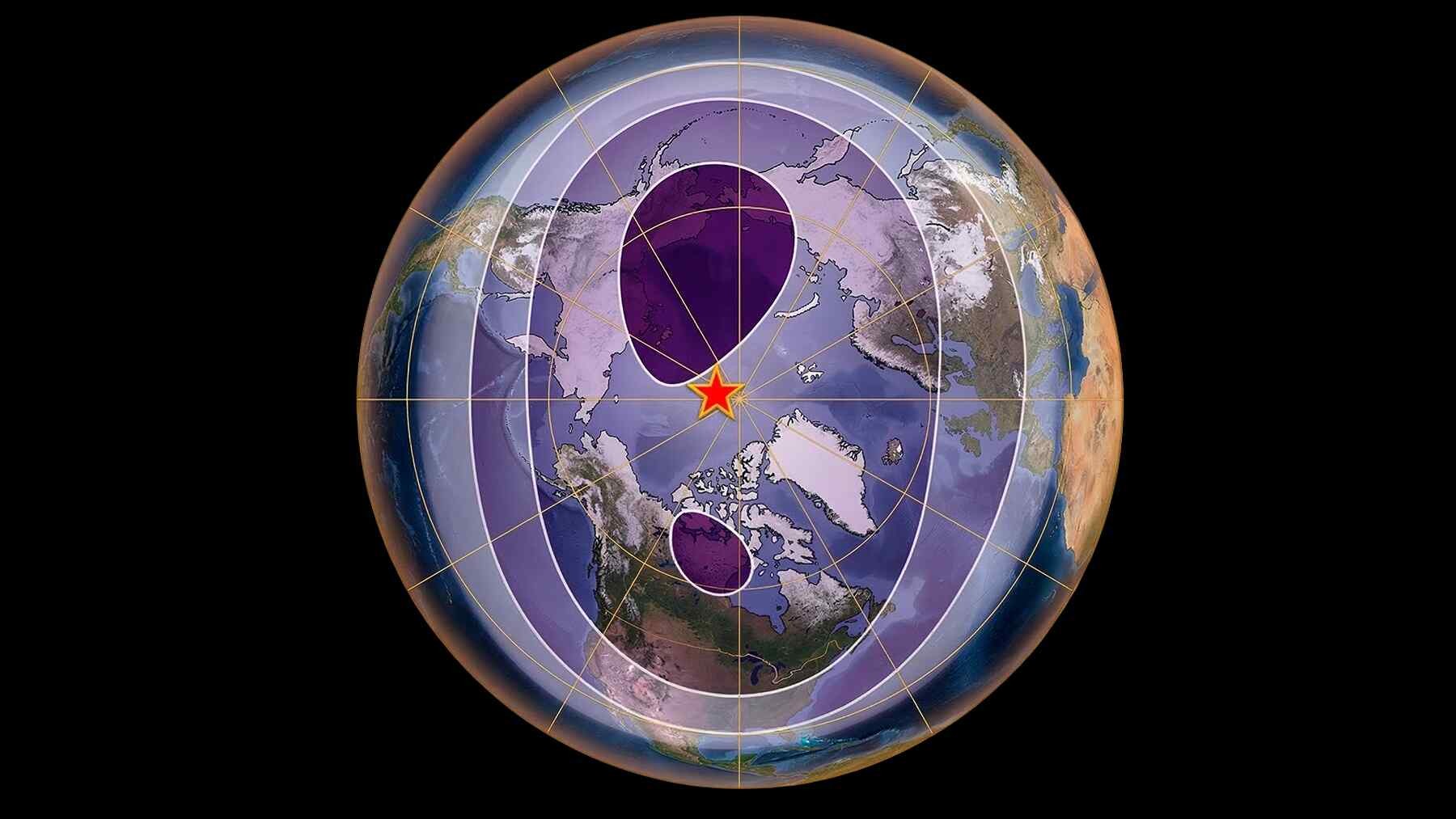
A truly epic battle is unfolding beneath Canada and Siberia
The magnetic North Pole race has been heating up in recent years.
The region beneath Canada is one of the players in this new magnetic tug-of-war, but unfortunately, it is losing as the magnetic field found there is weakening with every passing year.
Scientists digging beneath the surface to make astonishing discoveries is no new trend.
The discovery also points to the fact that the magnetic field beneath Siberia is pulling much harder than ever before. So in the magnetic tug-of-war between the two regions, Siberia is definitely winning. The magnetic North Pole’s position is determined by the balance between these two blobs in Canada and Russia.
The migratory animals of the planet will be affected by the change in our magnetic North Pole, as they rely on it to navigate the world. Everything from the Earth’s magnetic North Pole to the comets that graze our planet will be affected by this magnetic tug-of-war.