
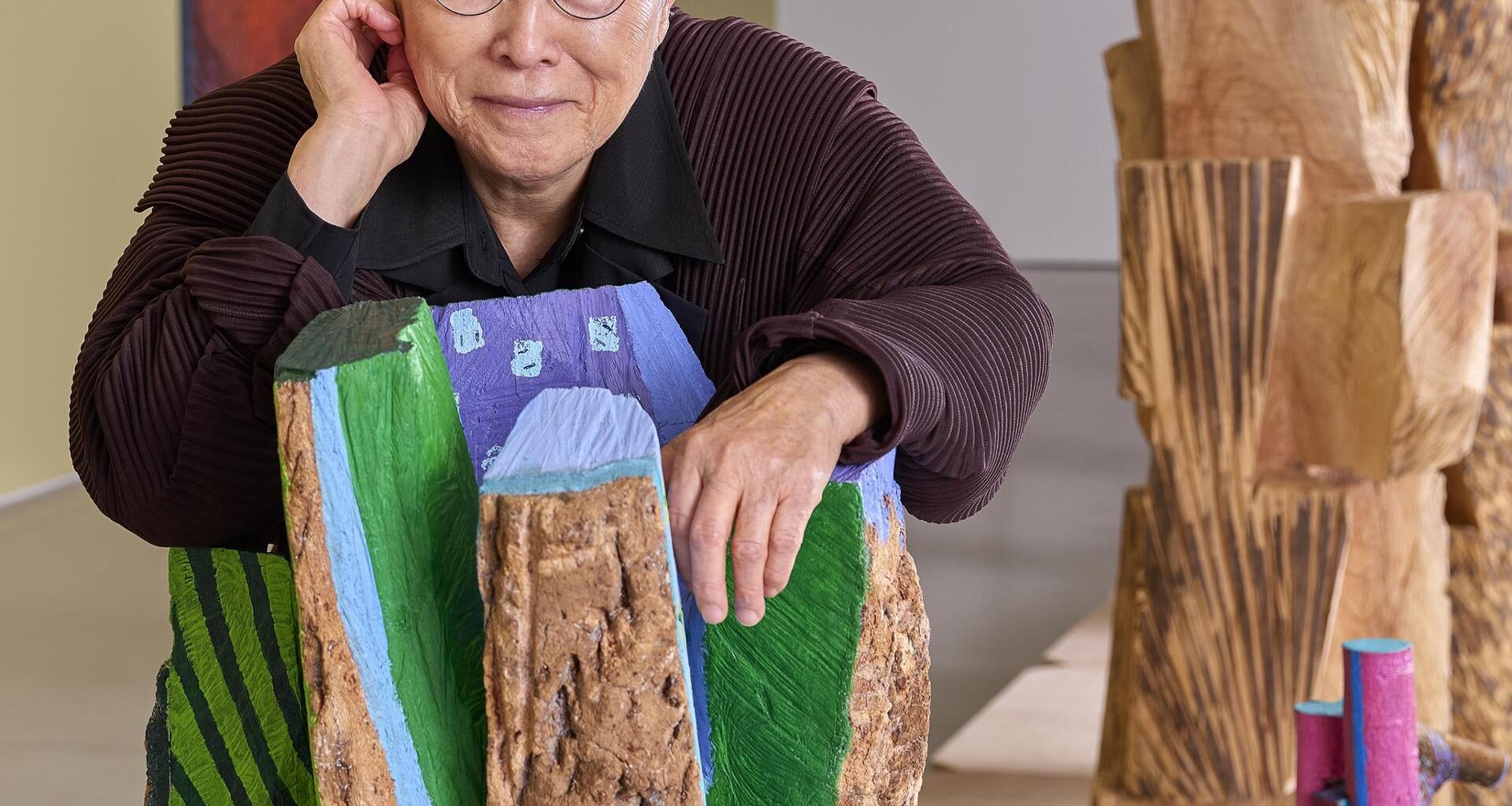
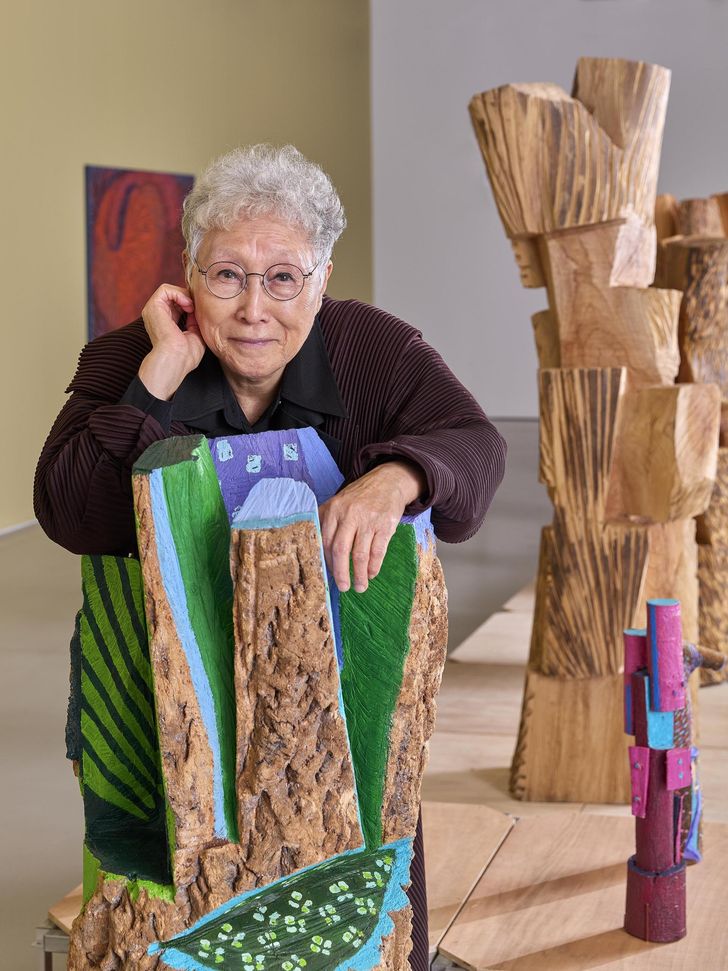
Nonagenerian sculptor Kim Yun-shin / Courtesy of Hoam Museum of Art
A muscular chunk of wood. A whirring chainsaw. A 91-year-old woman at the helm. It’s not exactly the combination you expect to see every day.
And yet there she was.
In Kim Yun-shin’s hands, the chainsaw was less a tool of destruction than of revelation. At an age when most hands have long grown still, hers were still carving life out of wood.
That relentless drive is what has carried her through a seven-decade career, yielding more than a staggering 1,500 sculptures and paintings along the way.
“That’s enough to stage at least three or four more retrospectives,” curator Tae Hyun-sun said with a smile.
Of course, no exhibition can hold a lifetime of work in a single showing. The Hoam Museum of Art in Yongin, Gyeonggi Province, has nevertheless mounted its most ambitious attempt yet, gathering 175 pieces for “Kim Yun Shin: Two Be One.”
It may be just a fraction of her oeuvre, but it is indeed a compelling one.
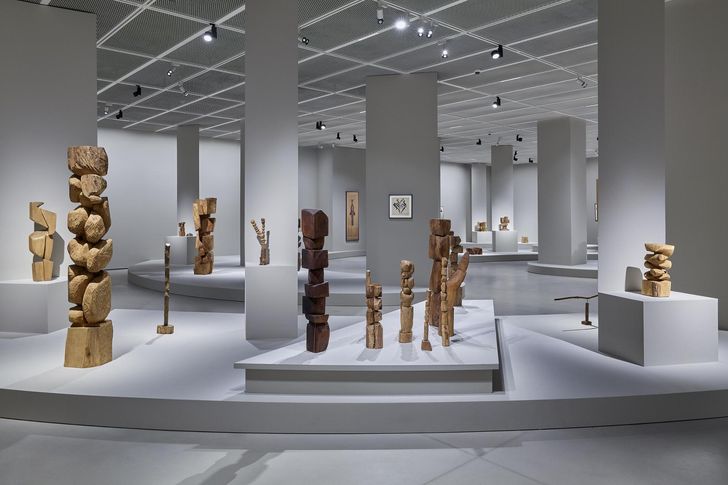
Installation view of Kim Yun-shin’s retrospective, “Two Be One,” at the Hoam Museum of Art in Yongin, Gyeonggi Province / Courtesy of Hoam Museum of Art
To give the works the room they deserve, the museum stripped away all partition walls on the ground floor, opening the galleries into one sweeping space. The decision pays off. Against the airy expanse, Kim’s wooden assemblies, twisting and rising, feel like living things sprouting from the gallery floor.
“I am the tree, and the tree is me. I’m simply nature,” said the artist, her thick white hair cropped short and a black overcoat draped over her shoulders, without a moment’s hesitation, Wednesday. It was a week before the official opening of her show.
Few who know her life story would doubt that sincerity. Four decades ago, Kim left her homeland and moved halfway across the world to Argentina, abandoning a stable career as a university art professor and risking being forgotten in Korea for the sake of one thing: wood.
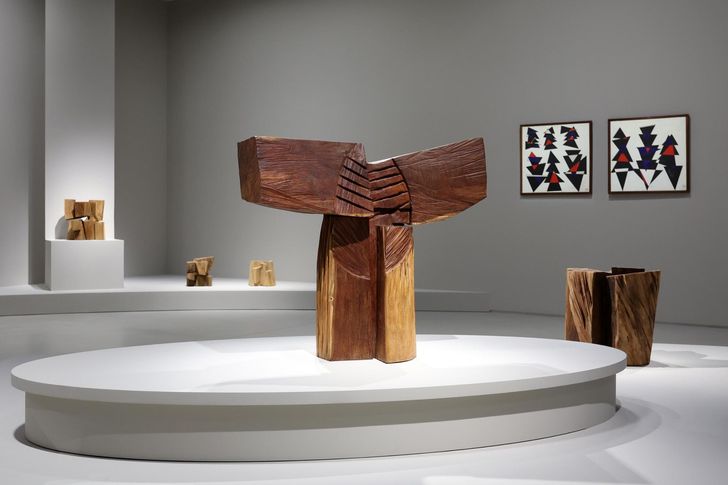
Installation view of Kim Yun-shin’s “Two Be One” at the Hoam Museum of Art / Newsis
When trees found her
The roots of Kim’s devotion to wood reach back to childhood. She was born in 1935 in Wonsan, in what is now North Korea, during the Japanese colonial period (1910-45). One of her earliest memories is of witnessing rows upon rows of pine trees fallen across the mountainsides near her village.
“I used to play with the stars, talk to the raindrops and chat with the grass, the flowers and the trees. Those trees were my friends. Why on earth were they lying there upside down?” she recalled.
She soon learned the reason: the Japanese empire, short on fuel during World War II, had cut down the pines to extract oil from their resin.
“As their friend, I wanted to raise those trees back up,” she said. “I wanted to work with them so people would keep them, preserve them.”
The thought stayed with her as she fled to the south with her mother at the outbreak of the Korean War in 1950 and later became one of the first women to formally train as a sculptor at Hongik University, one of Korea’s top art schools.
And when her niece invited her to Buenos Aires for a short visit in 1983, she had little idea that the old bond would stir again.
What struck her were the vast plains stretching to the horizon and dense strands of towering trees — a sight almost unimaginable in Korea at the time, where much of the woodland had been stripped bare during the war.
And above all there was the wood itself: robust, muscular hardwoods unlike anything she had known before, from algarrobo and quebracho to palo santo.
That alone was enough to persuade Kim to make Buenos Aires her adopted hometown.
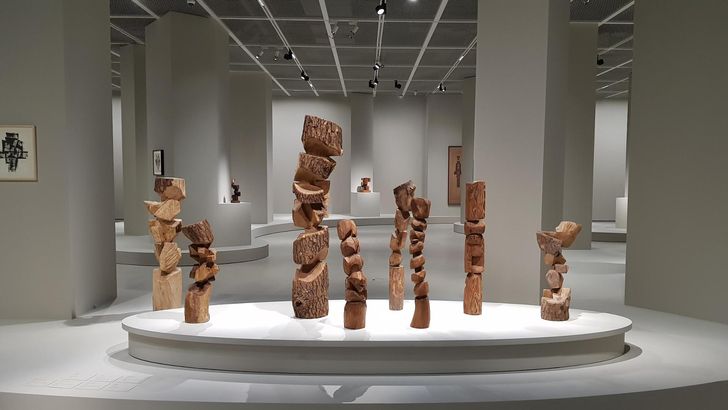
Installation view of Kim Yun-shin’s “Two Be One” at the Hoam Museum of Art / Korea Times photo by Park Han-sol
She made herself a promise to work her way through every material South America had to offer. If she could create a thousand works there, then she would allow herself to return to Korea.
But against the dense bones of hardwoods, the chisels and hand saws she had long relied on were simply no match. She had little choice but to take up a chainsaw.
“I had to become one with the saw,” the sculptor said. “Only when its blade moves as if it were part of me can the work flow naturally, the way I want it to.”
Over the next four decades, Kim immersed herself in the grain and substance of every wood around her.
The finished works reveal a striking contrast — between the pale inner wood exposed by her cuts and the rugged bark she deliberately leaves intact.
One centerpiece of the exhibition is “Add Two Add One, Divide Two Divide One 1987-88,” from the collection of the Guggenheim Museum in New York. Carved dynamically from palo santo, the towering form rises like a totem in motion. The work is being shown publicly for the first time.
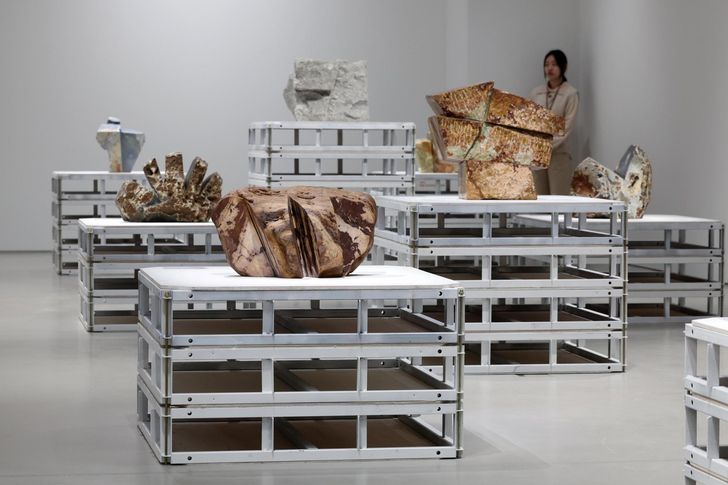
Kim Yun-shin’s stone sculptures are on view at the second floor of the Hoam Museum of Art. After spending time in quarries in Mexico and Brazil, Kim turned her attention to stone — onyx and sodalite — and coaxing luminous forms from materials just as demanding as the hardwoods. Newsis
As her confidence with wood deepened, Kim began pushing her practice further. She spent time in quarries in Mexico and Brazil, turning her attention to stone — onyx and sodalite — and coaxing luminous forms from materials just as demanding as the hardwoods. These sculptures now occupy the museum’s second floor.
“Stone is difficult in its own way, just as wood is,” she said. “It’s not something just anyone can do. Without the conviction that I had to pursue this path, I wouldn’t have come this far.”
That faith in material lies at the heart of her philosophy: “Add Two Add One, Divide Two Divide One.” The idea is simple yet profound. When artist and material meet, they first become one. From that union, something new emerges, separating into its own form.
“In the end, everything becomes one,” she said. “My art becomes me.”
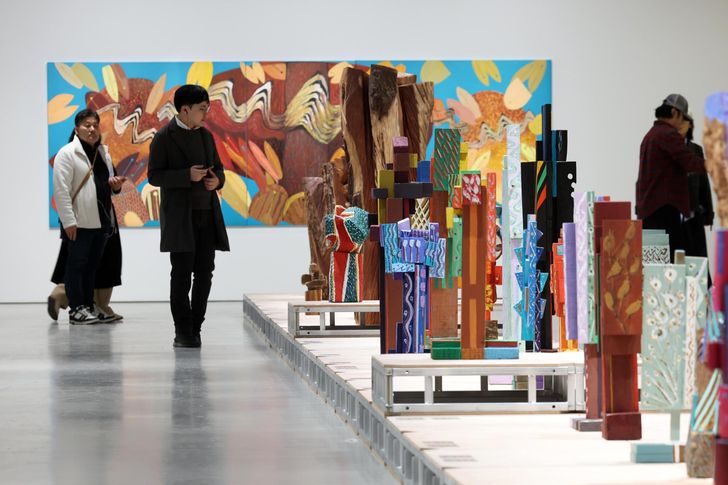
Kim Yun-shin’s retrospective at the Hoam Museum of Art closes with a striking final scene: a long, runway-like plinth lined with vividly colored wooden sculptures. Newsis
Still evolving
But the evolution of Kim’s practice did not end there. The show closes with a striking final scene: a long, runway-like plinth lined with vividly colored wooden sculptures.
When the COVID-19 pandemic struck, the artist found herself confined indoors. Materials ran out. What remained within reach were scraps of wood discarded around her studio.
She gathered all the fragments she could find and carved them into small forms. This time, she began painting their surface, turning the grain of wood into a makeshift canvas. Thus was born her “painting-sculpture,” each of its surfaces alive with kaleidoscopic bursts of color.
Two years ago, writing about the artist’s solo show at Kukje Gallery, I noted that her spirit of experimentation remained undiminished at age 88 — that it might still be years before she would be ready to set down her chainsaw.
In 2026, Kim now moves with the help of a cane and a wheelchair. And yet that thought still holds true.
Place a chainsaw in her hands and something shifts. The years seem to fall away; the body remembers the rhythm of the blade biting into wood.
“I don’t have any grand dream,” she said. “Now that I have returned to my own country, I simply hope the work I leave behind will be worthy.”
“Kim Yun Shin: Two Be One,” which opens on Tuesday, runs through June 28 at the Hoam Museum of Art.