
Members of Australia’s Iranian community believe Iran used a support member of the Women’s Football team to convince the players who sought asylum in Australia to return home.
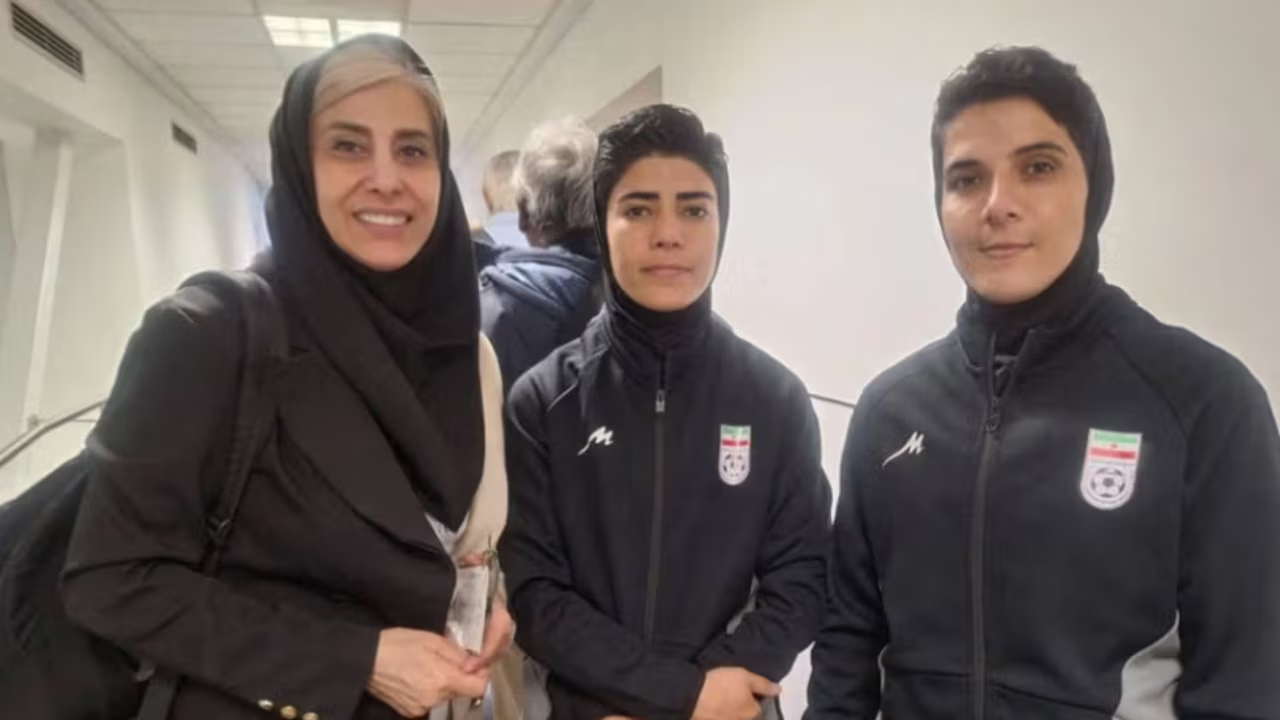
Iranian diaspora member Tina Kordrostami believes the team’s technical staff member, Zahra Meshkinkar, who was one of the late defectors from the national team, had stayed in Australia as a mouthpiece for the regime.
Ms Kordrostami, who was instrumental in persuading half a dozen players to stay following their short-lived campaign in the Women’s Asian Cup tournament, told The Australian that the federal government was unprepared to counter the reach of the Islamic Revolutionary Guard Corps.
“The team member was there the whole time to convince the girls to go back,” Ms Kordrostami said. “But we were hopeful (she intended to stay) because she looked genuinely happy.
“People in Iran have been depending on each other for so long, they don’t know how to trust a Western country because it’s all they know.”
Ms Meshkinkar and the two players, Zahra Sarbali and Mona Hamoudi, left Australia on Saturday for Malaysia, where the remainder of the squad is waiting until it is safe enough to continue their journey home.
The claims by Ms Kordrostami have been supported by independent Iranian broadcaster, Iran International, which reported that Ms Meshkinkar has been encouraging the women from inside the safe house.
There are now fears among the local Iranian community that the last three players granted humanitarian visas in Australia – including national team captain Zahra Gambari – may choose to return to their war-torn homeland.
Five players of the Iranian national team, known as the Lionesses – who had been based on the Gold Coast for the tournament – managed to escape their Revolutionary Guard handlers at the Royal Pines Resort with the help of federal police last week.
Home Affairs Minister Tony Burke revealed on Sunday morning that the squad members had decided to return despite being offered multiple opportunities to reconsider.
“While the Australian government can that opportunities are provided and communicated, we cannot remove the context in which the players are making these incredibly difficult decisions,” Mr Burke said.
“The Australian government has done everything we could to make sure these women were provided with the chance for a safe future in Australia.
“Australians should be proud that it was in our country that these women experienced a nation presenting them with genuine choices and interacted with authorities seeking to help them.”
A third player, midfielder Mohaddeseh Zolfi, returned to Iran with the team last week after previously indicating she would opt for asylum.
Iranian player leave
In a statement shared by regime-aligned news organisation Tasnim News Agency, Iranian officials linked the women’s decision to withdraw their asylum claim to a rejection of the West, stating the women were “returning to the warm embrace of their family and homeland”.
The statement described the outcome as “the disgraceful failure of the American-Australian project and another failure for Trump”.
“The national spirit and patriotism of the Iranian women’s national football team girls defeated the enemy’s plans against this team, which had been widely reflected in the hostile media with numerous projections.”
The Australian government had previously been accused of creating a “climate of intimidation and coercion” to convince team players and officials to stay.
Jim Chalmers said Australian officials were “incredibly professional” in their efforts to assist the women throughout the Asian Cup tournament.
“(Tony Burke’s) officials are absolutely top shelf, and they’ve been working around the clock on these issues and on a number of related issues as well,” Dr Chalmers said.
“The way these things unfold is ultimately a matter for those officials to determine. They have done the absolute best they can by these Iranian women under extreme and extraordinary pressure, and often that requires some pretty dramatic and unusual steps.”
The Lionesses arrived in Australia to participate in the Women’s Asian Cup just days after the US and Israel launched attacks on Iran, staying on the Gold Coast under strict surveillance from regime-connected staff travelling with the team.
Players were labelled “traitors” by the regime for refusing to sing the national anthem at their first match, and were booed by crowds at the two following games when they decided to participate.
They bowed out of the Women’s Asian Cup last Sunday following a third straight loss, with the majority of the team returning home on Wednesday.