
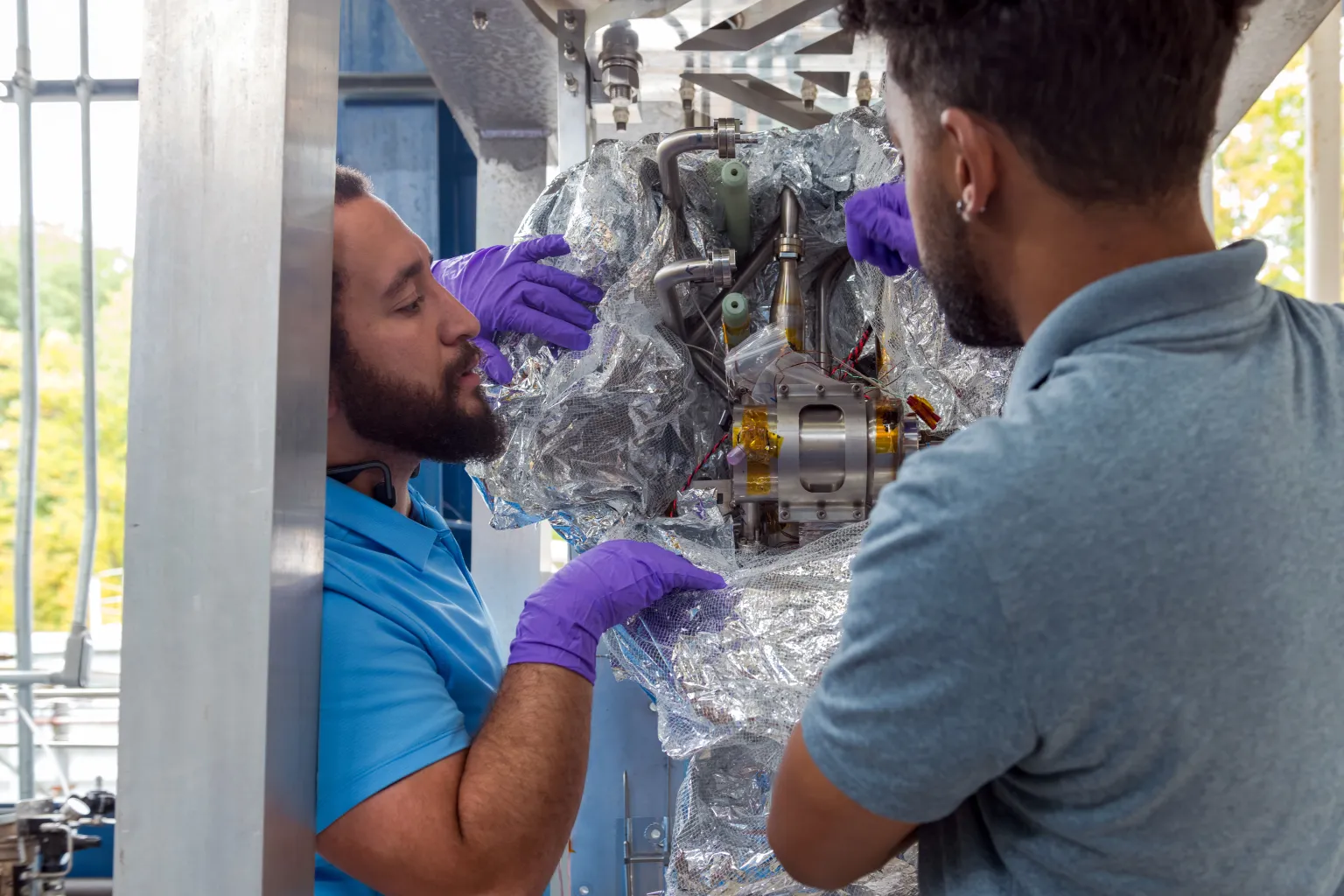
A fundamental challenge in long-duration space exploration involves the substantial mass of propellant required for missions. As mission objectives extend to more distant celestial bodies, the necessary fuel mass increases significantly. This greater fuel load, in turn, contributes to a heavier spacecraft, which then demands even more propellant for its initial launch from Earth. Experts at NASA’s Glenn Research Center in Cleveland, Ohio, are presently evaluating technology designed to mitigate this compounding issue.
The CryoFILL (Cryogenic Fluid In-Situ Liquefaction for Landers) project aims to fundamentally alter how NASA supplies fuel for future space exploration endeavors. This innovation holds the potential to reduce mission costs and extend the operational duration of activities on planetary surfaces. Evan Racine, CryoFILL project manager at NASA Glenn, elaborates on the scale of the challenge: “If you think about how much fuel your spacecraft would need to go to Mars and come home, it’s quite a lot.” He further explains the project’s strategic benefit, stating, “If we can produce and liquefy oxygen on the Moon or Mars, we can fuel landers on the surface where they land, reducing the amount of propellant needed to launch from Earth.”
CryoFILL and the biggest missions of our time
This initiative aligns directly with the objectives of the Artemis program, through which NASA intends to deploy astronauts on increasingly complex missions. The goal is to expand exploration of the Moon for scientific insight and economic advantage, thereby establishing a critical foundation for eventual crewed missions to Mars.
To facilitate a sustained human presence on the lunar surface, a key NASA objective is to harness the Moon’s indigenous resources to generate essential products, including propellants. Oxygen, a vital component of rocket fuel, can be extracted from water ice deposits located within the Moon’s permanently shadowed regions. While extracted in gaseous form, this oxygen requires cooling and condensation into a liquid state for its application as a propellant.
NASA Glenn’s specialists are utilizing a flight-like cryocooler, developed by Creare LLC under NASA’s Small Business Innovation Research program, to achieve this transformation. This device efficiently removes heat from the oxygen extraction system, enabling the oxygen to condense and remain stable at extremely low temperatures, specifically below minus 300 degrees Fahrenheit. Wesley Johnson, CryoFILL lead engineer, notes, “We’re testing with flight-like hardware to see how oxygen liquefies and how the system responds to different scenarios.” He concludes, “These are critical steps toward scaling up and automating future in-situ refueling.”
Over the next three months, NASA engineers will meticulously observe oxygen condensation under diverse environmental conditions. This data will be crucial for validating existing temperature computer models and demonstrating the scalability of this technology for larger-scale applications. Upon completion of the current test phase, the gathered information will inform the design parameters for implementing these technologies on the Moon, Mars, or other planetary surfaces.
More to the point, the Cryogenic Fluid Management Portfolio Project represents a collaborative effort across NASA, headquartered at NASA Glenn and NASA’s Marshall Space Flight Center in Huntsville, Alabama. This extensive portfolio, overseen by NASA’s Space Technology Mission Directorate, encompasses over twenty distinct technology development activities, reflecting a broad commitment to advanced cryogenic fluid management.
 Published by James Hydzik
James Hydzik is a technology geek focused on the junction of engineering, writing, and coffee. He joined Orbital Today in 2020 to help make sense of the Johnson government’s decision to buy OneWeb. Since then, he has taken on interviewing and editor-in-chief roles. James learned the ropes of editing and writing with Financial Times magazines, The World Bank, PwC, and Ericsson. Thus far, interviewing New Space movers has put the biggest smile on his workaday face. The son of an Electrical Engineer, James understands the value of putting complex topics into clear language for those with a lay person’s understanding of the subject. James is a European transplant from the United States, and as ex-KA3LLL, he now holds European amateur radio licenses. His next radio project is a portable 10GHz EME (moonbounce) station, as it combines his childhood interests in antennas and space.