
Joey Lynch
CloseJoey Lynch is a Melbourne-based sports journalist and AYA cancer advocate. Primarily working on football, he has covered the Socceroos, Matildas and A-Leagues for ESPN for over a decade.
Multiple Authors
Mar 15, 2026, 10:00 PM
And so, the wait for Women’s Asian Cup favourites Japan to be ‘tested’ continues; the anticipation of them being faced with an opponent that will serve to, even if only for a moment, slow down their march towards the final continuing unabated.
As after strolling through the group stage with an almost casual ease, Nadeshiko Japan secured their place in the last four of this year’s continental showpiece, as well as punched their tickets to the 2027 FIFA Women’s World Cup, in controlling fashion on Sunday afternoon — downing Philippines 7-0 at Stadium Australia.
Then again, maybe they were tested. For a while.
Not in the sense that Philippines ever looked like they were capable of winning the game; one only need look at the widespread changes coach Mark Torcaso made to his starting XI, bringing in youth such as Nina Meollo, Ariana Markey, Alexa Pino, Jourdyn Curran, Mallie Ramirez and Bella Pasion, to hazard a guess that the Filipinas entered this game with one on eye on what is now a locked-in clash against Uzbekistan with a spot in 2027 on the line to be staged on the Gold Coast next Thursday.
But, instead, in addressing an area their coach has identified as standing between them and being amongst the world’s best.
“If football was played only in the space between the two penalty areas, Japan would possibly be the most successful team in football history,” coach Nils Nielsen said soon after he took over the 2011 world champions in 2011.
– WC qualification via the Women’s Asian Cup: How does it work?
– Ante Milicic’s China not fazed by impending Matildas test
– ‘That’s tournament football’: Montemurro’s Matildas through to semis
“Specifically, it is those killer instincts that are often lacking, particularly in the first and final thirds. The Japanese are so polite, and it’s just not natural for them to have lots of duels in a game and be very aggressive. This is what needs to be taught, and those elements are needed for us to win those very tight games.”
Where are we going with this? Well, almost as soon as the opening whistle sounded, the challenge that was set to confront them on Sunday became apparent.
As we have already seen from this tournament, particularly in their opening game against Australia, Philippines retreated into its testudo, an iron tortoise that was getting ten, and sometimes eleven, players behind the ball in an effort to confound and frustrate their opponent’s attempts to play through them.
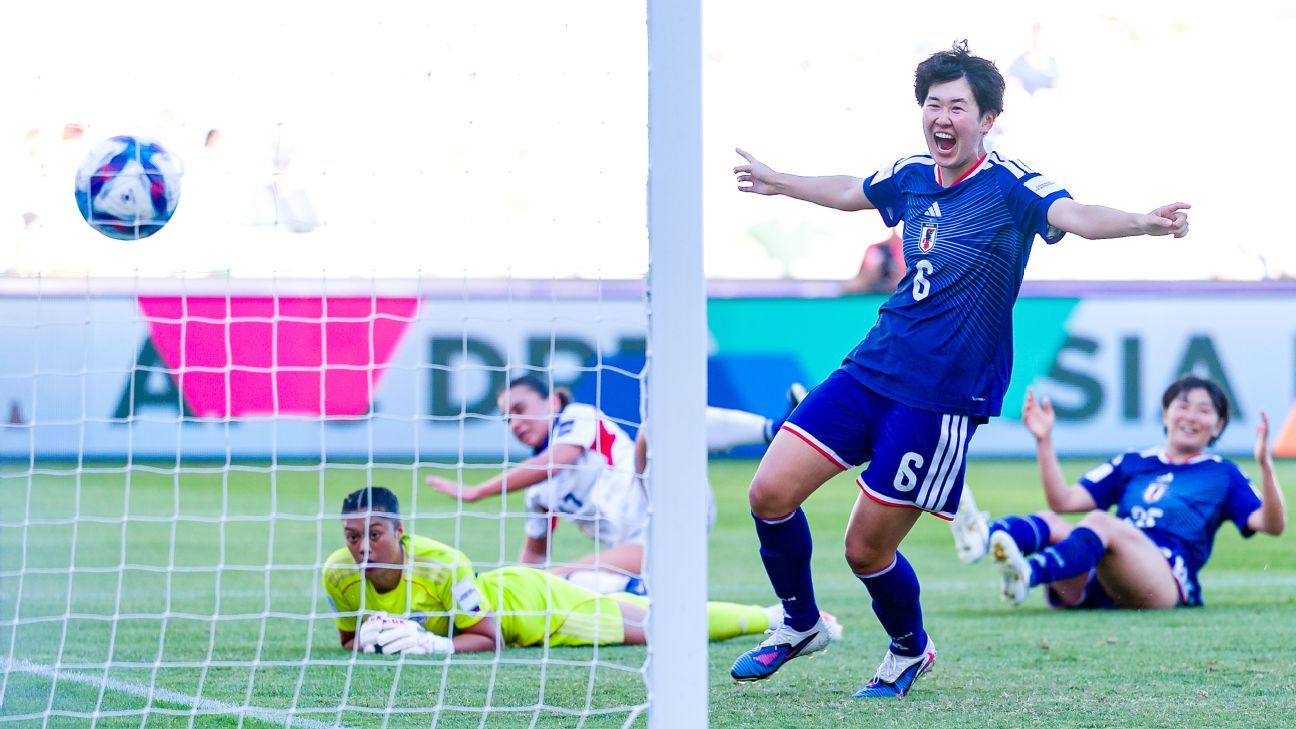
Japan’s 7-0 win over Philippines in the AFC Women’s Asian Cup took their record to 24 goals and none conceded in four consecutive victories. Andy Cheung/Getty Images
Half an hour into the contest, the Japanese had hoarded 87.2% possession, they had sent in 19 crosses and fired in 12 shots to none. A glance at the Philippines heat map showed a burning orange blob inside their penalty area, and nary a drop of activity anywhere close to their opponent’s penalty area. And yet the score was 0-0.
The technical and tactical ability of those in blue was unquestionable, obvious with every neat passing move they made, every darting run they performed, and every attempt to manipulate their opponents, both with and without the ball, they undertook. But these skills have never been in dispute when it comes to Japan; they’ve never been the thing that’s seen as holding them back.
Yet with every missed opportunity, every attempt sent wide, or save made by Meollo, a sense of uncertainty if you were watching could only grow, as would a sense of confidence in the Philippines.
Torcaso’s side had managed to hold the Matildas to just the single goal in Perth and, if they could produce a similar defensive display this time around, who’s to say they couldn’t find a way to jag a goal up the other end and stage one of the biggest upsets in Asian football history? This is knockout, tournament football, after all; anything can happen.
But then, finally, it happened.
Follow the Women’s Asian Cup YOUR WAY
Follow the nations and players you love, ignore the ones you don’t. The ESPN App is the best way to get all the 2026 Women’s Asian Cup live scores, news and videos you want ANYWHERE, ANYTIME.
• Download ESPN from Google Play Store
• Download ESPN from iTunes App Store
DOWNLOAD
In the opening minute of first-half stoppage time, Utah Royals attacker Mina Tanaka, after a chaotic goalmouth scramble following a corner, bundled the ball over the goalline to make it 1-0. Then, just a few minutes later and on the stroke of halftime, Spurs’ defender Tōko Koga headed in another set piece to provide a two-goal buffer.
And from there, the two telling blows struck, the floodgates could open.
Five more goals were mercilessly piled in, with Koga grabbing a brace and Remina Chiba, Manaka Matsukubo, Momoko Tanikawa and Riko Ueki all getting in on the party.
Even the move to bring off keeper Chika Hirao for Akane Okuma — the INAC Kobe Leonessa custodian just one of four domestic-based players in the team, a sharp contrast from the 2022 Asian Cup when there were 17 — didn’t signal a desire to let up, with the side in front ending the game with a staggering 50 shots.
“We have to give credit to a side that makes an art of defending and getting in the way,” Nielsen said post-game. “That’s what happened. We were a little bit hesitant, and we didn’t really get past that.
“And that meant that they could block pretty much every shot. And if you use your whole team for that, of course, you can do that over a period of time. But it’s difficult to make that your strategy once we score the first goal and throughout the game.
“Japanese players are very humble by nature. So, this thing with just taking the shot when it’s there, they like it more if they can pass it to someone else who could take the shot. [We’re] slowly building on that instinct that it’s okay to score, it’s okay to be good, it’s okay to take the chance and teach them that it’s fine also if you miss, but you have to try to score, you have to give everything.
“We are not there, we are not fully there yet, but we are better than we were. And that reflects in the score line. But you have to accept that there are things that we are very good at, and it comes naturally for the players, and there are other things that they need to work really hard. That’s just the way it is. It’s part of the game working.”
The concern, if you can call it that, coming out of Japan’s first four games is that they haven’t been challenged. But Saturday’s performance showed a level of ruthlessness that suggests they’ll be alright.
Perhaps South Korea in the semifinal, or Australia or China in the final, will give them a sterner test, but the mentality to keep going against a low-block and then keep going once it was broken showed a level of competitiveness that we otherwise don’t get to see a lot of in blowouts against lesser opponents.
For the Philippines, meanwhile, the clash with the Uzbeks awaits.
Given their recent success as the Southeast Asian Games and their previous qualification for the World Cup, you’d think that the Filipinas will come into that game as the favourite. And given the management of the squad undertaken by Torcaso against Japan, one would hope they’ll be fresh — injured Ramirez notwithstanding.
However, the concern will be that, with so much focus on defending this tournament, first against Australia, then South Korea and then against Japan, they simply won’t be able to find their shooting boots and break down what will likely be a very stout Uzbek low-block themselves.
Scoring just two goals against an Iranian side already eliminated and, clearly, distracted by other things, their advancement to the knockout stage was only salvaged by Japan’s win over Vietnam a few days later and, with the spotlight on, they’ll need to bring their guns to bear.