
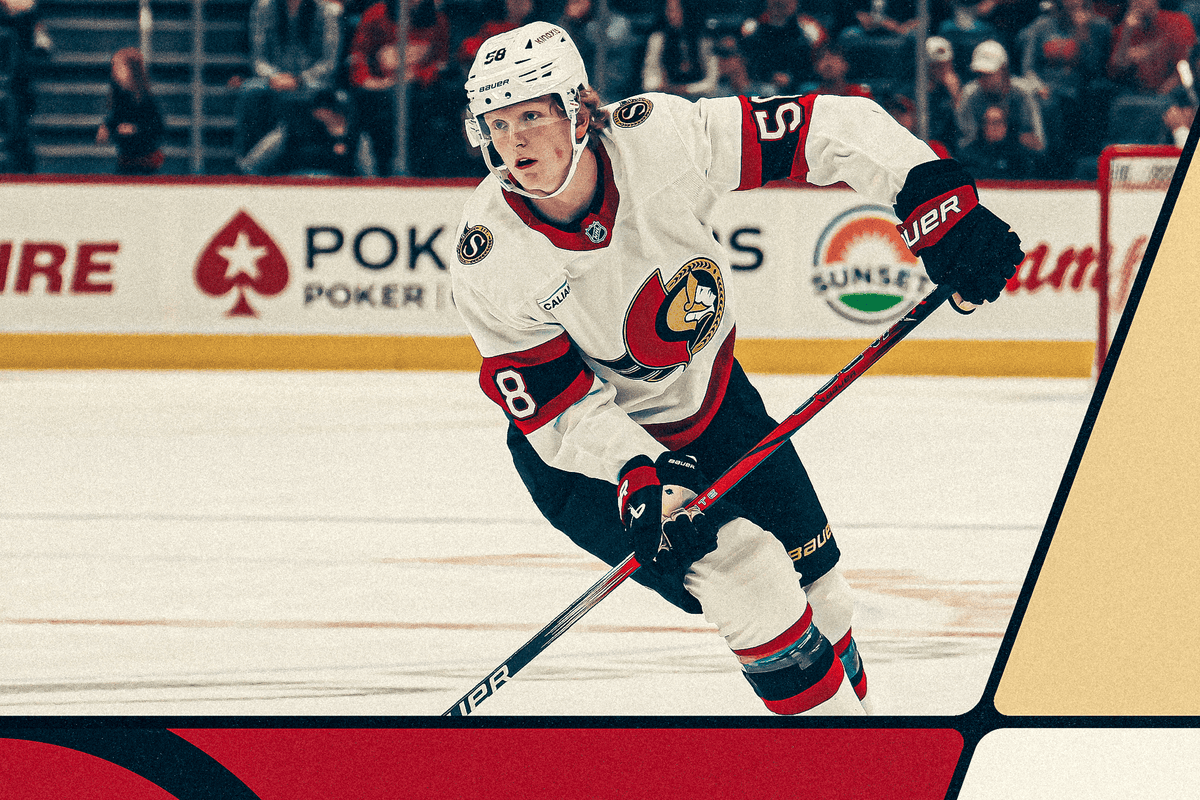
Welcome to Scott Wheeler’s 2026 rankings of every NHL organization’s prospects. You can find the complete ranking and more information on the project and its criteria here, as we count down daily from No. 32 to No. 1. The series, which includes evaluations on nearly 500 prospects, runs from March 9 to April 8.
Carter Yakemchuk and Logan Hensler give the Senators two legit right-shot D prospects and, in the former, maybe an offensive catalyst if he can put it all together. But a focus on pro-style, pro-built role player types outside of Round 1 over the years has left the rest of Ottawa’s pool with a group of players who could potentially become fourth-liners or depth D — potential bunt singles instead of home runs, if you will.
2025 prospect pool rank: No. 27 (change: +1)
Tier 11. Carter Yakemchuk, RHD, 20, Belleville (No. 7, 2024)
Yakemchuk’s rookie season in the AHL has gone about how I expected it would. He has been pretty productive on a poor Belleville team, but they’ve also given up a lot of goals, and he has been on for more of them against than anyone else on that team. His track record of production speaks for itself; Yakemchuk was one of the highest-scoring and most penalized draft-eligible defensemen in recent WHL history, breaking the rare 30-goal and 70-point benchmarks and sailing past 100 penalty minutes with the Hitmen (who missed the playoffs) two seasons ago. That’s a year after he was the only 2024 draft-eligible to make one of the WHL’s All-Star teams when he was named a Central Division Second All-Star, which was important considering he was only a couple of weeks away from being eligible for the 2023 draft.
I thought he was unremarkable at the 2023 U18 worlds, and he struggled in stretches at both the World Junior Summer Showcase and his first rookie tournament with the Senators, but an impressive first main camp with the Senators demonstrated his upside, and he’s always going to make plays. He has some highs and lows, though: after returning to the WHL last season, he had a good season and made some modest progress in a couple of important areas, but didn’t take a big leap forward there, either.
Led by his instincts, plenty of confidence and legit skill for a D his size, Yakemchuk generates a lot from the back end. While his game comes with some give and take, he has pro size, a pro shot, excellent one-on-one skill and hands, and an attack mentality that’s complemented by an active disposition to eagerly jump off the line or into the rush. He also has a developing sense for when to hold it and when to move it, which has been a work in progress for him over the years. He also protects the puck extremely well for a defenseman, which allows him to make the most of his decisions to involve himself in the play around the offensive zone, holding pucks past and away from reaching defenders and sometimes dazzling in extended sequences with the puck. It’s not uncommon to see him take a puck to the inside of the wall, beat his man off the line or go to the front of the net. And while he has work to do to refine his game and reads defensively, he has the size and tools (it never hurts when you’re a 6-foot-3 righty) to take the steps he needs to get there, and he plays really hard at both ends.
I would like to see his skating — which is fine going forward but heavy-footed in other areas and can burn him — improve, particularly from a standstill, where he can be a little slow out of the blocks. He’s not a natural athlete, either. There are games in which he dictates terms with his offense and physicality, really taking charge on the ice. If he can get a little quicker and continue to mature in his decision-making, he has high-end upside, especially offensively.
Tier 22. Logan Hensler, RHD, 19, Wisconsin (No. 23, 2025)
Hensler, who because of his October birthday played his two years at the U.S. NTDP before his draft year and played his draft year as a freshman with the Wisconsin Badgers, consistently impressed me in early viewings in his U18 season and then left me wanting more pretty often in the second half before finishing better at U18 worlds and acquitting himself nicely at the World Junior Summer Showcase. Last season, he played top-four minutes (more than 18 per game) for a Badgers team that lost more than it won and contributed on their power play. He was also OK in a third-pairing role at the World Juniors, where he clearly tried to simplify and play mistake-free.
I thought he was better than the numbers indicated at Wisconsin, especially given his age and the context of his team, but there are some who aren’t sure what his identity/role will be in the NHL, and I’ve also had a tough time with his projection at times. He hadn’t taken the step forward this year that I wanted to see him take at Wisconsin prior to a season-ending lower-body injury, either, and was a major disappointment at his second World Juniors. Though his production was up modestly and his on-ice results were solid pre-injury, he was actually playing less (down to 16-17 minutes per game), and I was still waiting to see him take charge more out there on both sides of the puck.
Hensler is a talented player and good prospect, but he’s not a no-doubter offensive defenseman or a lockdown defensive D type. He’s a smooth, mobile, balanced skater. He can use his feet to attack and create lanes. He’s a good athlete. He keeps his head and eyes up. He’s skilled with the puck. He has a decent stick and defensive instincts. He reads the play well on both sides when he’s dialed in, but there are times when it can feel like he’s just out there for a skate. There are also times when it seems like he doesn’t know his identity as a player.
I’ve really just wanted to see him take charge more on blue lines at the NTDP and Wisconsin. Even as one of the younger players on all of his teams with both USA Hockey and the Badgers, he has the talent to be more impactful than he has been (and he has been good for both). It can feel like he’s unsure of himself at times out there, and his game can miss that grab-it mentality. He has moments when he jumps up in transition and makes something happen, and shows some exciting qualities and instincts. I want to see more of that, and an equal assertiveness defensively. My viewings were mostly positive last year, but I’m still waiting for him to jump off the page at me. He’s capable of it.
He’s really fluid in and out of his edges. He has pro size. He has good handles. He has balanced posture on his heels and toes, and he’s capable of using it to play strong stick-on-puck gaps and carry and lead in transition. He has poise and comfort in all three zones. He has skill and offense. He’s a righty. It’s in there. If it all comes together, there’s a skating, transitional, PP2 second-pairing NHL D in there. I think there’s some risk that he doesn’t take that next step and just becomes a fine depth five-on-five guy who can move pucks.
3. Leevi Meriläinen, G, 23, Belleville/Ottawa (No. 71, 2020)
Meriläinen has always been a tricky goaltender for me to get a pulse on because I’ve seen him steal his fair share of games and also look shaky fairly often. When he’s on, he’s challenging shooters, quick up and down from his knees in his recoveries/closing the five-hole, quicker side-to-side on pushes, lightning fast through his feet in one-on-one situations with shooters (he’s excellent in the shootout because of his footwork) and fighting to get to pucks with his speed and athleticism. When he’s off, he can look small in the net, gives up goals on low-danger shots too often and is a little too active/sporadic in the net as well. He has found more control over the last few seasons in the pro game. There’s still something about his consistency that I’m not fully sold on, but it has improved, his quickness is a major asset and he has shown some real signs at various points. I’m not sure if he’s just organizational depth or an actual No. 2, though.
4. Blake Montgomery, LW, 20, Wisconsin (No. 117, 2024)
Montgomery was an interesting gamble as an overager who still felt raw, and he took off with the London Knights after being one of the first college-committed players to make the jump from the USHL to the CHL. He has had a few very impressive games as a freshman at Wisconsin, where he has shown his pro attributes this season as well. He’s long (6-foot-4) and he can absolutely fly. That in and of itself makes him intriguing. He’s an increasingly powerful, driven, straight-line winger who plays in routes, can gain the jump on D, can really lean into his wrister in motion and has worked to round out his game and add different elements as well. He has handling skill and has made some pretty plays in flight over the last couple of years, too. You can literally see him coming into his own in some games, and he’s learning how to deploy his obvious tools in real time. He has pro projectability in spades, will continue to fill out, and could become a development success story and a unique bottom-sixer if he stays on his current upward trajectory.
5. Jorian Donovan, LHD, 21, Belleville (No. 136, 2022)
Donovan made significant progress over the course of his junior career, going from a fifth-round pick I had real reservations about as a prospect pre-draft to OHL champ, Memorial Cup champ, a strong showing at an NHL camp and an entry-level contract. He became one of the top two-way defenders in the CHL, and while there was a transition period to the AHL last season, he has been one of Belleville’s bright spots for me this year, often playing 20 minutes per game to solid results as a young D in the league. He has the tools to become a No. 5-8 D and play NHL games.
He has pro size and excellent skating. His reads have taken steps toward average or maybe slightly above. He showed more confidence with the puck and began to try things and expand his game offensively last season, while also upping his physicality. He can defend. He has a good stick. He plays hard. I’m just not sure if there’s enough in his game to be more than organizational depth, but he should have a long pro career, and that would be a fine outcome given where he was drafted.
6. Owen Beckner, C, 21, Colorado College (No. 204, 2023)
Beckner is a player I know the Colorado College staff are quite high on. He was a 2023 seventh-round pick who took the BCHL-to-USHL-to-NCAA route, playing in the USHL post-draft and then making the jump to college as a 19-year-old in fall 2024. He then led their team in scoring as a freshman last year with 27 points in 37 games and is again leading them this year while hovering around a point per. He’s a 6-2, 190-pound center who plays 18 minutes per game and is a focal point of their power play. He’s also now wearing a letter for the Tigers, having just turned 21 a few weeks ago.
The challenge he’ll face once he makes the jump to the pro game is that he’s not a super competitive checker type, he has work to do in the faceoff circle and he has only been a spot-duty penalty killer in college. As a result, I wonder if he’s more of a top-six AHLer or call-up option than an everyday role player. He’s a talented, heady, decent-sized player who thinks the game well and can make plays. I would like to see him shoot and score more, because he has a dangerous wrister, too. He gets good pop off his curl-and-drag, and when he follows plays to the net, he can create havoc off his shot because he gets it off quickly and skates well off the puck.
I expect him to get an NHL contract when he leaves Colorado College. Then it’ll be up to him to climb through the AHL. He looks like good value in the seventh round, though.
7. Lucas Beckman, G, 18, Baie-Comeau/Chicoutimi (No. 97, 2025)
NHL Central Scouting’s No. 2-ranked North American goalie last year before the Sens took him early in the fourth round, Beckman is a late-August birthday and was outstanding for Baie-Comeau across an impressive 63-game workload between the QMJHL regular season and playoffs in his draft year and has been solid again this season for them before getting traded to Chicoutimi. Across three QMJHL seasons now, the 2023 second-round pick of the Drakkar has played to a save percentage around .915 in the regular season and a .921 in the playoffs. He also started against Latvia and came in against Norway for Canada at U18 worlds, stopping 21 of 22 in his two appearances there.
Beckman isn’t big, but he certainly doesn’t look small in the net, with an ability to play challenging angles, take away a shooter’s options and make the first, second and third saves. He’s athletic and quick on his feet without sacrificing his positioning and control, with an ability to make low-to-high or post-to-post saves, but not a reliance on that. He’s good technically, has good hands and is comfortable playing the puck as well. He also has impressive composure and seems to really be dialed in mentally. I like him where they got him. I wonder, too, if he’s one of Canada’s goalies behind Jack Ivankovic at next year’s World Juniors.
8. Kevin Reidler, G, 21, Penn State (No. 151, 2022)
After a strong post-draft season at the J20 level, Reidler made the move to North America two years ago, joining a Dubuque team with a track record of recruiting and developing Swedes and then jumping to the NCAA last season. He was good in the USHL, immediately becoming the starter for one of the top teams in the league, albeit one which played on the attack and gave up a fair amount back the other way — he was much better than his .902 save percentage and that revealed itself in a stellar playoffs. And while he was the backup at Nebraska-Omaha behind Simon Latkoczy last year, he played to a .920 save percentage in his eight games and then transferred to Penn State, where he’s their starter as a sophomore, and his numbers have been respectable behind a team that gives up its fair share.
A towering 6-6, 200-ish-pound goalie, Reidler reads and anticipates play well, has good hockey sense, is coordinated for his size and is good at moving laterally and going post-to-post or quickly stretching out for a goalie his size. By all accounts, he also has a great attitude/mindset. He doesn’t get flustered and just wants to learn. He’ll be a 3-4 year goalie in college, and then the Sens can assess where he’s at in his development. He’s worth following, though.
Tier 39. Lucas Ellinas, C, 20, Kitchener (No. 104, 2024)
Ellinas didn’t make my final top 100 for the 2024 NHL Draft, but there was a lot of chatter about him as a mid-round pick late in that year, and I had two different sources in the final two weeks before the draft give him some love. He hasn’t taken off in the last two seasons like some thought he might, though, and then he blew out his shoulder last January.
He has good speed, a strong work rate, good athleticism and a natural release. There’s a belief he’s still early in his development, too, and he can catch your eye on the ice and stand out in games with his consistent involvement in the play, and I know he impressed the Sens in his development camp/rookie tournament introductions. He plays a desirable, likable pro style, and some believe he has the makings of an effective bottom-sixer long-term. It will be a long-term path for him, though, and I think he may well end up as an AHL third-liner too.
10. Hoyt Stanley, RHD, 21, Cornell (No. 108, 2023)
Stanley was the best under-18 defenseman in the BCHL three seasons ago and earned a spot on the league’s All-Rookie team after missing most of the prior season with a concussion. Then, as an 18-year-old freshman at Cornell, he looked like he belonged without standing out, which is kind of all you can hope for out of a player who has taken that path to playing college hockey (especially given his age at the time). He’s now a junior, though, and his production hasn’t taken a step despite expanded minutes — he averaged 20 per game last year and is up to 22 this year — and positive two-way results generally.
He’s a long, mobile, pro-sized (6-3, 207 pounds) right-shot defenseman with impressive skating technique, enough ability to handle and maneuver with the puck on his stick, and a decent shot that I’d like to see him use more. He’s still a little raw in some areas, but I expect him to blossom into a standout college defenseman as an upperclassman. He projects as an efficient, effective two-way D with some secondary puck-transporting elements, and I saw enough NHL potential to rank him No. 98 pre-draft (10 spots in front of where the Sens picked him) ahead of the draft. I’m not sure he has done enough to warrant an entry-level contract to this point, though, and while he’s still young for a junior, the clock is now ticking.
11. Javon Moore, LW, 20, Minnesota (No. 112, 2024)
Moore is a pro-sized (6-4, 210 pounds) winger who can skate, which allowed him to attack off the rush and circle the offensive zone fairly frequently at Minnesota’s high school level in his draft year. Last year, his post-draft season in the USHL was fine, but it wasn’t a noticeable step forward (but you can live with that for a player who took a high school path, which comes with some learning up levels). He has progressed nicely as his freshman year at Minnesota has gone on this year, though, playing his best hockey of late.
Moore is also a player I kept getting told had some real offense to his game, and while I didn’t see it for a while, we’re starting to now. He doesn’t score off high-skill plays, and I find his actual impact on games a little more muted than his production and tools at times, but he’s learning how to more consistently get to good spots. I don’t think he reads the game naturally, and the skill level looks more average than above it to me still, but he has the tools of a go-getter for skill players and he just needs to continue to hone his identity.