
Sean Payton wanted it, and so it was done.
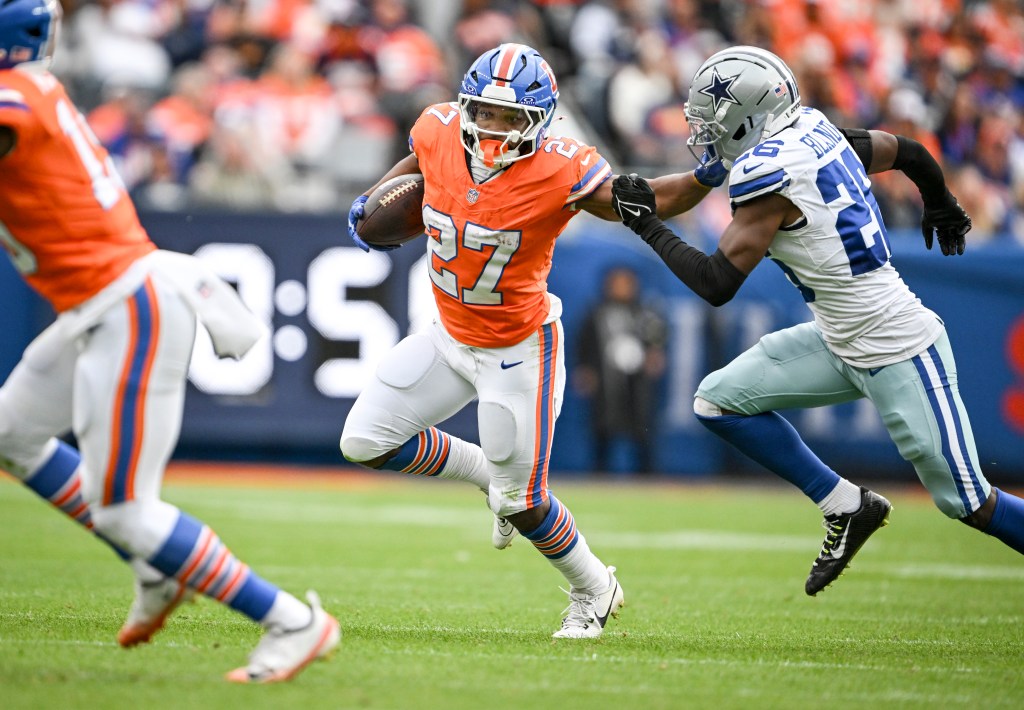
Last Tuesday, soon-to-be free-agent running back J.K. Dobbins was working out in the Broncos’ facility when he got a buzz from Payton to come up to his office. Dobbins finished, wandered up, and sat with Denver’s head coach for a simple conversation that’ll form the genesis of how Denver’s not-so-new-look run game will produce in 2026.
Payton told Dobbins that he was his guy, a source familiar with the situation told the Denver Post. That said enough. Being a Payton Guy has extended NFL lives and poured millions upon millions of dollars into loyal bank accounts. Being a Payton Guy, as former Saints linebacker Scott Shanle told The Post last year, is a “badge of honor.” And Payton has praised Dobbins to reporters throughout the year, enamored with the spirited presence of a running back who chose specifically to rehab a midseason Lisfranc injury in Denver to stick around the team rather than have surgery elsewhere.
“Losing J.K., obviously, was a tough loss,” Payton said after Denver’s season ended. “He brought a lot more to the locker room than you would know.”
And Payton made clear he didn’t want to lose Dobbins come 2026, the source said, in that March 3 conversation. The reality of Denver’s situation was slightly more complex. Jets star running back Breece Hall loomed as a potential free-agent option; asked if the Broncos would’ve gone after Hall had he hit the open market, a source with knowledge of the team’s thinking told The Post the decision would’ve been a “no-brainer.” But New York moved quickly to franchise-tag Hall.
Other top options, from Kenneth Walker III to Travis Etienne Jr., quickly fell off the board during the early week’s legal-tampering period of free agency. Dobbins remained, as his own market started to climb. And the Broncos moved quickly to secure their 2025 leading rusher, and certified Payton Guy, on a two-year deal.
That single sequence has encapsulated Denver’s dealings — or lack of them — through the first week of free agency. The reigning No. 1-seeded Broncos are approaching unprecedented levels of run-it-back roster retention. As of Friday, Denver is the only team in the NFL to not have signed a single external free agent. Not only that, but the Broncos have signed back 16 of their own 22 players set to hit free agency since late February.
The sheer wave of Payton favorites re-upping on minimum deals — tight end Nate Adkins, fullback Adam Prentice, receiver Lil’Jordan Humphrey, running back Jaleel McLaughlin — has washed in heaps of online vitriol from Denver’s own fanbase. Internally, the Broncos’ brass went into free agency aligned without expecting to make a massive splash in the market. Externally, the Broncos’ lack of activity gives the impression of an organization that is relying fully on its Payton-era foundation for a Super Bowl leap, for better or for worse.
The reasons for this week’s developments are multifaceted. But the overall reality is simple, lying in the hands of the head man still pulling the strings despite passing off the play-calling reins.
Asked their impression of the Broncos’ approach, one NFL assistant coach told The Post: “Sean obviously likes his football team.”
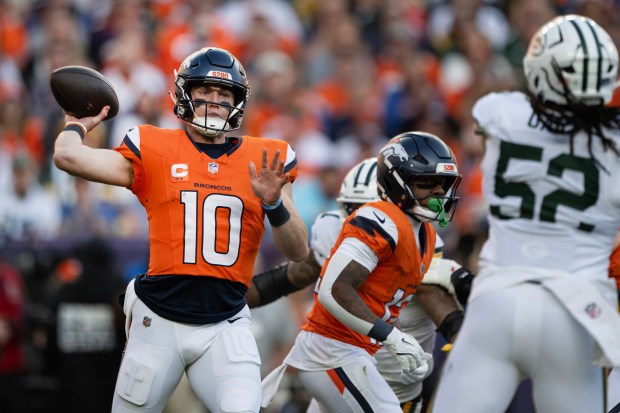 Quarterback Bo Nix (10) of the Denver Broncos attempts a pass during a game against the Green Bay Packers on Sunday, Dec. 14, 2025, at Empower Field at Mile High Stadium in Denver. (Photo by Timothy Hurst/The Denver Post)
Growth inside the building
There’s plenty left to play out, from the trade market to April’s draft. Denver, after all, first signed Dobbins in June 2025. But data indicates the Broncos have taken a particularly unique strategy on the first go-around of the free-agent carousel.
According to player data collected and analyzed by The Post, Denver currently has 94% of its total snaps from the 2025 season under contract. In the last 10 years, no team that’s made the AFC Championship Game has gone into the following season retaining more than 83.2% of its snaps from the previous year (the 2019 Kansas City Chiefs set this mark).
“Good call,” one NFL agent, speaking on condition of anonymity, remarked. “If it ain’t broke, don’t fix it.”
Denver, of course, was the furthest thing from broken in a 14-3 season in 2025. The issue: its offense, by all accounts, was continually bent out of shape. Payton fired offensive coordinator Joe Lombardi and receivers coach Keary Colbert after a 14th-place finish in points per game in 2025 and appointed a separate play-caller — 31-year-old Davis Webb — for the first time in his 18-year head-coaching career.
At the NFL Combine, Payton was asked whether coming so close to a Super Bowl appearance influenced him to consider a big offseason swing or simply to stay the course. He directly acknowledged that the Broncos played the margins too thin in a season of white-knuckle moments at Empower Field.
“From my lens, we won a lot of games by one score or less, right?” Payton said then. “And I’m not naive enough to think those games couldn’t have swung, and you could grab any two or three. But where’s the meat on the bone?
“The meat on the bone,” he continued, “exists with our takeaways. That has to improve. Our run-game consistency, our meat on the bone relative to a number of things that we won despite maybe — not being as good as others.”
That has quickly become the defining quote of Denver’s offseason, for better or worse. Despite Payton’s acknowledgement that the Broncos couldn’t simply stand pat, they have simply … stood pat. In fact, they’ve only lost production. Defensive lineman John Franklin-Myers, who was everything from a key pass-rusher to a behind-the-scenes mentor, left for a monster three-year, $63 million deal with Tennessee. Backup safety P.J. Locke went to Dallas. Denver cut linebacker Dre Greenlaw to save cap room.
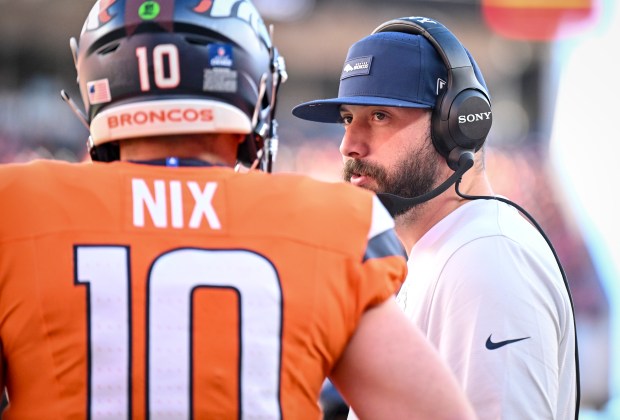 Quarterbacks coach Davis Webb of the Denver Broncos speaks to Bo Nix (10) during the first quarter against the Jacksonville Jaguars at Empower Field at Mile High in Denver, Colorado on Sunday, Dec. 21, 2025. (Photo by AAron Ontiveroz/The Denver Post)
There are a few explanations for this confusing puzzle. Piece together hints from across the past year, and Payton and general manager George Paton are clearly focused on development from young, cheap talent under a new-look staff. That starts, of course, with a continued third-year leap from quarterback Bo Nix.
Payton made it clear at the combine that Nix wasn’t a factor in the decision to pass play-calling duties to Webb; people close to Nix, though, have told The Post that Nix was generally supportive of the move.
“There’s certainly things we want to be better at,” Payton said at the combine, speaking on Denver’s offensive operation. “But it’s also being quicker. And look, it’s only if there’s someone that you feel like is good enough to do that, and (Webb) will have that opportunity.”
The Broncos are also plenty high on their young receiving corps of Troy Franklin, Marvin Mims Jr. and Pat Bryant, with the potential to hand-pick another weapon come April: Indiana star Omar Cooper Jr. visited Denver for a pre-draft visit on Friday. Rising second-year back RJ Harvey will have every opportunity to show he can improve as a runner from an equally dynamic and shaky rookie season. 2025 third-round pick Sai’vion Jones, who received just 39 snaps in the middle of a logjam in his rookie year, could also make a push in training camp for Franklin-Myers’ role on the defensive line.
Denver has room for growth in its tight-end crop, too, despite preserving a middle-of-the-road group for 2025. Veteran Evan Engram is tight with Webb dating back to their shared playing days in New York, and Engram had a 58-yard catch-and-run in Webb’s preseason play-calling showcase against the Cardinals in August. 2025 seventh-round pick Caleb Lohner, meanwhile — a raw big body who spent his rookie year on the practice squad — is training in Texas this offseason with former Packers Pro Bowl receiver Donald Driver, Lohner’s uncle Mike told The Post.
Another possible hidden wrinkle to Denver’s offseason: the 2027 draft is already generating substantial buzz in the NFL. The Broncos will likely receive a fourth-round compensation pick in ’27 with Franklin-Myers’ departure, which becomes particularly valuable given the strength of next year’s class. This would not be a foreign strategy.
The Jaguars, who’ve also been notably quiet in free agency, have let star running back Travis Etienne and linebacker Devin Lloyd walk specifically to acquire 2027 draft capital.
“I think on its surface, you would think, ‘Oh, OK, you’re going to make picks in 2027,’” Jacksonville general manager James Gladstone told local reporters Thursday. “Whereas, in reality, those draft picks and having more of ’em actually allows you the luxury of remaining in the hunt at different intervals throughout the entire calendar year, for acquiring players.”
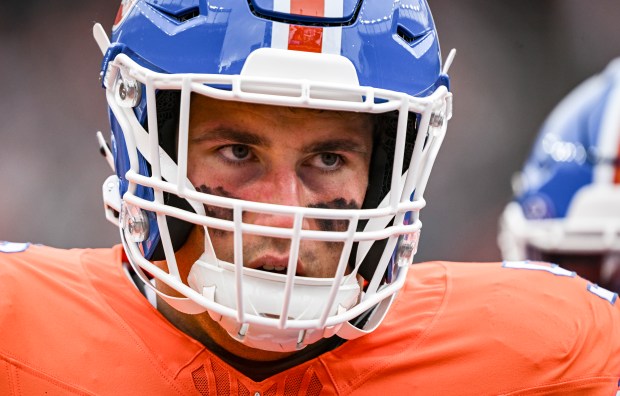 Zach Allen (99) of the Denver Broncos locks in before the game against the Dallas Cowboys at Empower Field at Mile High in Denver on Sunday, Oct. 26, 2025. (Photo by AAron Ontiveroz/The Denver Post)
Cap considerations
The Post sourced 10 different NFL agents for their thoughts on Denver’s lack of activity early in free agency. The clear consensus from those sitting across the table: the Broncos haven’t taken a bad approach, given they were a Bo Nix fractured ankle and an AFC title game winter wonderland away from a Super Bowl appearance.
“They had a great season,” one agent texted. “It makes sense to me to build off of what you already have.”
“Why would you not bring that entire team back (?)” another agent texted. “Good chance they win it all if no Injury (sic) and maybe even just if no blizzard.”
“It is odd,” another agent mused. “They probably see it, like — it’s not worth overspending on anybody.”
That point is key. Two NFL sources who spoke with Denver earlier in the week told The Post that the Broncos weren’t willing to spend more than $10 million per year at running back and $6 million per year at tight end. That ruled out the dynamic Etienne, who signed for four years and $52 million with New Orleans. That also ruled out Chig Okonkwo — a skilled tight end the Broncos called about, according to a source — who ended up signing for three years and $30 million with the Commanders.
That’s not stinginess for the sake of stinginess. At his end-of-season presser, Payton likened the Broncos’ financial freedom from Russell Wilson’s contract to renovating one’s house.
“If I said I’m going to give you $50,000 to decorate your home, or $200,000, your home’s going to look nicer, I think, if you’re a decent shopper,” Payton said.
Denver, though, really has closer to $50,000.
Much of the Broncos’ cap room has already been gobbled up by a rollicking run of long-term extensions across the past year, locking in core pieces from Zach Allen and Nik Bonitto to Luke Wattenberg and Malcolm Roach. The Broncos really haven’t had much to spend after extensions for Alex Singleton, Justin Strnad, Dobbins and Trautman — and need to keep an eye towards possible in-season extensions for key players like Mims, Riley Moss, and Ja’Quan McMillian.
The Broncos, too, may have to consider future renegotiations with All-Pros Pat Surtain II and Quinn Meinerz, who Denver extended at such bargains in 2024 that both are now making well below their market value. Surtain’s now the fifth-highest-paid cornerback in the NFL via average salary, and Meinerz is the ninth-highest-paid guard in the league.
The draft and the trade market still beckon, and Paton and Denver’s front office head into April with enviable capital: nine total picks, after being awarded two seventh-round compensatory picks for losing free agents in the 2025 offseason. There’s still time, as owner Greg Penner said in late January, for the Broncos to be “opportunistically aggressive.”
Thus far, though, Denver’s been all opportunistic and hardly aggressive.
Want more Broncos news? Sign up for the Broncos Insider to get all our NFL analysis.